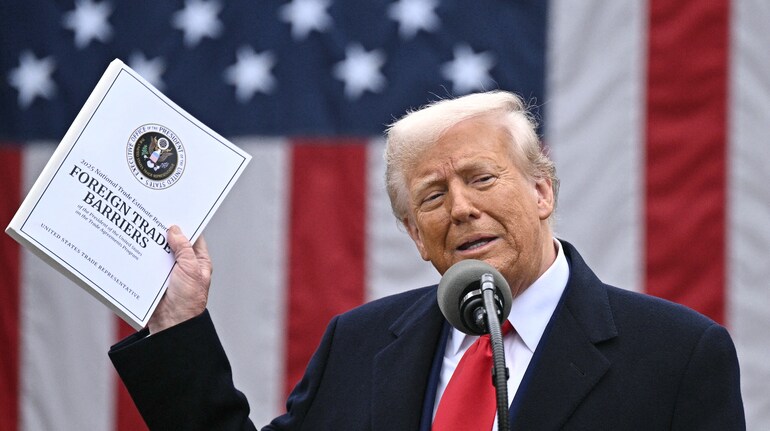
The reciprocal tariffs imposed by President Trump ‘Liberation Day’ marks a remarkable attempt to revive manufacturing across the board in a high-income country. US tariffs, by some estimates, are now in the 20-30% range, the highest since the late 1800s. Automobile tariffs of 25% imposed late last month and which will come into force on April 4 was the first salvo.
In an extraordinary speech on April 2, President Trump said reciprocal tariffs would attract as much as $5 trillion of investments, referring to spending pledges by Apple, a host of automobile manufacturers as well as plans to invest in data centres and semiconductors.
As per Bloomberg the investment pledges amount to $1.6 trillion.
Reciprocal tariffs, an upending of the rules governing trade since the Second World War, is clearly driven by a desire to boost US manufacturing.
According to a fact sheet released by the White House, US share of world manufacturing output was 17.4% in 2023, down from 28.4% in 2001. This had weakened US capabilities in high-tech manufacturing including military equipment.
Back to the 1870s
The historical sweep of the speech was also unusual, though illuminating.
President Trump made it clear that he was drawing his inspiration from the period between 1789 and 1914---and of this particularly the late 19th century--- when the US industrialised behind high tariff walls. Most revenues consequently were from tariffs.
To buttress the case for tariffs Trump said the US was “at its richest” between 1870 and 1913, when it was a high-tariff country. The US did indeed overtake Britain as the world’s largest economy in that period, a position it has maintained ever since.
He bemoaned the introduction of the income tax in 1913. That was also when the Federal Reserve was established, an institution which the President, has till now left unscathed.
Most economists will say that the US followed policies typical of a developing country in industrializing behind tariff walls. In the decades before 1947 Indian industry, for instance, demanded and obtained higher tariffs.
Tariffs an end in themselves or a mean to an end?
These tales from a distant though suddenly relevant past apart, what is the true purpose of the trump tariffs?
It appears increasingly that the tariffs are the end, not a means to an end to achieve other goals. The goal appears to be to bring back manufacturing to the US and, as a result, reduce the so-called over-financialization of the US economy.
The administration's economists disdain the job creation of the Biden years claiming that most of it is in government or so-called government-adjacent sectors, such as healthcare. The Trump administration wants to create 'true' private sector jobs in new factories making automobile, electronics, and semiconductors in the US under the protective umbrella of tariffs.
Is this possible?
In the coming years, a remarkable natural experiment will play out, as consequential as the competition between capitalism and central planning illustrated by the contrasting economic performance of East and West Germany between the late 1940s and 1989. West Germany won decisively.
In this case the experiment is whether the world's richest country --- 80% of whose GDP is accounted for by services while industry contributes 18%--- can significantly revive manufacturing behind a tariff wall.
Of course, success will be less clearly defined here because there is no clear-cut control element. One criterion could be that manufacturing significantly increase its share of US GDP from the current 18% and raise its share of global manufacturing output.
Impact on UD GDP: Trump vs Economists
Mainstream economic analysis disdains tariffs and claim that US GDP would be meaningfully lower because of their imposition.
Indeed, most economists would regard the whole affair as a massive exercise in self-harm. The US economy in 2024 was the best-performing among the developed economies, with growth in the 2-3% range in recent quarters compared to sub 1% growth in Europe.
Employment was at record levels and inflation was declining towards the Fed's target of 2% albeit from levels not seen since the late 1970s.
As per Goldman Sachs, the impact on US GDP could be as much 0.8% in the first year.
As per a 31 Mrach report by the Budget Lab at Yale the impact of a 20% hike in US tariffs would be 0.9% in 2025. “In the long run, the US economy is persistently 0.3-0.6% smaller, the equivalent of $90-180 billion annually in 2024$,” according to the report.
Mr Trump and his economists would brush away such doubters pointing to the dynamic effects of the flood of investment which they foresee in US domestic manufacturing, combined with tax cuts and deregulation.
Goodbye to WTO
Liberation day also marks the dismantling of the post second world War trading order. starting with the establishment of the General Agreement on Tariffs and Trade (GATT) in 1947, which became the World Trade Organization (WTO) in the 1990s. Going forward trade deals will be negotiated bilaterally between big countries or blocks, such as the US and China or India or the EU.
The only wiggle room in the executive order is a cluse which allows the President to lower tariffs if a country takes steps to reduce its trade deficit with the US and to align its overall policies with America’s national security interests. It’s a path that India, for instance, plans to pursue. Clearly WTO has no role in this.
How relatively weaker economies, such as African or Caribbean ones, will navigate this new world remains to be seen.
GATT/WTO operated under three core principles. These were a) Most Favoured Nation status which meant that all countries were treated equally when it came to tariff rates b) National Treatment which meant that imports and domestically produced goods were treated equally and c) no quantitative restrictions.
These rules, particularly the first one, will go out of the window. As a result of liberation day, the US will end up with a hodgepodge of tariffs. The same product will face different tariffs depending on the country of origin. Similarly, India, for instance, might offer the US one tariff rate and the EU another one for the same product, at least in the short term.
The dismantling of the rules-based order is a choice. President Trump and the MAGA movement loathe 'globalist' institutions like the WTO, apparently seeing them as extensions of the allegedly left-liberal leaning US 'deep- state' which, in the MAGA narrative, has been engaged in a decades-long endeavour to erode national boundaries and cultures through policies such as liberal immigration.
The disdain for the UN, and withdrawal from agencies such as the World Health Organization (WHO) and treaties such as the Paris accord on climate change are of a piece with this antagonism towards multilateralism.
Once upon a time the left in India and much of the rest of the world used to rail against the WTO and free trade. Indeed, historically tariffs have been proposed by left-wing governments and political movements.
Yet it's perhaps the most right-wing government in recent American history which is dismantling the post Second World economic order and post-cold war economic order, which was largely set up by the US, on the ground that low-income Americans have been hurt. That’s a turn of events which few could have foreseen.
Discover the latest Business News, Sensex, and Nifty updates. Obtain Personal Finance insights, tax queries, and expert opinions on Moneycontrol or download the Moneycontrol App to stay updated!
Find the best of Al News in one place, specially curated for you every weekend.
Stay on top of the latest tech trends and biggest startup news.