




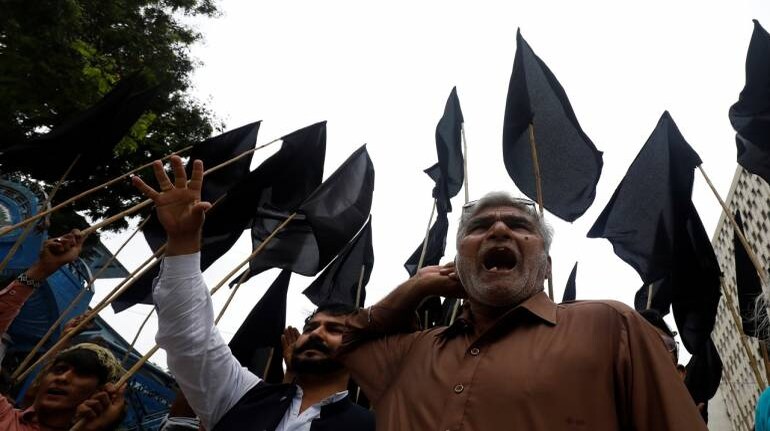
Hundreds are being rounded up daily and sent to jail for showing black flags to ministers, governors and other functionaries of the central government in protest against the Citizenship Amendment Act (CAA) in different parts of India. There have been cases when the arrested, many a time students, are slapped non-bailable criminal offences and incarcerated for days together, jeopardising their future.
The offenders are booked under various sections (such as 143, 145, 147, 149, 151, 341, 504, 506) of the Indian Penal Code some of which are even non-bailable, although apparently none of them makes any reference to black flags.
It caused consternation over a couple of years ago when 11 Lucknow University students, two of them girls, were sent to 14-day judicial custody allegedly for breaching security and showing black flags to Uttar Pradesh Chief Minister Yogi Adityanath. In the FIR, the police also pressed Section 7 of the Criminal Law Amendment Act, which made the process of obtaining bail difficult, and may even prove detrimental to the students’ future.
Waving of black flags should have been the most democratic way of expressing dissent because it is only a symbolic gesture that brings no harm to the target, but our law considers it a criminal offence, thanks to the colonial mentality left behind by the British.
Black flags became anathema for law enforcers long before terrorist outfit Islamic State adopted black as its dreaded flag. Intolerance to the black colour is so intense that sometimes the police rough up even people who are dressed in black coloured clothes.
Strange as it may sound, the Indian law allows much worse forms of insulting public figures, such as burning of effigies, use of garlands made of chappals, spraying of black paint and oil. More creative protesters press into service coffins and wreaths, funeral prayers and pyres. The police can’t do anything about it because the courts have held that there is no provision in the Indian Penal Code that makes the burning of effigies a punishable offence. The police can, at best, charge protesters with rash and negligent handling of fire or combustible matter.
Indians have been burning the effigies of Ravana and other characters in Ramayana for ages as part of the Dusserha festival. However, that is not the reason why effigy-burning is ‘lawful’ in India. It was the British who made it legitimate.
As per history, British Catholic dissident Guy Fawkes and 12 of his friends hatched a conspiracy to blow up King James I during the opening of Parliament on November 5, 1605. However, the assassination attempt was foiled the previous night, when Fawkes was discovered in a cellar below the House of Lords. Londoners immediately began lighting bonfires in celebration of the foiled plot. British parliament later declared November 5 as a public day of thanksgiving.
Since then, Guy Fawkes Day, also known as Bonfire Night, is celebrated in one form or the other. When British drew up the Indian Criminal Procedure Code in 1860, they made it a point not to make burning of effigies punishable.
The British never liked the idea of being shown black flags in India when they were ruling the subcontinent. When the Simon Commission arrived in India in 1928 to study constitutional reforms in its biggest colony, it was greeted with black flags under the leadership of Lala Lajpat Rai, who got grievously hurt in the police action against the demonstration and died a fortnight later.
However, waving of black flags was never frowned upon in Great Britain as it was considered a most civilised way of registering protest. Black flags with jihad-inspired white inscriptions became unlawful decades later when supporters of Islamic State took out demonstrations to express solidarity with the outlawed Islamic outfits, which many considered outrageous.
Their bias against black flags in India was passed on to the new rulers, who happily lapped up some of these unreasonable rules without giving them a thought. We still have several laws from the Victorian-era that we inherited from the British. While Britain has changed many of these as they corresponded to the morality of a bygone era, India is still persisting with them.
According to Law Minister Ravi Shankar Prasad, over 1,400 redundant Acts and statutes had been scrapped so far while a significant number still await repeal. There are hundreds of such laws which had expired long ago in terms of their applicability and relevance.
It is high time India decriminalised the black flag protest, the most innocuous form of democratically expressing dissent.
K Raveendran is a senior journalist. Views are personal.
Discover the latest Business News, Sensex, and Nifty updates. Obtain Personal Finance insights, tax queries, and expert opinions on Moneycontrol or download the Moneycontrol App to stay updated!
Find the best of Al News in one place, specially curated for you every weekend.
Stay on top of the latest tech trends and biggest startup news.