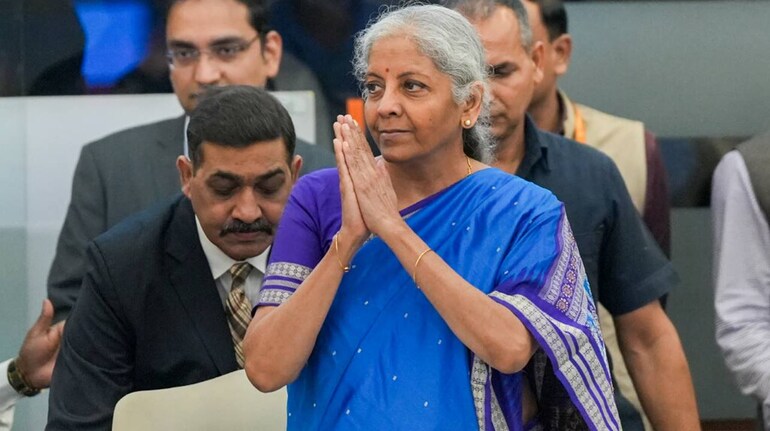
A scheduled two-day meeting of the GST Council concluded in a day, with states and the centre jointly opting for a sweeping change in the GST rate architecture. Perhaps the most surprising aspect of the meeting was that prior apprehensions among states of a possible revenue loss on account of a mid-year refit in rates didn’t matter.
Given the scale of change it was, relatively speaking, the most harmonious GST Council meeting in years. All major political parties were represented by virtue of administering one or more states. Yet, they seemed to have no serious difference with the proposed changes, even if they are at daggers drawn elsewhere.
What’s the secret here?
It may be the manner in which the rate structure has been changed, which fits the template of every government, state and centre, in adjusting tax slabs. The broad approach has always been to move items loosely classified as those of mass consumption to lower slabs while tinkering minimally with the slab which contributes the bulk of the revenue.
The inverted pyramid
India’s tax structure can be visualized as an inverted pyramid, a narrow base supporting a wide superstructure.
Before getting down to GST, consider the case of corporate tax. Union budget documents show that in FY23, 1.07 million corporate tax returns were filed. Out of that, 743 firms, or a mere 0.6% of the 1.07 million corporate tax returns filed, contributed 53.2% of the corporate income tax. Over 40% of the firms that filed returns recorded a loss. But the government’s revenue base mainly depended on the financial health of 743 firms.
GST’s most important slab
The inverted pyramid model applies to GST too. Of the many pre-GST 2.0 slabs that exist, it’s just one that really matters for the revenue base: 18% slab.
The table below shows that the government informed Parliament that it contributed 70-75% of overall GST revenue in FY24.
Proportion of GST Revenue Collected at Each Slab (in % for FY24)
| Slab (in %) | Percentage of revenue collected |
| 5 | 6-8 |
| 12 | 5-6 |
| 18 | 70-75 |
| 28 | 13-15 |
| Others | 1-2 |
Source: Lok Sabha Question 1012, December 2, 2024
In general, services, which represent the largest share of GDP, have been taxed at 18%. Preserving the base taxed at 18% has helped the GST Council bring down the average GST rate since the tax was rolled out in 2017.
According to the government, the average GST rate in FY24 was 11.64%. It was almost 3 percentage points lower than the average GST rate of 14.4% in May 2017. Over the last eight years, the GST Council was able to gradually lower the average GST rate without sacrificing its overall revenue on account of the inverted pyramid model.
What matters in politics is the distributional impact of taxes
All political parties in India, when in government, shield the poorer sections of the population from high headline tax rates. GST is no exception.
Sacchidananda Mukherjee, an economist at NIPFP, studied the distributional impact of GST on the average household consumption expenditure. The consumption data comprised 390 items derived from the government’s (NSSO) consumption expenditure survey of 2022-23.
The results suggest that the GST Council has tried to keep most items of mass consumption, especially food, at low rates or exempt them from GST.
To illustrate, out of 390 items, GST categorization of exempt to 12% tax, covered 64% of the items. The bulk of items covered by the consumption survey are lightly taxed.
A noteworthy feature is that the GST Council has been careful to make sure food items fall in a low tax category.
Most of the items in the 18% slab and above are in the non-food bracket. There’s always been unanimity of view among political parties on trying to keep food prices low. About 64% spending on food in rural areas and 58% in urban areas fall under the exempt to 5% GST slab.
Motorcycles encapsulate the broad political approach to taxation
Roughly, four of every five passenger vehicles sold in India are two-wheelers. Among two-wheelers, the commuter segment of motorcycles is one with a strong demand in rural and urban areas.
GST 2.0 has brought down the rate of two-wheelers to 18% from 28%. However, there’s an exception. Motorcycles with an engine capacity above 350cc will henceforth attract a 40% tax for the “sin” of wanting to buy them. This proposal is unlikely to have triggered a debate as, for the want of a better term, it’s the ‘leisure riders’ and not commuters who are likely to purchase them.
For sure, the inverted pyramid model is not a neat fit. However, it’s a good approximation of the approach to taxation when viewed through political lens. GST 2.0 ticks all the boxes in this respect, making it an astute political play.
Discover the latest Business News, Sensex, and Nifty updates. Obtain Personal Finance insights, tax queries, and expert opinions on Moneycontrol or download the Moneycontrol App to stay updated!
Find the best of Al News in one place, specially curated for you every weekend.
Stay on top of the latest tech trends and biggest startup news.