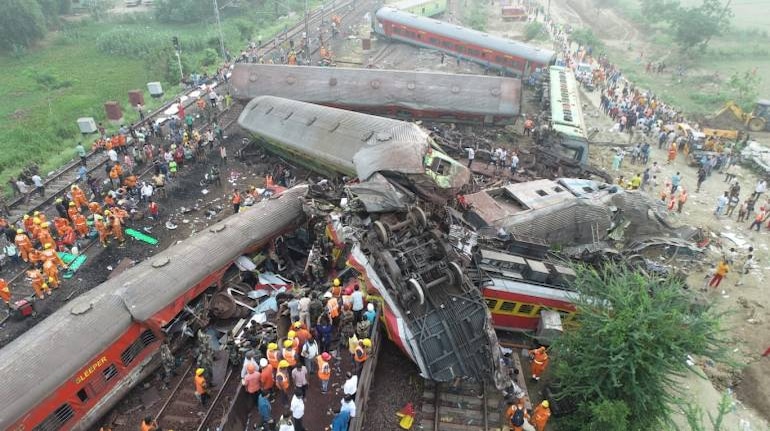
An accident involving 275 casualties and more than 1,100 injured is not likely to be forgotten easily. The Coromandel Express accident at Behanaga Bazar is unprecedented not only in terms of the number of human lives involved but also the number of high-speed trains.
Accidents involving collision, derailment, fire, sabotage, bomb blasts, floods, wash-aways and landslides which result in loss of human life are classified as major accidents in the Railways. While sabotage, bomb blast, and wash-aways involve externalities, collision, derailment and fire are internal to the railway operations. Railways have robust standard operating procedures in place to ensure that such accidents do not take place and even if they take place the damage is minimised.
A Freak Accident
The Coromandel Express accident is a freak because it involves a series of mishaps i.e., collision, derailment and then collision between the freight train and two mail express trains running at the speeds of 128 kilometres and 125 kilometres per hour, respectively. It is rare and unfortunate that another express train was running through the spot at exactly the same time. While the collision with the freight train can be attributed to human error or equipment failure, there was nothing that anyone could have done to contain the subsequent events and consequent loss of life.
The sequence of events prior to this disaster is now fairly well established – the freight train was running ahead of the Coromandel Express. To give the passenger train precedence, the freight train was taken in the loop line and accordingly, the point was set in the direction of the loop line. A point is where a train can change tracks. After the goods train was taken in the loop line, the point was supposed to be normalised for the main line and a green signal was given to the Coromandel Express to run through.
While the indication on the Station Master panel was that the point had been normalised and was set to the main line, at the site it was found that the point remained in the direction of the loop line. Therefore, the Coromandel Express entered the loop line at full speed and collided with the freight train in the rear. It is undisputed that the Coromandel Express was given the green signal, then the big question is if the point was not set to the main line, how can there be a green signal? In the Railway parlance, it is known as ‘interlocking’.
Once the train entered the loop line at the speed of 128 kmph, it had to derail because turnouts which enable a train to change directions are not designed for that kind of speed. The train parted and part of it travelled on the main line in the derailed condition, toppled over on the other side and hit the tail end of the Howrah Superfast Express train passing at full speed.
Interlocking Failure
The question is what could have gone wrong for this interlocking failure to happen? Interlocking at this station is the latest state-of-the-art solid-state known as ‘Electronic Interlocking’. In electronic interlocking, all interlocking logic is embedded in the hardware and technically it cannot be tinkered with. But the outdoor sensors are still wired and glitches can take place on account of wrong wiring or wilful manipulation of the circuitry, perhaps with the intention of achieving faster operation. The electric signal maintainer might have assumed that the point is set in the normal direction, based on the indication on the panel, or the system malfunctioned by itself.
Only a detailed enquiry can reveal what actually has happened. However, if a single person can manipulate the system or a single piece of equipment can fail on the unsafe side, it cannot be accepted as a fail-safe system, which is a fundamental philosophy of Indian Railways operations.
There is widespread media clamour to link this accident with Kavach. It is very clear that the Kavach technology could not have prevented or minimised the impact of this kind of accident. Whenever such incidences take place, it is natural that the focus shifts towards safety and more funds are likely to get allocated towards safety-related issues. It is important that the precious resources are not frittered on vendor-driven fanciful improvements but the focus should be on the replacement of overaged assets and training of line staff. Safety is more of a culture than equipment and technology.
Subodh Jain is former Member - Engineering, Indian Railway Board. Views are personal, and do not represent the stand of this publication.
Discover the latest Business News, Sensex, and Nifty updates. Obtain Personal Finance insights, tax queries, and expert opinions on Moneycontrol or download the Moneycontrol App to stay updated!
Find the best of Al News in one place, specially curated for you every weekend.
Stay on top of the latest tech trends and biggest startup news.