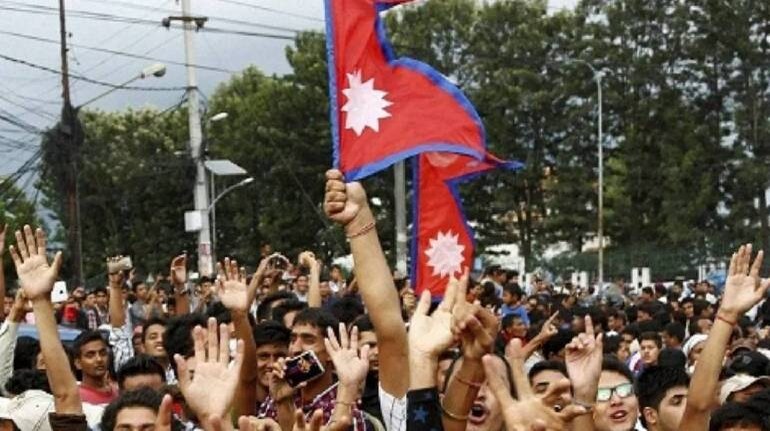
Marches demanding the restoration of monarchy, and even more importantly, turning Nepal back into a Hindu state, are expected to intensify this month. New Delhi, on its part, is closely monitoring the developments without getting unduly perturbed by the turn of events in the fledgling democracy, strategically perched in the Himalayas in India’s immediate neighbourhood, where China and the United States have also emerged as major players.
India, in fact, has been sitting pretty in Nepal since February when Prime Minister Pushpa Kumar Dahal Prachanda and Khadga Prasad Sharma Oli, pro-China communist comrades-in-arm, suddenly fell out and the Nepali Congress, which has the highest number of lawmakers but is aligned with India and the US, extended its support to Prachanda in Parliament ensuring his continuance as the PM.
Since this realignment, Nepali Congress’s 80-year-old leader Sher Bahadur Deuba, is the most powerful figure in Nepal today as Prachanda depends on him for survival. The current Prachanda-Deuba partnership means that India and the US are the dominant foreign powers in Nepal presently, elbowing out China at least for the time being.
BJP’s Dismay Over Nepal’s Secular Turn
In the context of marches and demonstrations in Kathmandu and other parts of Nepal, the return of former King Gyanendra is as impossible as it is impractical, regardless of slogans shouted on the streets professing undying love for autocratic royals. Oli put it succinctly saying that reviving monarchy is as absurd and unthinkable as returning to the Stone Age. Other leaders have also ruled it out equally emphatically.
But, importantly, the countrywide marches have opened up the possibility of turning Nepal back into a Hindu state. And this is hugely significant from India’s perspective, particularly from the perspective of the Prime Minister Narendra Modi-led Bharatiya Janata Party government, which is a Hindu-first regime through its Hindutva ideology and has been in power since 2014 and is most likely to get reelected in 2024. Nepal was first declared a secular state in 2007 by an interim Constitution; it finally ceased to be a Hindu state in 2015 when the new Constitution was adopted turning it into a secular republic.
Calls reverberating across Nepal to ditch secularism and change the Constitution to make it a Hindu nation once again, is in line with the wishes of the BJP and the Modi government. Top BJP leaders and ministers, including former party president and presently Defence Minister Rajnath Singh, and Uttar Pradesh Chief Minister Yogi Adityanath have openly and bitterly criticised Nepal for shedding its Hindu character and embracing secularism. Rajnath Singh had said in 2010 that he would “be happy when Nepal is a Hindu state again”. India sees the Hindu religion in Nepal as a bulwark against China’s bid to dominate the country.
So, today, New Delhi has no reason to oppose the reversal of secularism that the pro-Hindu Rashtriya Prajatantra Party and the maverick businessman-politician Durga Prasai are demanding, accompanied by incredibly huge turnouts in many Nepali cities and towns.
Unbridgeable US-India Differences
But any support, covert or overt, India extends to the campaign underway for a Hindu Nepal, will pit it directly against the US. And the conflict is bound to undermine the Modi government’s standing in the Joe Biden administration-led Quad covering the Indo-Pacific, and the overall New Delhi-Washington strategic-cum-defence and economic partnership.
The US and European Union strongly favour religious freedoms which come with secularism in Nepal, including the right to propagate Christianity. They are against any curbs on churches or missionaries. Essentially, the US-led West is against Hindu nationalism, whether it is in India or Nepal.
Any Indian backing for scrapping secularism and Hinduising Nepal will inevitably result in a geopolitical clash with US jeopardising bilateral relations. A few months ago when there were talks of holding a referendum in Nepal to decide whether it should remain wedded to secularism or abandon it, a US State Department International Religious Freedom Report, citing Nepali civil society leaders, said that demands for a Hindu state were being funded and influenced by rightwing groups in India. The information was obviously credible enough for the Americans to disseminate it officially to exert pressure on New Delhi.
It is generally believed that octogenarian kingmaker Deuba’s loyalties are divided between Washington and New Delhi. It is also often said that he is torn between India and the US. Given his duality, it seems that India has leaned hard enough on Deuba to make him speak up for its agenda in Nepal, which clashes with the US’s priorities.
Taking up cudgels for New Delhi at Washington’s cost, Deuba is now saying that while republicanism is non-negotiable and restoration of monarchy is out of the question, the Nepali Congress is open to debating the merits and demerits of secularism in party forums.
Call it opening the ‘Pandora’s box’ or the thin end of the wedge, remarks by a tall leader like Deuba on debating a basic principle of the country’s Constitution has the potential to legitimise BJP’s unease over Nepal’s secular turn. It also works in favour of the Modi regime’s desire to turn the clock back to the Hindu religion’s pre-2007 status in Nepal, even if it means locking horns with the mighty US in its backyard.
SNM Abdi is an independent journalist specialising in India’s foreign policy and domestic politics. Views are personal, and do not represent the stance of this publication.

Discover the latest Business News, Sensex, and Nifty updates. Obtain Personal Finance insights, tax queries, and expert opinions on Moneycontrol or download the Moneycontrol App to stay updated!

Find the best of Al News in one place, specially curated for you every weekend.
Stay on top of the latest tech trends and biggest startup news.