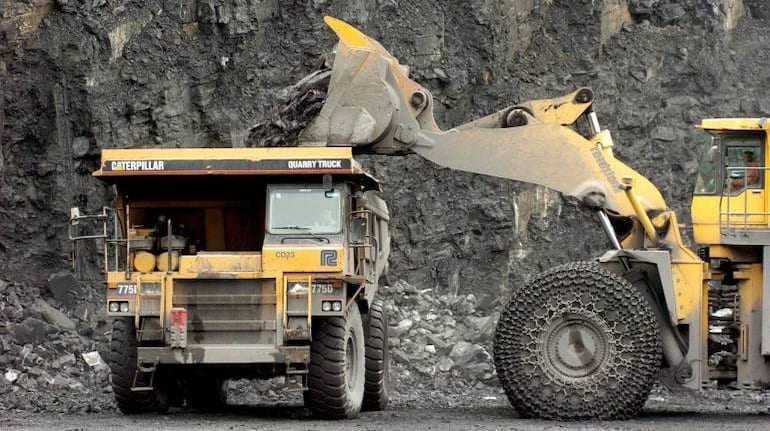
Restoring the United States’s infrastructure and reshoring its manufacturing requires a gargantuan amount of rocks. Suppliers of cement (made from limestone) and granular aggregates (sand, gravel and crushed stone) are set to be huge beneficiaries of President Joe Biden’s $2 trillion investment splurge.
The winners include several European giants: CRH Plc, Holcim Ltd. and Heidelberg Materials AG – yet their shares are valued at a fraction of US peers. Listing shares in the US, as CRH did recently, might encourage investors to give them a second look.
Put simply, these companies mine rocks, and then turn them into asphalt and concrete for roads, bridges and buildings.
It might sound dull, but US-based cement and aggregate suppliers such as Martin Marietta Materials Inc, Vulcan Materials Co and Summit Materials Inc are thrilling investors.
Martin Marietta has gained 34 percent so far this year and trades at 25 times estimated earnings; Vulcan is valued at more than 30 times this year’s earnings.
They should be fairly recession resistant, as subdued US homebuilding is counterbalanced by booming public infrastructure and non-residential construction.
These firms also have a surprising amount of pricing power: Their materials often account for only a small portion of total construction costs, which makes tweaking prices easier – lately many contractors have been forced to accept two increases per year. Aggregates are produced close to construction sites because their weight makes long-distance transport uneconomical – hence contractors often can’t shop around; strict environmental rules restrict new capacity near densely population areas; plus, there are few substitute materials.
Martin Marietta’s aggregates and cement prices were around one-fifth higher in the third quarter compared with the same period a year ago, helping it achieve a robust 28 percent operating return on sales — far higher than before the pandemic.
Investors have tended to overlook non-US firms that share some of these same characteristics — even though more than 80 percent of US cement capacity is foreign owned. Fed up with being ignored, Dublin-based CRH switched its primary listing in September to New York from London.
As the largest building-materials company in North America, CRH generated $19 billion of sales in the US last year (58 percent of the total) so a valuation more in line with US peers seems justified. Future inclusion in US indexes such as the S&P 500 may help secure the desired re-rating. CRH has a $42 billion market capitalisation but there’s room for improvement: Even after gaining 50 percent so far this year, its shares trade at just 14 times estimated earnings.
Switzerland-based Holcim and Germany’s Heidelberg Materials say they have no plans to list in the US, but they should give the idea serious consideration because the status quo isn’t working.
Each has a significant US footprint. Holcim is on track to generate 40 percent of sales in North America this year; at Heidelberg the proportion is almost one quarter. “Our US position in not reflected enough — at all — in our group share price performance,” Heidelberg Chief Executive Officer Dominik von Achten conceded earlier this month when asked by analysts about the disappointing valuation and possible strategic moves to address it.
A low stock price is a poor takeover currency and makes US acquisitions appear comparatively expensive. Heidelberg was interested in buying Summit and recently made two unsuccessful bids, Bloomberg reported last month (Summit is also trying to bulk up domestically via a $3.2 billion takeover of the US unit of Colombia’s Cementos Argos, which it plans to fund partly with stock.)
There’s much to admire about European building material firms besides cheap exposure to the US. They’re rushing to decarbonize, for instance: Cement is a major source of planet heating emissions and they can charge more for lower-carbon concrete. They are moving beyond just supplying basic rocks to offering systems and complete solutions: CRH builds roads, while Holcim has a fast-growing roofing business.
Plus they are prioritising strong pricing rather than higher sales volumes; hence their earnings have remained solid even as European construction activity has sagged.
Holcim CEO Jan Jenisch told investors last month the company should no longer be viewed as a cyclical company. While that’s an appealing proposition, a US share listing would make an even more attractive package.
Chris Bryant is a Bloomberg Opinion columnist. Views do not represent the stand of this publication.
Credit: Bloomberg
Discover the latest Business News, Sensex, and Nifty updates. Obtain Personal Finance insights, tax queries, and expert opinions on Moneycontrol or download the Moneycontrol App to stay updated!
Find the best of Al News in one place, specially curated for you every weekend.
Stay on top of the latest tech trends and biggest startup news.