






After a tsunami triggered a meltdown at the Fukushima Daiichi nuclear reactor in 2011, the world’s third- and fourth-largest exporters decided on radical changes to their energy policies. Both agreed that a break was needed from the grids of the past. In every other way, the approaches couldn’t have been more different.
Japan shut down its nuclear sector almost immediately, and made up most of the difference by burning more coal. Germany announced a slower nuclear phaseout, along with support for the nascent wind and solar industries. Twelve years later, the differences are stark.
In Germany, a renewables boom pushed the zero-carbon share of generation to 58 percent last year. Emissions per capita fell 21 percent relative to their level in 2010, even as real gross domestic product rose about 14 percent per person.
Japan has trailed on nearly every measure. Almost uniquely among developed markets, it has seen the fossil share of its grid increase over the past decade, while zero-carbon power fell to 28 percent. Emissions are down just 8.6 percent, while wealth climbed a more modest 9.4 percent. Until the invasion of Ukraine cut off Germany’s supplies of Russian gas, Japan was even paying more for its electricity.
How could the host country of the first major emissions-reduction treaty — the nation that invented the lithium-ion battery, the hybrid car and solar-powered calculator — have fallen so far behind?
The answer isn’t so much a single reason, as a combination of factors that seem insignificant on their own, but collectively amount to a formidable obstacle. That serves as a warning to other countries who believe the renewables revolution is strong enough to sustain the increasing burdens of trade barriers, planning red tape, and grid maintenance now being placed on it. Pile enough well-meaning regulations onto any sector, and eventually it will snap.
Some of Japan’s problems are inevitable facts of geography. Renewables take up a lot of space, but Japan’s mountainous topography means usable territory is scarce. The area of agricultural land feeding its 126 million people — which is also the bit most-suited for renewable power — is barely more than that of far less populous Ireland or Guatemala.
Those problems are compounded by the fact that about a fifth of this farmland and 11 percent of total area is unregistered, thanks to a quirk of inheritance law that means large tracts of the country are officially held in the names of people who’ve been dead for generations.
Economies of scale are crucial to bringing down the costs of wind and solar projects, but that’s only possible if developers are able to assemble large landholdings — something that’s close to impossible when you don’t know who owns what. Two of Japan’s largest solar farms are on ground previously reclaimed from the ocean for salt pans and a shipyard. There aren’t many locations of that sort around.
Earthquakes and typhoons also mean that large-scale construction projects have to be built with unusually high levels of disaster resilience. Class III wind turbines, a relatively lightweight, good-value design that dominates in most countries, are rarely used in Japan because of the risk they’ll be damaged by extreme gusts.
The biggest factor, however, may be the structure of the power market. Japan doesn’t have a national grid the way most other countries do. Instead, it has 10 separate companies roughly corresponding to its historic regions, each operating more or less autonomously. A developer wanting to take advantage of ample solar resources in the southern Kyushu island to supply renewable power to Tokyo must negotiate with five separate utilities to ensure there’s sufficient transmission cables to get the electrons where they’re needed.
Those utilities were traditionally vertically-integrated companies owning everything from generators and power lines to electricity retailers — a set-up that meant they had little incentive to work with upstart renewable players who threatened to undermine their existing businesses. Solar developers, for instance, typically pay twice as much to the utility to connect their projects to the grid, as when they do the work themselves. Until last year, wind farms often had to pay utilities to upgrade their own grids or install batteries, because of the way clean generation would disrupt the existing fossil-fired set-up.
New regulations in 2020 were introduced to break up that monopolistic structure, but to date there’s little evidence it has been effective. A gap in electricity prices between eastern and western Japan, which ought to be brought into line in a competitive power market, still yawns wide.
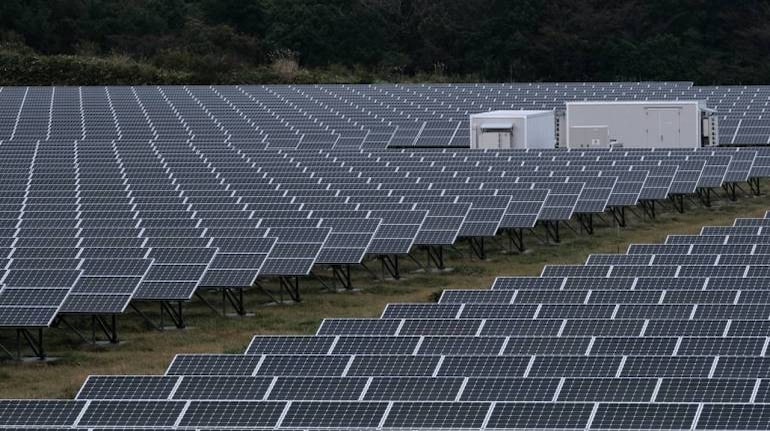
Even the success stories of Japan’s energy transition have been tainted. The country is the biggest solar generator in the world after China and the US, thanks to rules introduced after the Fukushima disaster that initially guaranteed payments as high as ¥40 (27 cents) per kilowatt-hour for 20 years. The over-reliance on that policy, however, has kept prices high. Most other countries have depended far more on reverse auctions, where renewable developers bid against each other to deliver the best-value project. In Japan, by contrast, prices rise to match the tariff being offered by the government.
As a result, Japan is one of the few places in the world where renewables are still struggling to undercut traditional fossil power. Onshore wind costs about three times what it does in Brazil, China, India and Spain, leaving it largely absent from the market. Solar power has only in the past 12 months dipped down below the $100/MWh level that most other developed countries breached in the middle of the last decade. That means solar can finally compete with new coal plants on price alone — but it’s still costlier than running an existing fossil generator, if you can get a project built at all.
Faced with these impediments, it’s hardly surprising that Japan’s energy transition plans are so unambitious. Group of Seven countries last year promised to largely eliminate fossil power from their power grids by 2035. There’s very little prospect founding member Japan will achieve this: In 2030, it will still be 41 percent fossil-fired, based on the government’s latest power plan.
Things are likely to wind up worse than that. If local objections continue to stymie a wider restart of the country’s nuclear reactors and electricity demand doesn’t fall as fast as the government projects, fossil turbines could account for 60 percent or so of generation in 2030, equivalent to where Germany was in the 1990s.
Utilities, meanwhile, are pinning much of their hopes on spraying ammonia into their existing coal and gas furnaces to complement or supplant carbon fuel, an untested technology with high costs and questionable environmental benefits. Development of solar parks, which is going on at record rates in most countries as the cost of photovoltaic modules falls to record lows, has almost ceased in Japan.
The outcome of all this is disastrous on levels that go well beyond the environment. Fossil fuels now account for nearly 30 percent of Japan’s import bill, helping to widen the trade deficit and contributing to inflationary pressures disturbing a society habituated to decades of stable prices. A country that has worried about its dearth of natural resources for more than a century now gets nearly three-quarters of its electricity from cargoes shipped every day through the tense waters of the South China Sea and surrounding Taiwan. Europe’s rush for renewables after getting cut off from Russian gas last year has done nothing to shift thinking in Tokyo.
That’s a tragic waste. Japan’s ample hydroelectric capacity and windy offshore waters mean the country could have a 100 percent renewable grid at prices lower than current electricity tariffs, according to a study last year. It’s not going to happen, however, unless the government does more to force cooperation and vision from the fossil-fired monopolists who generate and deliver Japan’s plug power.
Other countries should take care before feeling too superior about this. The global wind industry has been bleeding red ink all year. Billions of dollars in losses have been announced in recent weeks by General Electric Co. and Orsted AS, while Siemens Energy AG went to the German government for financial support. The US is unlikely to achieve much more than half of its goal to connect 30 gigawatts of offshore wind by 2030.
China’s dirt-cheap solar module prices aren’t available in the US and India because of trade barriers, and efforts to fix all this look to be falling short. Instead, an intractable blend of protectionism, red tape, and institutional inertia very similar to the situation in Japan risks dragging down the energy transition when it is just about to take off.
Japan provides a cautionary tale in a world heading toward net-zero. The danger is that it becomes a prophecy.
David Fickling is a Bloomberg Opinion columnist. Views do not represent the stand of this publication.Credit: BloombergDiscover the latest Business News, Sensex, and Nifty updates. Obtain Personal Finance insights, tax queries, and expert opinions on Moneycontrol or download the Moneycontrol App to stay updated!
Find the best of Al News in one place, specially curated for you every weekend.
Stay on top of the latest tech trends and biggest startup news.




