By Athan Joshi
Economist John Williamson coined the term "Washington Consensus" to describe the set of neoliberal economic policies promoted 1980s onwards. These policies, which were largely designed to stabilize struggling Latin American economies, advocated for free-market reforms. The term “consensus” indicated that these policy ideas were backed not just by the IMF and the World Bank but also by the mandarins in Washington DC, who were controlling these institutions as the Cold War entered its final lap.
A key tenet of this neoliberal consensus was trade liberalization, which sought to remove barriers to trade by reducing tariffs and other restrictions. In the wake of the Soviet Union's collapse and the triumph of liberal democracy, epitomized by Francis Fukuyama's “The End of History”, the liberalization of trade moved from being just a guiding principle to a biblical edict. As the World Trade Organization (WTO) was established in 1995, the mantra of “tariffs are bad” became the rallying cry of progressives across the globe.
Tariffs, once a commonly used tool of national economic strategy, have been much vilified by proponents of free trade over the last four decades. The Washington Consensus, in its push for global trade liberalization, marked tariffs as the enemy of progress and prosperity. Yet this view oversimplifies the role of tariffs in fostering national economic growth. Throughout history, many countries, including the United States, have used tariffs not as a barrier to trade, but as a means to build industrial strength and economic resilience.
Hamilton and the Use of Tariffs as a Strategy for National Development
The idea of using tariffs to protect and nurture nascent industries is not new. In fact, it was one of the foundational strategies for economic development in the United States. In 1791, Alexander Hamilton, one of the United States' founding fathers and its first Treasury Secretary, authored the influential “Report on Manufactures”, in which he advocated for the use of tariffs to foster national industrialization.
Hamilton was not anti-trade, nor was he a proponent of economic isolationism. His strategy was simple: the U.S. should strengthen its domestic industries before it competed on the global stage, particularly against England, the dominant economic power of the time.
Hamilton’s ideas were based on the belief that economic strength comes from within, and tariffs could provide the necessary shield for domestic industries to grow. This strategy—building economic "muscle" before competing internationally—was not particularly controversial in the 18th and 19th centuries. It was a widely accepted strategy in nations that sought to compete with established powers. The German economist Friedrich List, Hamiltonian in his intellectual dispensation, advocated for the use of tariffs to protect and develop emerging industries. European railroads are often talked about as a great symbol of foresight and mobility. List’s insistence on defending nascent industries using tariffs and giving them world-beating infrastructure to use for trade is behind this modern-day praise.
The Global Use of Tariffs: From America to Asia
The idea of using tariffs to protect domestic industries and build national economic strength extended far beyond the United States. In the 19th and 20th centuries, Germany, Japan, and even South Korea employed protectionist strategies to build their industrial bases and achieve economic success. Japan’s Meiji Restoration is a classic example of how tariffs, coupled with infrastructure investments, were used to build a modern, industrial economy. South Korea, under the leadership of General Park Chung Hee, used tariffs to protect and develop its steel industry, which became the backbone of the country’s economic transformation.
The Smoot-Hawley Tariffs of 1930 in the United States, which were designed to protect American goods during the Great Depression, further underscore the role of tariffs as a tool for economic recovery. These tariffs provided a cushion for domestic industries against foreign competition, allowing American manufacturers to stabilize and adapt in a tumultuous global market. While the Smoot-Hawley tariffs are often criticized for exacerbating the global economic downturn, they also helped position the U.S. as a dominant economic and military power during and after World War II.
A Return to Hamiltonian Economics
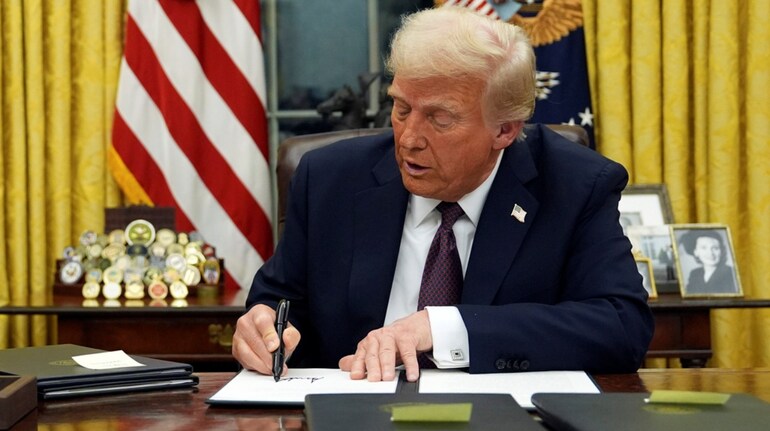
President Trump’s push for tariffs and formation of an External revenue service represents a return to ideas first championed by none other than Alexander Hamilton and which were mainstream just four decades or so ago (Reagan-era import quotas on Japanese autos!). In the current global context, they are a means of maintaining the U.S. position in the global hierarchy. A country’s military power rests on its economic, industrial and increasingly technological strength. United States’ relative standing to China matters as much the country’s absolute prosperity and President Trump likely sees these tariffs as one way of maintaining the U.S.’ numero uno position.
The pure economic outcomes for US consumers from such tariffs are of course debatable and lead to further questions. Are tariffs the best way to achieve pure geopolitical outcomes? Can tariffs be used on raw materials and intermediate goods, which are feedstock for the high-value, desirable for local manufacturing of consumer goods?
Yet, what we know for sure is that the Washington Consensus has run into an immovable object in the form of President Trump. The question is whether tariffs are an unstoppable force or just another page in the economics textbooks. The next four years will answer that question for the U.S. and for the world at large.
(Athan Joshi is a Sophomore at Los Altos High School with interest in politics, economics and business.)
Views are personal and do not represent the stand of this publication.
Discover the latest Business News, Sensex, and Nifty updates. Obtain Personal Finance insights, tax queries, and expert opinions on Moneycontrol or download the Moneycontrol App to stay updated!
Find the best of Al News in one place, specially curated for you every weekend.
Stay on top of the latest tech trends and biggest startup news.