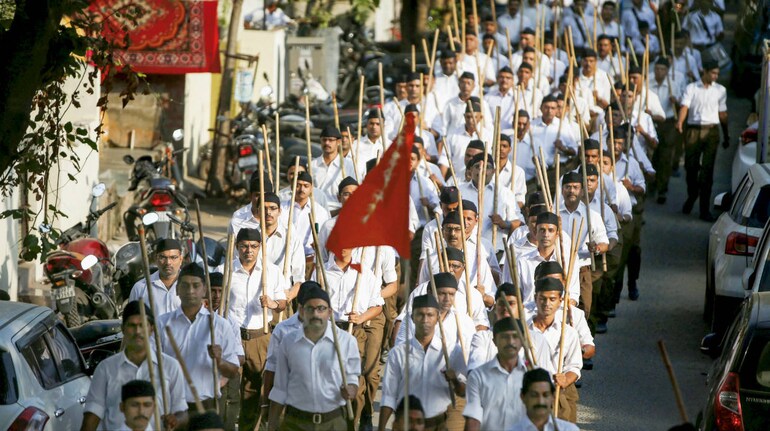
As the Rashtriya Swayamsevak Sangh (RSS) observes its centenary year, its institutional journey, ideological evolution, and contemporary footprint are attracting considerable attention—not only in India but across the world.
For those seeking to understand the progressive unfoldment of the organisation, the final address of its founder, Dr Keshav Baliram Hedgewar, holds special significance. Delivered on 4 June 1940, on the concluding day of an RSS training camp in Nagpur, the speech was neither ceremonial nor rhetorical. Instead, it was a distilled articulation of purpose. There were no references to power, politics, or personal legacy; rather, Dr Hedgewar emphasised organisation, character, continuity, and an unbroken commitment to national life. Eighty-five years later, as the Sangh completes a hundred years of existence, those words read like a living compass guiding its journey.
Dr Hedgewar’s Final Days
Dr Hedgewar had spent the last few months of his life in extremely poor health. Despite this, he continued his work for the RSS. Eventually, Gopalrao Ogale, editor of Maharashtra, along with several other prominent individuals, persuaded him to go to Rajgir in Bihar in January 1940 for treatment. He stayed there for two months and had to return again in April.
On 16 May 1940, Dr Hedgewar returned from Rajgir to Nagpur to attend the RSS training camp at Pune. However, he remained gravely unwell and suffered from high fever for the next 24 days—the entire duration of the camp. On 4 June, he delivered a short speech with great effort, addressing the swayamsevaks. This proved to be his final message.
A Message of Organisation and Brotherhood
He began by saying: “I do not feel that I am in a fit condition today to say even a few words to you. As all of you know, I have been confined to bed for the last twenty-four days. From the point of view of the Sangh, the last one year has been a glorious period. Today, I am seeing before me the Hindu Rashtra in miniature.”
He reflected on the bond among swayamsevaks, noting that even without prior acquaintance, they were drawn to one another through the philosophy of the Sangh. Swayamsevaks from Punjab, Bengal, Madras, Bombay, Sind, and other regions—each with distinct cultural and behavioural backgrounds—came together with warmth and mutual affection.
He observed that while even siblings sometimes quarrel over property, such disputes could never arise among swayamsevaks, bound as they were by shared ideals and a common purpose.
Confined to his home for 24 days, Dr Hedgewar said that although his body was absent, his mind remained amidst the swayamsevaks. He expressed his deep desire to participate in the previous evening’s programme, at least for the prayer, but had been restrained by doctors’ instructions.
A Vision for Bharat
As the swayamsevaks prepared to depart, he bid them farewell and urged them to take a lifelong vow—to remain committed to the Sangh until their final breath. He cautioned against allowing any distraction to weaken their resolve and urged daily introspection by asking: “How much Sangh work did I do today?”
Outlining the larger purpose of the RSS, he stated that merely attending routine programmes or being physically present at the sanghasthan was insufficient. The true mission, he emphasised, was to organise the entire Hindu society from Kanyakumari to the Himalayas. The Sangh, he said, must not remain confined to swayamsevaks alone but must encompass the vast Hindu society beyond its immediate fold.
The true path to national salvation, he asserted, lay in organisation. Only through such organisation could Hindus safeguard themselves and the nation.
Sharing his vision for the future, Dr Hedgewar spoke of a time when the entire Bharat would stand united, undivided, and indivisible—secure from hostile intentions. He clarified that the Sangh had no desire to assault anyone but must always remain vigilant and capable of resisting aggression.
He concluded with confidence that every swayamsevak would leave with the firm conviction that Sangh work must hold the highest priority in life.
As his health continued to deteriorate, Dr Hedgewar was taken to the Mayo Hospital on 15 June for specialised tests and was later shifted to the residence of Babasaheb Ghatate. On 20 June, his condition worsened further. Realising that the end was near, he called MS Golwalkar to his side and, in the presence of senior RSS functionaries, entrusted him with the responsibility of leading the Sangh.
On Friday, 21 June 1940, Dr Keshav Baliram Hedgewar, the founder of the Rashtriya Swayamsevak Sangh, breathed his last.
Earlier RSSFACTS columns can be read here.
(Arun Anand has authored two books on the RSS. His X handle is @ArunAnandLive.)
Views are personal, and do not represent the stand of this publication.
Discover the latest Business News, Sensex, and Nifty updates. Obtain Personal Finance insights, tax queries, and expert opinions on Moneycontrol or download the Moneycontrol App to stay updated!
Find the best of Al News in one place, specially curated for you every weekend.
Stay on top of the latest tech trends and biggest startup news.