Until the pandemic hit, companies were becoming more willing to open up about the diversity of their workforce. But even those that embraced transparency went shy on the topic when COVID-19 hit. That suggests they have something to hide when it comes to how they managed staff during the health crisis.
A record 173 companies, with a combined market value of $13 trillion, submitted data on their employment practices to the most recent Workforce Disclosure Initiative survey, which covers 2020. The project, led by London-based governance campaigner ShareAction, gathers information from major corporations on behalf of 66 investment institutions, including Amundi SA, JP Morgan Asset Management, and Schroders Plc. These investors are expected to engage with boards to drive up employment standards globally.
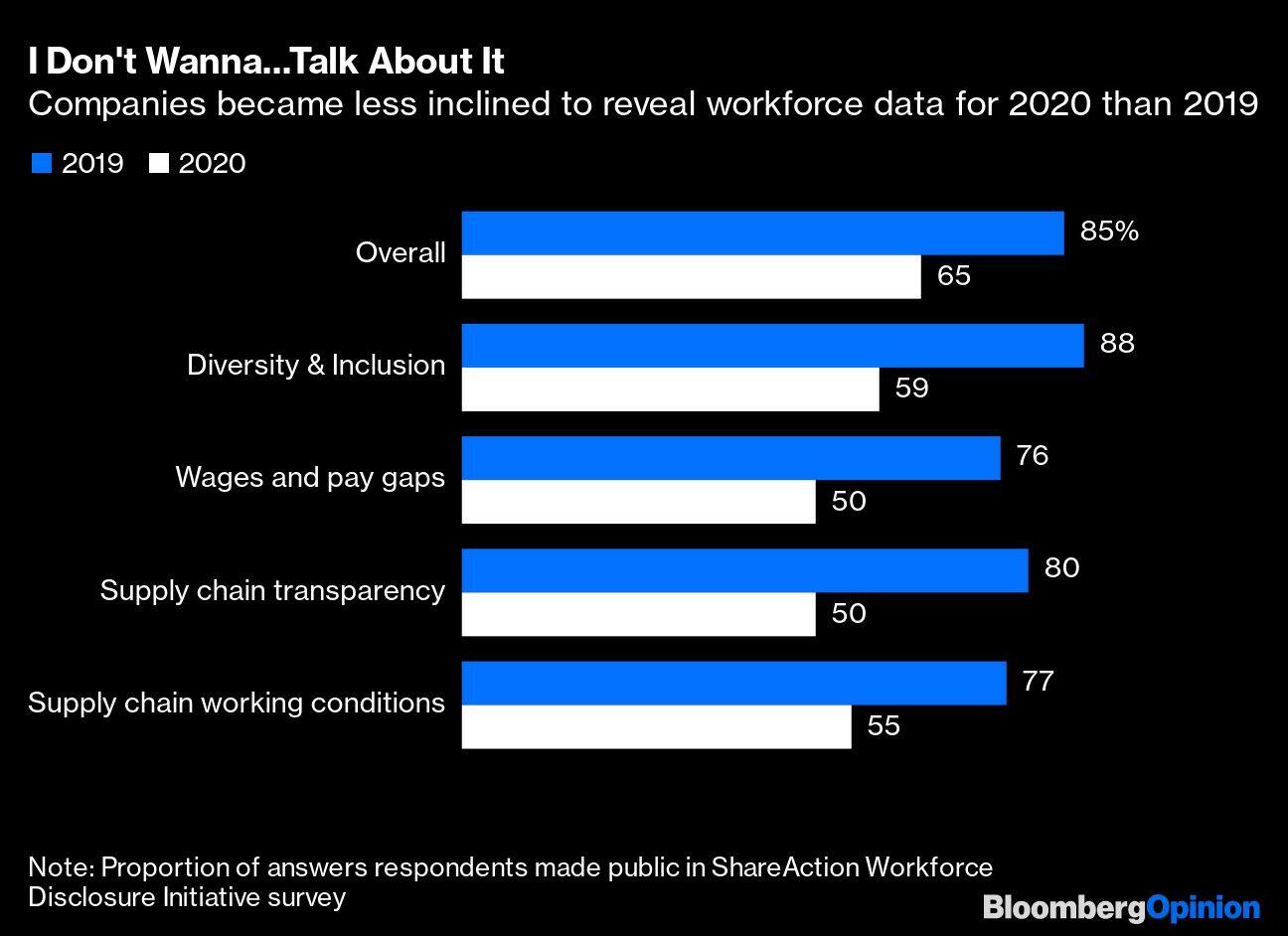
Some of the survey must be answered publicly. But for the most part, companies participating can elect for responses to stay within the WDI investment group. And they were quick to tick that box this time around, with only 65 percent of responses made public when given the choice. For 2019, that figure was 85 percent. The sudden reversal in transparency was especially sharp when the questions related to diversity and inclusion, wage levels and pay gaps, and supply-chain transparency.
Of course, the responses still go confidentially to the investment managers in the WDI, who can hold the companies accountable for their answers. And ShareAction says it has gathered more data than ever, largely due to more detailed submissions on supply chains — an area where responses have been historically poor.
But you can see why a lot of companies wanted to keep their individual answers out of the public domain. ShareAction aggregates the results, and these showed no change in the average level of data provided on pay gaps. Some 97 percent of respondents broke down their leadership by gender, but only 39 percent did so by race or ethnicity. True, there are legal prohibitions on collecting this data in some jurisdictions, but 43 companies still provided no data when they could have done so.
Responses on the gender and ethnicity breakdown of internal hires — a metric that assesses progress throughout the firm — were low, too. And just over half of companies didn’t reveal the number of discrimination and harassment incidents staff had reported, while 61 percent wouldn’t say how many such episodes were resolved. Reporting on how human-rights grievances were remedied was also weak.
As for the actual data itself, information-technology companies performed particularly poorly on pay inequality, with a gender pay gap of 32 percent and ethnicity pay gap of 59 percent — respectively nearly twice and 2.5 times the average.
These findings add to existing evidence that the corporate sector as a whole placed less emphasis on workplace equality in the pandemic. But they also reinforce the value of measuring workforce composition. Companies with more than 30 percent female representation on boards were more likely to resolve discrimination and harassment incidents than those with less, for example. And the longer a company had participated in the survey, the lower its ethnicity and gender pay gaps were on average.
Of course, 2020 was a challenging year as businesses grappled with COVID-19. Investors ought to tolerate a slowdown in the expansion of disclosure, and hear — if not always accept — explanations for why social metrics within ESG went into reverse. The reduced public disclosure is regrettable, but at least these companies are having a dialogue with a large investor group, and each year the survey includes a higher number of questions that cannot be answered privately.
Still, there’s a crucial difference between pausing on disclosure and turning back the clock on workplace fairness. As ShareAction says, the pandemic put a light on glaring inequalities across the business supply chain and the oft-quoted mantra was “build back better”. Shareholders should continue to hold companies’ feet to the fire. And they should impose the greatest pressure on the companies that don’t disclose workforce data at all.
Chris Hughes is a Bloomberg Opinion columnist covering deals. Views are personal, and do not represent the stand of this publication.
Credit: Bloomberg
Discover the latest Business News, Sensex, and Nifty updates. Obtain Personal Finance insights, tax queries, and expert opinions on Moneycontrol or download the Moneycontrol App to stay updated!
Find the best of Al News in one place, specially curated for you every weekend.
Stay on top of the latest tech trends and biggest startup news.