




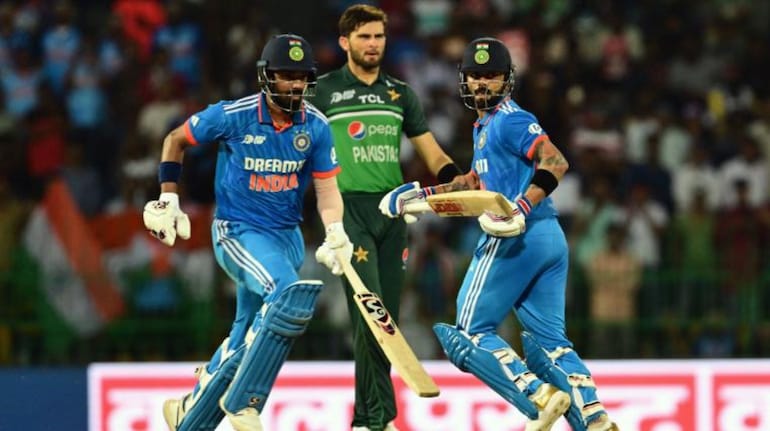
The venom created through political differences has to be lowered and that can only be done through cricket, says Ramiz Raja, a former cricketer, commentator and former chairman of the Pakistan Cricket Board (PCB).
The problem between India and Pakistan cannot be solved by cricket matches, counters Sunil Gavaskar, India’s former opening batsman and now commentator.
The difference in opinion highlights the complex relationship between the two nations, even when seen through the lens of cricket—not politically—though the two can oftentimes not be separated. It’s the political garnish that makes this (cricket) rivalry world class, adds Raja in a new three-part docu-series, The Greatest Sporting Rivalry – India vs Pakistan, which dropped on Netflix on 7th February.
The series, directed by Chandradev Bhagat and Stewart Sugg, captures some aspects of this rivalry, but condenses a long, complex relationship into just 110 minutes.
2004-2008: When cricket was more than a game
The story, told mostly through India’s exhilarating 2004 tour of Pakistan, though captures the intensity of the drama that ensued. India won the one-day international series 3-2 and the Test series 2-1, in such an evenly contested series that it could not have played out better.
A brief mention of the partition leads up to the love-hate relationship between the two countries, marred often by terror attacks and other forms of friction. While the players of the two countries have always professed affection and respect for one another, cricket contests have not been without their share of on field conflicts, like that between Anil Kumble and captain Inzamam-ul-Haq during the 2004 series or between Javed Miandad and Kiran More many years earlier.
Some of two countries’ best-known cricketers, including India’s R Ashwin, Virender Sehwag, Sourav Ganguly, Shikhar Dhawan, K Srikkanth, More, besides Gavaskar and Pakistan’s Waqar Younis, Shoaib Akhtar speak about their experiences. Others like John Wright, who coached India in the early 2000s and Australian Matthew Hayden, who has experience commenting on cricket from India, bring in neutral voices though the surprises in the show, making rare appearances on screen, are Miandad and Inzamam.
A significant part of the narration is from Sehwag and Akhtar, both for their ability to speak with disarming candour and for their exploits in the 2004 series. Sehwag became the first Indian to score over 300 in a Test innings, in the first Test in Multan while Akhtar, in typical fashion, had bursts of fiery spells and spectacular failures.
“I am a weekend car. Leash me out on a Friday night. Let me win games for you,” says a smiling Akhtar, commenting on how he was over-bowled at the nets during that series instead of being saved for brief bursts of lethal spells.
Ganguly mentions an incident when, during the series, a player asked Akhtar about his memorably long run-up. Akhtar replied, “The Boeing 737 needs a runway to fly.”
India’s then Prime Minister Atal Bihari Vajpayee had told the Indian team before the 2004 series, Sehwag remembers, that whether they win the series or not, they needed to win the hearts of the people. That tour and the subsequent 2006 series, besides two played in India in 2005, 2007, had taken significant steps in normalising cricket relations between the two countries. The inaugural edition of the Indian Premier League (IPL) in 2008 had players from Pakistan, including Akhtar.
“We resolved some pending issues through cricket,” says Akhtar.
There is no friendship in cricket; win or loss makes a big difference, adds Ganguly.
Mumbai attacks are a breaking point
While cricket triggered a wave of co-operation and friendship between the countries, the 2008 terror attacks in Mumbai brought an abrupt end to the bonhomie. Cricketing relations between the two got restricted to ICC events in neutral countries, though every ICC event has a mandatory India-Pakistan match, which is a money spinner for the game’s governing body. India has not toured Pakistan since 2006, when they lost a three-Test series 0-1.
The show drops ahead of the ICC Champions Trophy which begins 19 February in Karachi, Pakistan, though all of India’s matches will be held in the UAE. Tickets for the Indian-Pakistan match in the Champions Trophy, on 23 February in Dubai, were sold out in minutes, according to several reports.
The Indian Express reported that the tickets were open for sale last Monday with about 1,40,000 fans queuing up online. The minimum price for the tickets was 500 AED (Rs11,863) and went up to as high as 12,500 AED (Rs2,96,595), the paper cited data from Geo News.
Rivalry resumes in neutral spaces
While the interest for this contest, especially in the UAE which has a large population of expatriates from the two countries, is not surprising, it reinforces the claims for this to be the sport’s greatest rivalry, a statement that repeats in the series. If India were to make it to the semi-final and the final of the Champions Trophy, the matches would be held in Dubai.
It has also been decided that Pakistan’s matches at ICC events hosted by India will also be held at neutral venues, including knock-out games. The agreement will apply to the 2025 women’s ODI World Cup in India and the 2026 men’s T20 World Cup, which will be co-hosted by India and Sri Lanka, ESPN Cricinfo reported.
The “greatest rivalry” is too precious for the sport and all rules get adjusted to make sure that the two teams not only play each other at every ICC event, but do so in a politically acceptable way. The Greatest Rivalry reinforces that paradox: can’t do with each other, can’t do without each other.
Discover the latest Business News, Sensex, and Nifty updates. Obtain Personal Finance insights, tax queries, and expert opinions on Moneycontrol or download the Moneycontrol App to stay updated!
Find the best of Al News in one place, specially curated for you every weekend.
Stay on top of the latest tech trends and biggest startup news.