






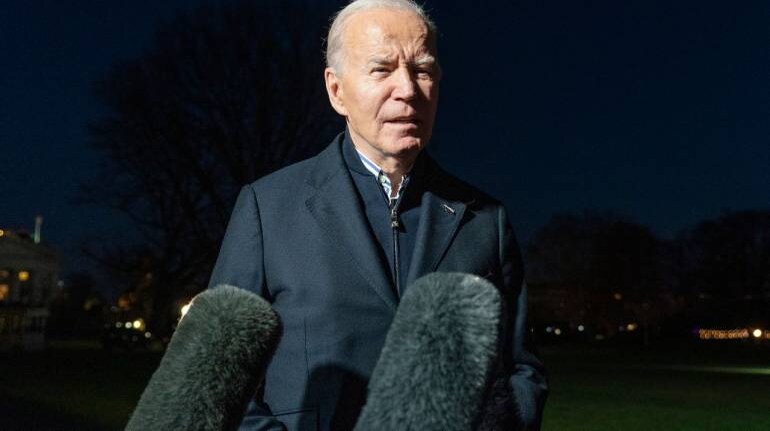
“Hit Iran now. Hit them hard,” one Republican senator advises US President Joe Biden. “The only answer to these attacks must be devastating military retaliation against Iran’s terrorist forces, both in Iran and across the Middle East,” chimes in another. Anything less, he adds, “will confirm Joe Biden as a coward.”
Such schoolyard baiting rarely yields good strategy. As Republicans line up to attack their perceived enemy — Biden, that is — they seem to see the president’s alleged “weakness” as the sole cause of every global problem, and to assume that things could not be made immeasurably worse — as in World War III worse — by goading him into letting slip the dogs of war. Wisdom and strength look different. If the Republicans don’t get that, let’s hope Biden will.
The attack in question is Sunday’s drone strike in northeastern Jordan, which injured more than 40 American military personnel and killed three, the first US deaths directly caused by enemy fire so far in the present Middle East conflict. The drone was apparently launched by Iranian-backed militia groups. But Iran insists that accusations of its own involvement are “baseless,” and that the militias it supports “do not take orders” from Tehran.
In several ways, the drone assault thus resembles the roughly 160 previous attacks launched in recent months by Iran’s proxy militias, from missiles lobbed by Hezbollah into Israel from Lebanon to drones and shells fired by the Houthis from Yemen at ships in the Red Sea. All these attacks are meant to provoke the US or Israel into escalation; all, including the latest, have been low-level in intensity (compared with, say, Russian missile attacks against Ukraine); and all may or may not have been initiated at the behest of Tehran.
What’s clear is that Biden must respond, just as he answered previous strikes with proportional counterstrikes, and as he vowed on Sunday to do now — “at a time and in a manner of our choosing.” Targets for retaliation are being drawn up. As former admiral James Stavridis argues, these strikes should wipe out sites that have launched missiles or drones at US forces, as well as ammo and fuel depots and more. But — and this is where Biden’s Republican gadflies err — they should not include targets inside Iran yet.
As strategist-in-chief, Biden has had to keep multiple objectives in mind. These include helping to free the remaining hostages held by Hamas, getting Israel to stop its “indiscriminate” bombing of the Gaza strip, keeping prospects alive for a two-state solution, building a future alliance that includes Israel and Saudi Arabia and checks Iran, and maintaining US credibility among allies around the world who depend on Washington for protection. Right at the top, though, is another: preventing this war from spreading, like so many others in history, to the region and beyond. A hit on Iran, which is increasingly aligned with Russia and China, could be a vector for such a global conflagration.
If Iran is shown to have attacked US forces directly, Biden must retaliate, even if that means escalation. But until that is the case, it behooves his administration to consider other scenarios. One is that Iran, which until Oct. 7 appeared to strive for a detente with the US, dreads a head-on confrontation and is trying to avoid it, but is finding that its sway over proxies is tenuous because these militias are pursuing their own agendas.
If so, the bigger risk, according to Ali Vaez, director of the Iran Project at the International Crisis Group, is that Tehran feels that “this conflict has made it look weaker rather than stronger.” Afraid of losing credibility, Iran would have to retaliate against an American strike, knowing that this would begin a cycle of escalation it would eventually lose. That sense of vulnerability would probably lead the mullahs to conclude — as North Korea’s Kim Jong Un did long ago — that the only deterrent against an all-out US or Israeli attack, including regime change in Tehran, is to build nuclear weapons. Iran would need about a month to produce enough enriched uranium for a handful of warheads, Vaez thinks, and another couple of months to have the bombs ready.
Along the way, the escalation spiral could easily spin out of control. The US and Israel would need to consider large-scale bombing or more to prevent Iran from going nuclear, knowing that even huge destruction would only delay but not end Tehran’s quest. The conventional war between the US and Iran would become a humanitarian disaster that could dwarf that in Gaza. America’s other adversaries, notably Russia, would be tempted to open or expand additional fronts, in eastern Europe or elsewhere.
A countervailing reading of the mullahs’ intentions is that they want to sow maximum chaos in the region, mainly to bury the rapprochement between their enemies in Saudi Arabia and Israel and to mobilise world opinion against the Great Satan in Washington. But if that were the case, they could have done so by now, by urging Hezbollah to launch a full-bore attack against Israel, or by striking US assets directly. They haven’t.
What Biden’s Republican detractors in this election year overlook is that wise tactics at this stage demand a proportionate and limited retaliation, and only at the militias who launched the attacks. Using diplomatic backchannels, Washington and Tehran must simultaneously signal their intention not to go to war.
Much of the Republican bluster is in fact pure grandstanding, as even their presumptive candidate for president, Donald Trump, knows but won’t admit. “This attack would NEVER have happened if I was president, not even a chance,” he blurted on Truth Social. That conveniently elides the strikes that Iran executed against US assets on his watch, and his own caution in retaliating.
What Trump understood then — when he had actual responsibility — and what Biden knows now is that deterrence requires assured retaliation, but in a way that averts rather than accelerates the very worst outcomes. The situation in the Middle East is dangerous and just became more so. In this context, resolve combined with restraint is not cowardice, but statecraft.
Andreas Kluth is a Bloomberg Opinion columnist. Views do not represent the stand of this publication. Credit: BloombergDiscover the latest Business News, Sensex, and Nifty updates. Obtain Personal Finance insights, tax queries, and expert opinions on Moneycontrol or download the Moneycontrol App to stay updated!

Find the best of Al News in one place, specially curated for you every weekend.
Stay on top of the latest tech trends and biggest startup news.




