In an RSS training camp (Sangh Shiksha Varga) in 1943 at Pune, the then Sarsanghchalak, M.S. Golwalkar, popularly known as Guruji, stood up to introduce an RSS functionary who was going to deliver the ‘Bauddhik’ (intellectual discourse) that day. Guruji said, “Many amongst you wouldn’t have seen Dr. Hedgewarji. If you look at Balasaheb Deoras, you would see Dr. Hedgewar.” Dr. Keshav Baliram Hedgewar, the founder of the Rashtriya Swayamsevak Sangh (RSS), passed away in 1940.
Early Association with RSS and First Shakha
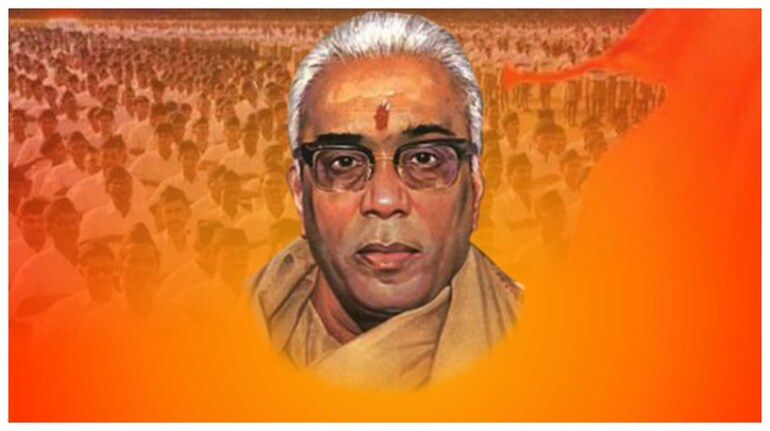
Madhukar Dattatraya Deoras, popularly known as Balasaheb Deoras, was the third Sarsanghchalak of the RSS. He was among the first batch of swayamsevaks who had joined the first RSS shakha started by Dr. Hedgewar at ‘Mohite Baada’ in Nagpur. (Though the RSS was founded in 1925 on the occasion of Vijaydashami, the first daily Shakha started a few months later in 1926.) Balasaheb was groomed by none other than the founder of the RSS himself, which is probably one of the reasons that millions of swayamsevaks, who had never seen Dr. Hedgewar, found a reflection of the RSS founder in Balasaheb.
Along with Balasaheb, the first batch of swayamsevaks included Keshav Rao Vakil, Triambak Jhiledar, Alhaad Ambekar, Bapu Diwakar, Narhari Parakhi, Bali Yeshkunyyvar, Madhav Rao Muley, and Eknath Ranade. Eleven-year-old Balasaheb was their undisputed leader, and his fellow swayamsevaks looked up to him right from the beginning, even though Ranade was one year older and Muley was three years older than him. Later, Ranade and Muley both became General Secretaries (Sarkaryavahs) of the RSS and played a stellar role in expanding the organisation.
Family Background and Early Life
Balasaheb was born in Karanja, Balaghat (Madhya Pradesh) on 11th December 1915. He was the eighth among nine siblings. Bhayyaji and Parvatibai had four sons and five daughters. His family and friends used to call him ‘Bal’ (child in Marathi) at home, which is how he got the name Balasaheb Deoras. Balasaheb’s younger brother, Bhaurao (another RSS stalwart who dedicated his life to the cause), was born on 19th May 1917.
By the time the RSS was founded in 1925, the Deoras family had shifted back to Itwari Mohalla in Nagpur. Balasaheb was studying in the sixth grade when he joined the first RSS shakha.
Commitment to Social Equality and Anti-Untouchability Movement
The resolve to do away with caste-based discrimination and establish a just and equal society remained close to Balasaheb’s heart. While delivering a lecture at the Vasant Vyakhyanmala on 8th May 1974 (shortly after becoming the Sarsanghchalak), he categorically said, “We should accept that untouchability is a grave error and we must do away with it completely.” This statement is considered to be one of the milestones in the history of the RSS, as it led the organisation to fight caste-based discrimination with renewed vigour. During the 21-year tenure of Balasaheb as the Sarsanghchalak, he relentlessly campaigned against caste-based discrimination and untouchability. It also highlights a personality trait of Balasaheb: he believed in challenging the status quo.
Anecdotes Illustrating His Personality
Once, Balasaheb, along with Shriramji and Pandurang Pant, was descending the stairs at Mahal (Nagpur) office. They were going for a programme when an RSS functionary, who was quite old, was telling another swayamsevak, “We are quite old now. We can’t change our attitude.” Balasaheb overheard this, stopped, turned around, and told the elder swayamsevak, “You should mend till you end.”
Leadership Sensitivity and Training Discipline
Once, during a first-year training camp in Nagpur, Dr. Ravindra Joshi, who was in charge of the Western region as a Pracharak, went to meet Balasaheb to give information about the activities and schedules at the camp. After sharing all the details, Balasaheb asked him, “What would be the ‘wake-up time’ for the participants in the morning?” When he learned that the wake-up time was 4 a.m., he said to Dr. Joshi, “Why are you waking them up so early? These kids are still quite young.”
Institutional Reforms in RSS Shakha System
Balasaheb also introduced certain important changes in the RSS’ functioning that had a long-lasting impact. Before he took over as in-charge of Nagpur, RSS shakhas were held six days a week, with Sunday being a day off. During the holy month of ‘Shraavan’, in addition to Sunday, there was no shakha on Monday either. Balasaheb introduced activities for both Sunday and Monday, and gradually, the RSS began holding shakhas seven days a week, 365 days a year, without a break — a practice that continues today.
Beginning of the Morning Shakha Tradition
In 1938, at Balasaheb's behest, the first morning shakha of RSS was started in Mohite Baada, Nagpur, where relatively older swayamsevaks began attending. Tatyaji Baviskar was the karyavah of this ‘Prabhat’ (morning) shakha, and Baburao Maagh was the Mukhyashikshak.
The idea for starting a morning shakha came about as Balasaheb noticed that several RSS workers, who worked in offices or other businesses, could not find time to attend the evening shakha. To keep them engaged with the organisation, the morning shakha was introduced. Over time, the ‘Prabhat Shakha’ played an important role in consolidating the RSS’ network. The activities designed for the ‘Prabhat Shakha’ are generally less physically demanding than those of the evening shakha, as relatively older swayamsevaks attend the morning shakha.
Introduction of Ghosh (Band) and Group Songs
Balasaheb is credited with starting the ‘Ghosh’ (band) of the RSS and the tradition of group songs. During the Vijaydashami festival of 1937, around 2,000 swayamsevaks sang five group songs in Nagpur, which thrilled everyone present. Balasaheb had personally selected these songs and ensured that the swayamsevaks had practised them thoroughly.
Earlier RSSFACTS columns can be read here.
(Arun Anand has authored two books on the RSS. His X handle is @ArunAnandLive.)
Views are personal, and do not represent the stand of this publication.
Discover the latest Business News, Sensex, and Nifty updates. Obtain Personal Finance insights, tax queries, and expert opinions on Moneycontrol or download the Moneycontrol App to stay updated!
Find the best of Al News in one place, specially curated for you every weekend.
Stay on top of the latest tech trends and biggest startup news.