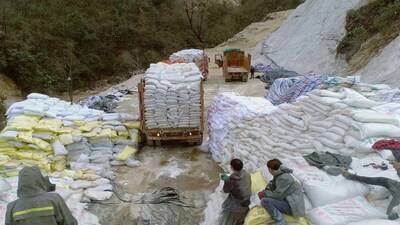
The US can beat China on critical minerals but not by copying it
America must rebuild the infrastructure that underpins markets and thus supply chains

GST at 8: A tax reform that empowered every Indian
Eight years on, GST has gained strong approval. GST has lowered tax rates on essentials, unified India’s market, reduced logistics costs and boosted inter-state trade, benefiting both consumers and businesses through simplification and digitisation
AI’s diagnostic power in Radiology is not limited to screening
AI in radiology is no longer just a screening tool. It now collaborates in diagnosis, reduces errors, speeds up workflows, and supports clinical judgement - redefining its role from passive observer to active partner
Karnataka Bank’s top brass exit: Personal reasons or boardroom friction?
Karnataka Bank’s CEO and Executive Director step down citing personal reasons, but governance-related concerns and board-level differences are also in focus.
New discovery of rare earth deposits in Kazakhstan provides India opportunities
The discovery by geologists potentially puts the country among the top three nations in terms of deposits. India has a long-standing trade relationship with Kazakhstan which is a critical supplier of uranium for its nuclear plants. Moreover, a lasting legacy from the Soviet era is popular goodwill for India on account of its soft power. All the ingredients for a mutually beneficial relationship are in place
2W demand to hit the skids on ABS regulation
With demand moderating, 2W makers may find it challenging to pass on cost increases from ABS regulations to customers
GST at 8: A look back and suggestions for the way ahead
Eight years of GST mark not just the survival but the steady maturation of India’s boldest tax reform. While the journey has not been without hiccups, the direction remains firmly forward-looking. With GST reasonably stabilised now, what is needed as a next step is a set of GST reforms guided by principles of ease of compliances, transparency, and reduced complexity
Is there an India-China crack in the BRIC-work?
President Xi Jinping’s near-certain absence at the BRICS summit could weaken the bloc’s effort to increase Global South’s heft in the world order
Chart of the Day: Early crop sowing data indicate a good season for agriculture-inputs providers
Rice, pulses, coarse cereals and cotton are seeing good sowing
RBI warns global spillovers could singe Indian markets as US bonds lose haven label
India’s financial system is resilient but global spillovers are treacherous as ever
Data Story: India’s industrial engine sputters at FY26 start as consumer goods production slumps
FY26 began on a worrying note for Indian industry, with IIP growth sharply slowing as consumer goods production continues to contract
Traders in this asset class need not fear Algos, AI
Retail equity traders are finding it difficult in the face of AI and algo trading. But this asset class is not as exposed to the risk as equities is
MIA: Gaps in China’s PLA as Xi Jinping unleashes a purge
Last week, China’s ‘Supreme Leader’ Xi Jinping purged high ranking military personnel. A look at the long list of purges unleashed by Xi leads to the question if it’s a form of insurance against being toppled from within. Is China’s contemporary ‘emperor’ a lonely and insecure man?
44th Amendment: Restoring constitutional safeguards and limiting emergency powers
The Forty-Fourth Amendment (1978) reversed the Emergency-era changes, strengthening democratic safeguards by restricting executive powers, protecting fundamental rights, and ensuring stricter parliamentary oversight during national emergencies
Why India should not forget the cost of Colonisation
Sanghnomics: A new study revisits colonial-era records to highlight how British rule systematically drained India’s wealth through tribute, taxes, and remittances—hindering development and funding Britain’s global imperial ambitions
Ruchir Sharma: The world is changing, the US market is not
Until one of these three scenarios plays out, the US markets are likely to continue shrugging off the gloomcycle
Farm products represent tricky terrain in India-US trade talks
In a week’s time the 3-month pause on the US’ unilateral announcement of reciprocal tariffs ends. Agriculture and dairy segments represent India’s 'red lines'. However, US pressure to open up these areas may not subside as it seeks to find an alternative to China’s market
Trump-brokered Congo-Rwanda peace deal aims to unlock critical mineral access for US
The US brokered a peace deal between two warring nations, Congo and Rwanda. But the Trump administration’s real purpose is to muscle in on Congo’s mining belt, which produces critical minerals required for advanced technologies
Why Akzo Nobel India’s minority shareholders may have got a profitable exit
JSW Paints’ acquisition of the Dulux-maker has been designed as a win-win for all including shareholders, but much depends on what happens next
Quick Take: Torrent Pharma puts the money where its heart is
Torrent’s India business has been outperforming the domestic market
Chart of the Day: Diamonds are forever, at a discount
Diamond exports from India have plunged to a two-decade low, and the downturn isn’t over yet. As demand slumps and uncertainty looms over U.S. tariffs, FY2026 could see another painful year for the industry.
Reconfiguring supply chains in a world where trust’s eroding
Thinking about supply chains has moved from just-in-time to just-to-be secure following geopolitical turmoil. A risk-based framework for reconfiguring India’s supply chains can address security considerations without jeopardising the country's economic growth
Europe’s bid for strategic autonomy faces twin hurdles: Trump’s tariffs and China’s clout
The European Union’s quest for strategic autonomy is increasingly under strain, caught between an unpredictable US and an assertive China. As the trade landscape shifts, the bloc’s internal fractures and external dependencies are being laid bare
As the 2026 election nears, Bengal braces for more bloodshed
A nine-year-old girl was killed in a bomb blast days after a TMC by-election win in West Bengal’s Nadia district, once again exposing the violent underbelly of the state’s politics. With a history of crude bomb attacks and political killings, the countdown to the 2026 assembly polls already looks ominous
Weekend Wild Card: Dubious insider reveals Trump’s yuge Nobel Grand Slam
We submit below the transcript of an allegedly secret meeting of the committee to decide the Nobel Awards for this year, clandestinely smuggled to us by a shady source: