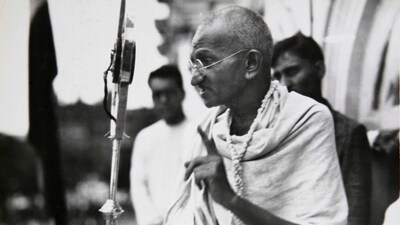
Remembering Mahatma Gandhi, the crusader for justice
As we observe his birth anniversary in a world still scarred by conflict and inequality, Gandhi’s life raises a hauntingly urgent query: can there be freedom without justice?

Regulatory changes overshadow main monetary policy
MPC’s decision to maintain status quo on rates was expected. Its message on policy consistency and economic resilience was reassuring. The highlight, however, was the regulatory package to ease credit flow and smoothen banks’ transition to an enhanced risk standard
‘We, the People’: Pride, helplessness and the dharma of democracy
India today is both a source of pride and a sense of disorientation. Our democracy survives, but the absence of accountability, fairness, and civic discipline raises a blunt question: are we truly living up to the promise of our republic?
Despite moderating growth and lowered inflation forecast, why did RBI MPC hold off on rate cut in October?
While the MPC voted unanimously to keep policy rates unchanged, a couple of MPC members expressed their views for changing the policy stance from ‘neutral’ to ‘accommodative’.
GDP - AI = 0?
Plus, who is paying the tariffs
RBI MPC October policy signals dovish tone, opens up space for future rate cut
Given the backdrop, the commentary by the RBI Governor was dovish as compared to neutral to hawkish in August policy.
RBI policy decision signals emerging space for easing while holding rates for now
Investors should view the current pause as an intermission rather than a finale; the script still allows for a dovish turn. How should fixed income investors tweak their portfolios?
OPINION | Why India’s auto component industry must prepare for a multi-fuel future
India's mobility future is multi-fuel, with EVs, hybrids, CNG, and ethanol vehicles coexisting. Auto component makers must build flexible, tech-diverse capabilities to stay competitive in this evolving ecosystem
No rate cut, but RBI makes up with prudential easing, a softer tone
Prudential levers are being eased for banks to lend more freely to the economy.
Making sense of NSE IFSC's daily expiry options
The initiative to launch 0DTE option contracts has raised eyebrows among traders, particularly given ongoing discussions surrounding the potential phasing out of weekly expiries in favour of longer-dated contracts
Martin Wolf: A world with two predatory superpowers
Nations must work out how to contend with Trump’s America and China
OPINION | Indian Railways unveils ground-breaking engineering feats across India
Indian Railways has achieved major milestones, from the Pamban Bridge to the Katra-Srinagar route, advancing connectivity, operational capacity, and global integration, all while introducing new innovations like Vande Bharat sleeper trains
Data Story: How cement sector dynamics could play out, post GST rate cuts
Given tepid demand due to monsoon, festivities weighing on construction activity, a lull in pricing will prevail for some months ahead
Chart of the Day | RBI's inflation taming: A battle won or just a breather?
With CPI at rock-bottom lows but core acting stubborn, the MPC faces a moment of truth on the rate cut front
OPINION | Beyond the Numbers: Why India’s financial inclusion score tells only half the story
India's financial inclusion progress is commendable, but true inclusion requires more than infrastructure. A 'Sentiment Index' measuring trust and engagement could ensure meaningful participation and guide targeted interventions for equity
RBI monetary policy committee: Why jump the gun?
There is scope for 20-30 bps increase in the official FY26 growth forecast and a downward revision of a similar magnitude to inflation.
OPINION | Building a Sustainable Mining Future: Balancing growth and responsibility
India's mining sector is evolving to balance economic growth, environmental responsibility, and community development. Innovations in sustainability, gender inclusion, and ecological restoration are shaping a regenerative mining future
How should investors in FMCG stocks read unexpected negative effects of GST rate cuts?
HUL’s sales warning for September and October raises the risk of it becoming a sector-wide issue. The key points investors should be looking at to gauge the sectoral outlook
OPINION | India’s Secular Dilemma: Balancing faith and the State
In India, religion is not limited to personal belief; it is deeply woven into the social fabric and continuously shapes citizen–state interactions. In such a context, maintaining a strict and absolute separation between state and religion becomes exceedingly difficult
China’s Alibaba is a late entrant to the AI pantheon
For now the big difference with the Metas and Googles is that China’s tech giants remain largely domestic beasts
How Nvidia’s Jensen Huang became AI’s global salesman
The chipmaker’s chief executive is urging countries to establish their own ‘sovereign’ AI ecosystems — but one which relies on its technology Link To FT.com: https://www.ft.com/content/179cc3bb-9d03-49a4-af20-049b03875379
OPINION | Vijay, the megastar with the trappings of a political party
Aura can sustain an actor in the tinsel world. Not in politics. Tamil cinema’s matinee idols who reached the top did so on the back of a well-oiled political structure. The stars who didn’t heed the lesson have been consigned to flashbacks
OPINION | Why the Jaguar Land Rover cyberattack is a warning shot for the Indian automotive sector
The protracted struggle of Jaguar Land Rover with a massive cyberattack has revealed that cyberattacks are not just about abstract occurrences restricted to machines but are increasingly about supply chain disruptions and livelihood losses. Indian automotive players should conduct a cyber audit of their facilities, map out supply chain implications of operational disruption and secure cyber insurance to avoid hefty damages
OPINION | Anxiety about alienation grips Ladakhis. Government should address it
A journalist who spent a few days in Ladakh prior to the violence on September 24 shares his impressions from the ground. Ladakhis are fearful of land alienation and seek the protection of the Constitution’s Sixth Schedule and statehood. Sonam Wangchuk may be in jail but he is the local with street credibility
Chart of the Day: Hindustan Aeronautics, Bharat Electronics holding on to their ground despite a rise in competition
Bharat Electronics’ share in defence capital expenditure increased significantly in the last 10 years