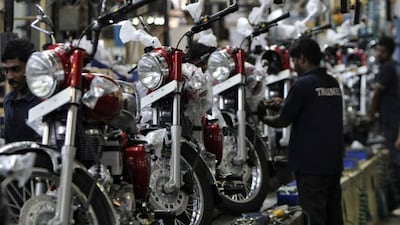
Stress lurks in two-wheeler finance; lenders, investors must stay watchful
Two-wheeler loans are a small proportion of lenders’ loan books but are important enough to be monitored.

Chart of the Day | The US-India tariffs equation: Who wins, who loses?
While US exports to India have gone up 25 times in the last 30 years, imports have gone up 38 times
Delivery Diaries: The timeless tradition of gifting food - love on a plate
Gifting food has deep cultural roots, from ancient traditions to modern online deliveries. The Ordering for Others (OFO) category highlights how people express love and care through food, with major spikes during festivals, anniversaries, and special occasions like Mother's Day and Valentine's Day
A relatively warmer winter doesn’t seem to have affected wheat crop
In wholesale markets, wheat price has inched upward over the last six months to register an inflation rate of 9.75 percent in January. A relatively warm winter has added to anxiety about the price trend of this critical cereal which will have a bearing on food inflation. Despite adverse developments, initial signs suggest that we are not likely to see a repeat of 2022, when a surge in temperature undermined wheat output
Ruchir Sharma: The rising economies born through crisis
Financial stress is forcing reform and recovery in many overlooked countries
Chart of the Day: A historical perspective on market declines and recovery
The Indian stock market has been on a decline since its peak in September 2024, with Foreign Institutional Investor (FII) sell-offs playing a key role. As investors assess whether the downturn is nearing its end, historical data offers insights into potential recovery timelines.
Unilever’s new CEO a man in a hurry, may nudge HUL to move faster
Fernando Fernandez believes US and India are Unilever’s main anchor markets and ‘accelerating in India is very important’ to him. HUL’s Investors will agree
Why the ‘Tiger’ need not dance with the ‘Dragon’
Sanghnomics: As US-China trade tensions rise, China seeks India’s support. However, India remains cautious due to past economic and security concerns. Experts argue India should prioritise ties with the US while leveraging trade opportunities arising from the tariff war
A reassuring vision for India’s capital market
SEBI Chairman Tuhin Pandey’s tenure is expected to focus on enhancing market participation, increasing regulatory transparency, and fostering a more efficient, technology-driven financial ecosystem. Rather than advocating for disruptive changes, he stresses steady, data-driven reforms
Europe’s increased defence spending doesn’t cut it. Ukraine needs the US
The US not just provided the largest support to Ukraine among individual countries, its supply of military hardware has no immediate substitute. Moreover, Europe’s stated intent to ramp up military spending will run into the constraint caused by the continent’s relative economic decline. The US is irreplaceable in Ukraine’s war effort
President Trump and the unhappiness of the supply chain strategist
Supply chain managers worldwide have faced multiple disruptions in the past decade, from the COVID-19 pandemic to geopolitical conflicts. However, the unpredictability brought by Donald Trump’s second term, with rapid tariff threats and trade wars, has created unprecedented challenges
Deconstructing the DOGE narrative about government debt
The fear of US public debt, often exaggerated by policymakers, overlooks fundamental economic realities. Instead of focusing on debt reduction, the priority should be ensuring government expenditures enhance productive capacity to sustain economic growth
Can India create a Goldilocks moment for its trade?
New Delhi needs to leverage the US offer for a bilateral deal and China’s cooperation call to its advantage
The Eastern Window: Will Trump’s tariffs bring the Dragon and the Elephant together?
As India and China attempt to mend ties, can India afford to embrace Chinese FDI while safeguarding its strategic interests?
Merchant power producers in a sweet spot on rising demand, limited generation capacity
Given the long construction timelines of new projects, companies are finding it lucrative to purchase and turn around financially troubled power plants.
Widening the lens on the Hoysala temples, a legacy at risk
The Hoysala dynasty's architectural wonders, beyond those in Belur, Halebid and Somnathpur, face neglect and theft. Despite being listed as ‘protected’, many lesser-known sites remain vulnerable. Experts stress the need for wider preservation efforts beyond the iconic landmarks
The Reading List: March 7, 2025
A selection of articles and social media gems from the world of economy, business and finance, curated by our research and opinion teams
Tuhin Pandey’s SEBI brings fresh hope with a focus on trust and transparency
In his first major public engagement, Sebi’s chairman laid out a vision. It promises to usher in a regulatory approach that is not overzealous. Instead, there will be a push to be mindful of trade-offs and a willingness to listen to feedback. He’s promised 'optimum regulation'
Finance Commission’s workings need a greater degree of transparency
India’s federal structure is under stress on several grounds, particularly tax devolution between Centre and states, and among states. Finance Commissions play a critical role in the devolution process. However, a drawback in their approach has been the absence of an adequate level of transparency on the underlying reasons for significant changes in devolution formulae
Revisiting ‘The Fundamentalist Project’ to understand western bias against RSS
RSSFACTS: The Fundamentalism Project's analysis of the RSS faces criticism for incorrectly labelling the organisation as fundamentalist. Gurumurthy argues the project misrepresents the RSS, emphasising its ideological differences from Abrahamic fundamentalism and highlighting flaws in the academic framework applied
What corporate credit spreads are signalling on returns
High-yields might not be a giveaway any more but are fairly priced
Noble Yet Unequal: Gender inequality in India's legal profession
Women's participation in India's legal field remains severely limited due to systemic biases, work culture, and financial inequality. Despite challenges, ongoing reforms and advocacy signal hope for greater gender diversity and inclusion in the profession
India’s middle-class market: How big is it really?
As urban consumption has weakened due to inflation and low wage growth, the actual size of the consuming class is being called into question
US yields are finally falling, but for the wrong reasons
A change in market expectations – from an inflation slowdown to an economic slowdown – is reflected in how long-term US treasury yields have fallen more than short-term yields. What does this mean for Indian investors?
Vault Matters: Why green financing is not yet a greener pasture
The US is having a total rethink on its approach to renewable financing and back home the trend seems to have just gotten started. Like most times, are we picking the tail end of an idea?