





Last week, Richard Mille, famed for its innovative use of cutting-edge materials in its robust sports watches, some of which are famously endorsed by Rafael Nadal, launched the world’s thinnest watch.
At 1.75mm, the case of the RM UP-01 is thinner than the strap attached to it. The watch weighs just 30 grams, including the strap, and took about 6,000 hours to develop. Despite its slenderness, the watch is capable of withstanding 5000Gs and comes with a power reserve of 45 hours.
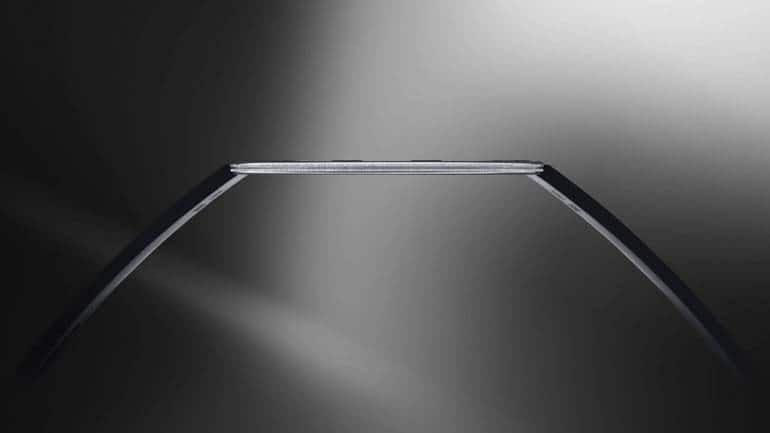 The RM's base plate, skeletonised ridges and balance wheel are made from Grade 5 titanium.
Salvador Abona, Richard Mille’s technical director for movements, says that in its quest for absolute flatness, the company “had to offer a watch that, far from being a ‘concept watch’, was up to the task of following a user’s daily life, whatever the circumstances.”
Long story short — according to Richard Mille, the world’s thinnest watch, made in collaboration with Italian luxury sportscar maker Ferrari, is also an everyday watch.
Millimetre by millimetreWith the UP-01, the 21-year-old brand is now part of a group of highly accomplished watchmakers who have sought to shave off the inches, millimetre by millimetre, over the last 70-odd years. These include Vacheron Constantin, Jaeger LeCoultre (JLC), Bulgari, and Piaget.
Making a thin watch takes some doing: you have numerous, delicate mechanical parts and a reed-thin case to fit it all in. In some cases, as with Piaget, and now, with Bulgari, it becomes an intrinsic part of your identity.
Leadership in this race for ultra-flatness, of course, can never be taken for granted. It was Vacheron Constantin that kind of fired the first salvo with the 2.94mm Calibre 1001, and then, barely two years later, launched the 1.64mm Calibre 1003.
The '70s witnessed serious action with JLC, as well as the likes of the pioneering Jean Lassale, which made a manual wind movement that was just 1.2mm thick, getting into the game. The rivalry become more intense this past decade, with JLC’s Master Ultra Thin Jubilee, which was 4.05mm thin and featured the world’s thinnest manual caliber (1.85mm).
Piaget responded with the 3.65mm Altiplano 900P. Bulgari took over, more or less completely, in 2014 and has since then, under its Finissimo collection, produced a succession of record-breaking timepieces - the world’s thinnest tourbillon, thinnest minute repeater, mechanical chronograph and tourbillon chronograph.
This March, a year after it unveiled the thinnest perpetual calendar, the brand, founded in 1884, in Rome, by an eponymous Greek silversmith, snatched the thinnest-mechanical watch crown from Piaget’s Altiplano Ultimate Concept. If the Piaget was an unbelievably slender 2mm, Bulgari’s Octo Finissimo Ultra went 10 percent thinner.
Barely three months later, Richard Mille entered the scene and we all know what happened next. The RM’s base plate, skeletonised ridges and balance wheel are made from Grade 5 titanium, and the movement, which weighs just 2.82 grams and has an ultra-flat escapement, is assembled within the case instead of a construction in which the caseback also does double duty as a baseplate to ensure shock resistance.
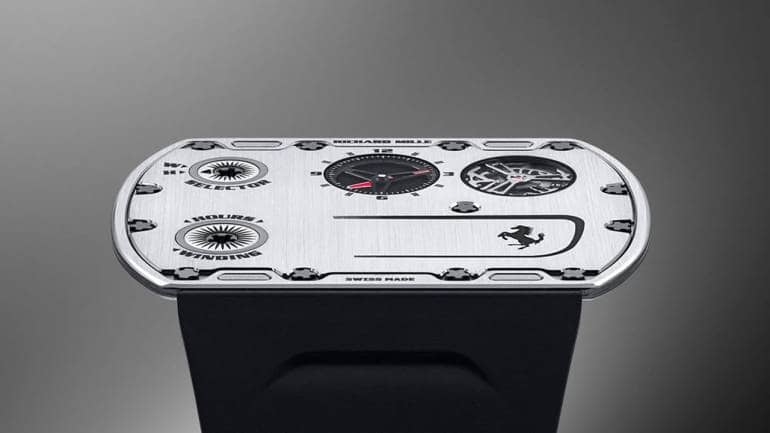 The watch has two crowns—one to set the winding and the other to activate them.
The watch gets two crowns—one to set the winding or hand-setting function and the other to activate them.
Plus, just in case the Richard Mille logo is not enough, you also get the Prancing Horse on the titanium surface.
The RM UP 01 is limited to 150 pieces, and at $1.8 million, you’ll need to be an F1 driver—like Ferrari’s Charles Leclerc or Carlos Sainz Jr—to pick one of these up.
Discover the latest Business News, Sensex, and Nifty updates. Obtain Personal Finance insights, tax queries, and expert opinions on Moneycontrol or download the Moneycontrol App to stay updated!
Find the best of Al News in one place, specially curated for you every weekend.
Stay on top of the latest tech trends and biggest startup news.




