
As pending cases in the Indian judicial system near the 50-million mark, questions may again arise over court vacations. Much ink has already been spent dissecting what ails our judicial system and whether cutting down on court holidays is a solution.
At a public event after the Supreme Court re-opened following its summer vacation, Chief Justice of India (CJI) NV Ramana spoke about the immense workload judges across the courts are tackling.
The CJI, in a candid moment, rued that his grandchildren may not even recognise him owing to the little time he gets to spend with them.
These comments invited reactions on social media, where people continued to ask why the number of working days for the courts cannot be raised to reduce the overall workload.
Yet, criticism of the judiciary for taking days off is not only misdirected but also unreasonable, legal professionals Moneycontrol spoke to said.
Some facts first.
The Supreme Court takes a summer break of roughly 45 days and a winter break of around two weeks in addition to one-week off each for Dussehra and Diwali. The high courts across the country set their own calendars, including for lower courts falling under the supervisory jurisdiction. High courts take fewer days off compared with the top court. The lower judiciary has the highest number of working days.
Critics ask why the judges need these vacations at all.
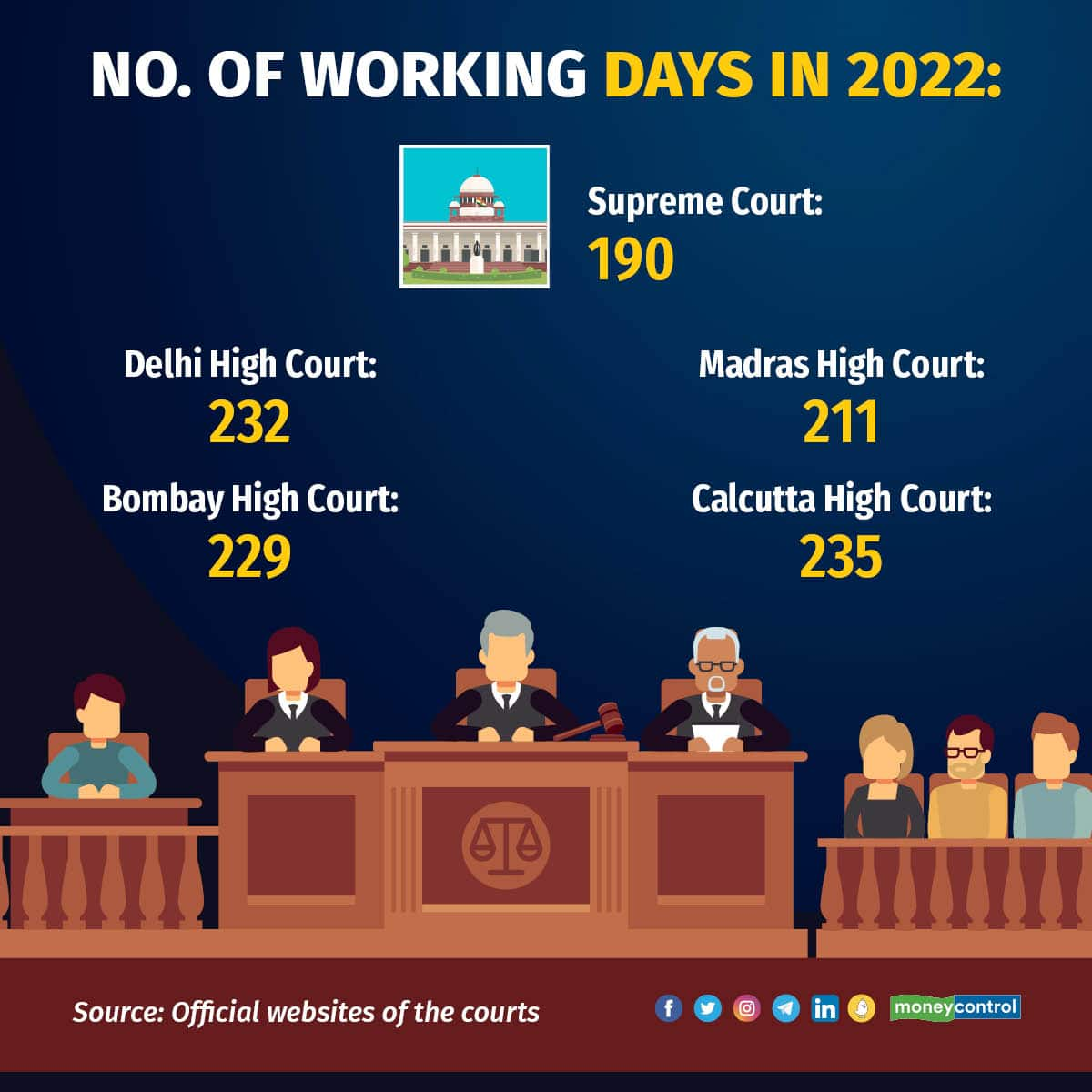 All the high courts across the country set their own calendar and for the lower courts they supervise and govern.
More than meets the eye
A judge’s work is not limited to the hours spent sitting in the courtroom hearing cases. Much of a judge’s work takes place beyond court hours.
"A lot of what judges do is not in the public gaze and this is true for judges right from the magistrate in a court near you all the way up to the Chief Justice of India,” said Advocate Bharat Chugh, who has served as a Civil Judge/Metropolitan Magistrate for a period of four years.
With daily work keeping the judges busy through the week, the intellectually laborious work involved in writing a judgment often gets spilled into the vacation period for judges of the higher judiciary.
Writing a judgment, one of the most crucial parts of a judge’s jobs, entails hours of reading case details, submissions by all parties, and the judge’s original research on the question of law.
All the facts and arguments presented before a court have to be summarised by the judge and a reasoned answer to the questions of law involved in the case has to be given.
This is the reason why the number of pages that a judgment runs into is directly proportional to the complexity of the question of law involved.
Working on a judgment requires a certain amount of time, which is simply not available to the judges during working days, and this is where the vacation days feature.
Reducing these days for the judiciary could prove counter-productive and add to the pile of reserved judgments rather than solve the issue of delays and backlogs.
“I think the ‘vacations v. backlog’ debate is premised on a misconception of actual judicial work. The truth of the correlation can be claimed only if, in turn, your imagination that the judge is somewhere on vacation in the Alps was true. However sumptuous that may sound, it isn’t true. They (the judges) are mostly churning out judgments and doing other administrative work tasked to them,” points out advocate Govind Manoharan, co-head of Godiyal & Manoharan Chambers.
The Supreme Court delivered over 40 judgments on the re-opening day after the summer vacation this year. The top court sees many judgments being pronounced during the re-opening week after its summer and winter breaks, demonstrating that quite a bit of the vacation period is spent on judicial work.
Also, judges need a break too, to recharge and to rejuvenate.
Intellectual labour
"A vacation is meant to give the judges a break from what is essentially a seven-day job... A median judge in the high courts and the Supreme Court pretty much works seven days a week,” says Alok Prasanna Kumar, co-founder and lead at Vidhi Centre for Legal Policy. "Vacations are necessary… if you want our judges to not burn out or overwork, then they need to have vacation."
A typical working day for any judge, from the trial courts all the way to the Supreme Court, begins at least two hours before and continues well after the designated working hours of the court, explains advocate Shraddha Sondhi who has worked as a judicial clerk with a judge at the Delhi High Court.
In addition to hearing cases daily, a judge has to also prepare for these scheduled hearings by reading the relevant case briefs, which could run into hundreds of pages.
This homework would essentially have to be done either the night before or early morning before the court assembles, Sondhi points out.
Much of the weekend is spent preparing for the coming week while administrative duties and public engagements and commitments also keep judges busy.
Advocate Sriram Parakkat, who practices law at the apex court, says the number of cases each judge has to prepare for each day is many times higher than the number lawyers would have to work on.
A quick look at the daily cause list – list of cases to be heard by a bench at a court – would show that a Supreme Court bench takes up between 15 and 20 fresh cases on average each day.
The number of such pre-admission stage fresh cases is higher for high courts, which too are empowered to hear cases concerning the fundamental and constitutional rights of citizens.
In addition to these, courts also hear regular cases that are in advanced stages.
Each case heard by a court of law has significant bearing on the parties involved.
“There can be something we call a ‘decision fatigue’ because judges are making decisions that have a bearing on lives of the people… and this can be extremely exhausting,” said Chugh.
“The work of a judge is also something that is likely to take an emotional toll… So, in order for the judges to rejuvenate, there is a need for time off,” he added.
But can this time off work not be reduced to perhaps tackle the issue of backlog and delays, like critics of court vacations suggest? Experts say trimming vacation days serves no purpose.
Systemic overhaul needed
"There is no correlation between the delay and the number of vacation days that the court takes,” said Alok Prasanna Kumar who added that the root cause of delays and the backlog was a deeply entrenched systemic problem.
"There are many systemic and procedural changes from top to bottom that need to be made if the cases have to move quickly through the systems and the issue of delays has to be addressed… reducing vacations is not one of the solutions."
With more people resorting to the justice delivery system for exercising their legal rights, the number of new cases entering the system has spiked. Law Minister Kiren Rijiju, in the monsoon session, pointed out that the courts are burdened by a high backlog because while the courts are efficiently settling and disposing of cases, new cases pile up.
A situation like this would require judicial reforms that do not seek to burden more an already overburdened judiciary.
Efficiency risk
"Indian judiciary is one of the most overburdened judicial systems across the world and exhausting your judges further is not a solution to any of the problems plaguing the justice delivery system,” Chugh said.
Abhik Chimni, an advocate at the Delhi High Court, says increasing working hours or days for judges risks hampering their efficiency.
“Simply cutting down on vacation days or increasing working hours of judges will not give them the time and space required for discharging their judicial duties. It is the judge-to-case ratio that needs to be worked on,” he said.
Kumar said while filling up of vacancies in the judiciary is likely to reduce the backlog, it will not fix the root cause of the problem.
“Fundamental source of delay is the fact that we have very outdated systems and procedures in our judiciary and we don’t use modern methods and technology for processes… it is really not a system that is designed to deliver," he said, stressing the need for systemic change.
Discover the latest Business News, Sensex, and Nifty updates. Obtain Personal Finance insights, tax queries, and expert opinions on Moneycontrol or download the Moneycontrol App to stay updated!
Find the best of Al News in one place, specially curated for you every weekend.
Stay on top of the latest tech trends and biggest startup news.