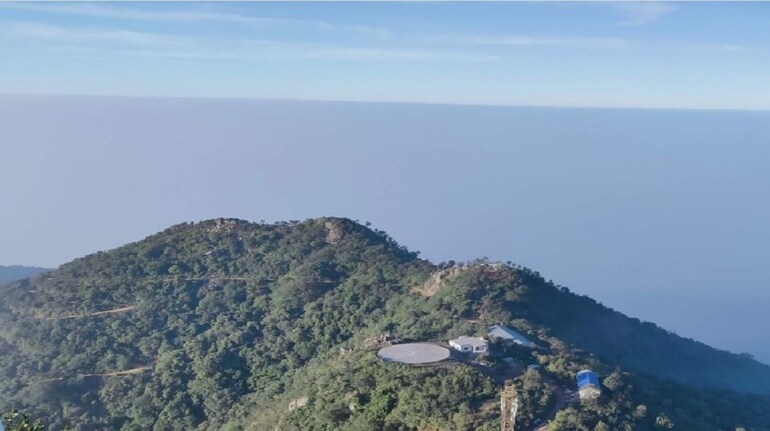
The Jharkhand high court recently asked the state government to deploy more home guard constables to ensure that the Parasnath Hills in the Giridih district are protected and perpetrators are stopped from littering and selling non-vegetarian food products in the vicinity.
The controversy surrounding Parasnath Hills is not new. The battle to claim the hills as part of their cultural identity has led to a conflict between Jains and tribals. The hills, home to Sammed Shikharji, are a pilgrimage destination for Jains. The hills are also considered as “Marang Buru” (supreme deity or the great mountain) by the Santhal community. However, both the communities differ sharply in diet and customs.
What do Jains believe?
This range of hills is one of the most important pilgrimage centres for Jains. They call it Sammed Sikhar. The hill is named after Parasnath, the 23rd Tirthankara. According to beliefs, 22 Jain Tirthankaras attained salvation on this hill. For each of them there is a shrine (gumti or tuk) on the hill. Some of the temples on the hill are believed to be more than 2,000 years old.
“The Jains, being followers of one of the oldest religions, have held this hill sacred since the time of the tirthankaras [in the BCEs],” Amit Jain, a community leader in Parasnath, told Indian Express.
Jains from across the country undertake the 27-km trek to the summit and back, where 20 Tonks (pinnacles), one for each Tirthankara, are located.
What do Santals believe?
The Santals call it Marang Buru, the hill of the deity. They celebrate a hunting festival on the full moon day in Baisakh (mid-April). It is the supreme animist deity in the Santal tradition. Accordingt to Indian Express, the Jug Jaher Than (sacred grove) on the hill is the most sacred dhorom garh (religious site) of the Santals.
The Dishom Manjhi Than on the hill, the symbolic seat of the dishom manjhi (the traditional Santal leader) where customary rituals are performed.
Marang Buru is also the supreme seat of justice for Santals. The Lo Bir Baisi is a tribal council that resolves disputes. The issues that cannot be handled at the village level, convenes at Boda Darha in Sohraiya village, at the eastern part of the Parasnth Hills.
Root of conflict
When British botanist and explorer Sir Joseph Dalton Hooker first visited the eastern end of the Chota Nagpur plateau in 1848, this is how he described Parasnath hill: “It is a remarkably handsome mountain, sufficiently lofty to be imposing, rising out of an elevated country, the slope of which, upward to the base of the mountain, though imperceptible, is really considerable, and it is surrounded by lesser hills of just sufficient elevation to set it off.”
Jharkhand was carved out of southern Bihar in 2000. The history of the Parasnath dispute can be traced in the Bihar District Gazetteers Hazaribagh, 1957. According to a version in this compendium, the Jains objected to the construction of a sanatorium for British troops in Parasnath hill, complaining that its sanctity would be violated. “Accordingly, the idea of establishment of sanatorium was abandoned not merely because of confined space and absence of water but in respect of the sentiments of the Jains and the building which was constructed was later utilised as a dak bungalow,” it stated.
It was in 1911 that the conflict between Adivasis and Jains over Marang Buru/Parasnath officially entered state records.
According to the 2011 Census, the Adivasis, who comprise 26 per cent of the population of Jharkhand.
According to the Gazette, each year Santals assemble during the full moon of Baisakh and celebrate a religious hunt (Sendra) for three days. Following this, a big tribal session is held.
The entry of this custom in the record-of-rights which was prepared in 1911. It was followed by the institution of a suit by the Swetamber Jains claiming that no such custom exists.
Arjun Marandi, a community elder, told Indian Express that during the three-day long Sendra, all male members of the Santal community head into the forest to hunt. “It’s a rebirth for Santal men. Either die or hunt to survive,” said Marandi.
The Jains follow a spiritually-motivated vegetarian diet so Sendra became an issue for them. However, the initial effort to ban hunting on the hill was unsuccessful.
Their suit was dismissed by the district court, and upon appeal, rejected by the Patna High Court in 1917.
Changes after independence
The Indira Gandhi government passed the Wildlife Protection Act in 1972 and Adivasi villages around Marang Buru lost their status under the Fifth Schedule of the Constitution.
The forested area on and around the hill was designated as a wildlife sanctuary in 1978. As a result, rituals at the Jug Jaher Than in Marang Buru were halted till 2000.
In 2008, Ajay Tudu, a prominent Santali activist who led the movement for the resumption of Adivasi rituals at Marang Buru, was shot dead.
In 2023, a memorandum by the Ministry of Environment, Forest and Climate Change ordered that no alcohol or meat be served within a 25 km radius of the hill. The memo also banned serving eggs or meat in Anganwadi centres and primary schools in the area.
According to Indian Express, nonetheless, Santals celebrated the Sendra festival in the jungles of Marang Buru in early May.
Discover the latest Business News, Sensex, and Nifty updates. Obtain Personal Finance insights, tax queries, and expert opinions on Moneycontrol or download the Moneycontrol App to stay updated!





Find the best of Al News in one place, specially curated for you every weekend.
Stay on top of the latest tech trends and biggest startup news.