Blackshirts of Italy were members of a fascist militia supportive of Benito Mussolini from the end of the First World War till the final stages of the Second World War. Their target was socialism of all hues, and their programme was reactionary to the core. What characterised them was a feeling of disgruntlement, a sense of being wronged and robbed, and a desire to tackle perceived societal ills by force.
On the face of it, Periyar’s Dravidar Kazhagam might have little to do with the fascists of Italy, other than its members nursing a sense of injury in their assertion of collective pride and ethnic identity. But Black, for the DK as for the Italian voluntary militia, symbolised anger and protest, aggression and defiance.
The causes of the Dravidian rebels might have changed over the years, but the symbolism of the black shirts have survived time and political movements.
In Tamil Nadu, black is more evocative of protest than of grief. It is the colour of opposition to those in power, a sign of standing up against any form of perceived subjugation.
When the DMK, or the Dravida Munnetra Kazhagam, was formed as a breakaway group from the DK, its founder CN Annadurai added a band of red to the black flag. The red was to denote progress and change, consistent with the DMK’s decision to become a political party unlike the apolitical social reform movement that was DK.
But the essence of the black remained in the DMK’s DNA, as a feature of its protest against any hegemonic attempts by parties with roots in the north of Vindhyas.
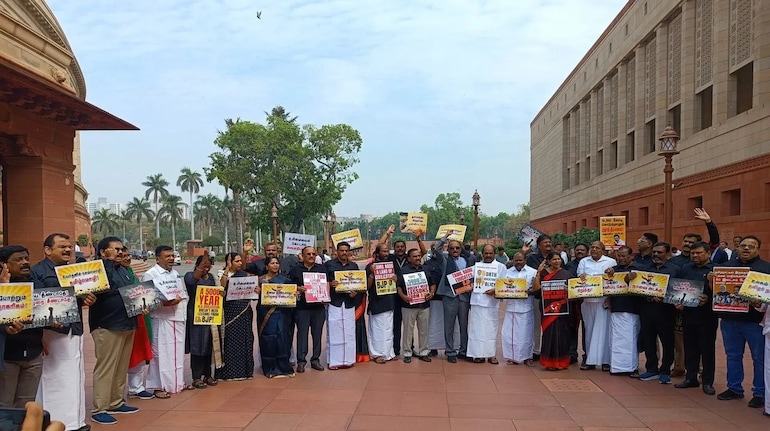
Thus, it was no surprise that DMK MPs attended Parliament on March 11 dressed in black and protested against the three-language formula under the NEP and the Union Education Minister Dharmendra Pradhan's “language” calling the DMK government “dishonest” and its party MPs “uncivilised”.
The MPs also carried placards like ‘Tamil Nadu educates, BJP manipulates’ and ‘A 5000 year old civilisation doesn't need lessons from BJP' to resist the union government’s attempts to force Hindi on the southern people and its arm-twisting way of not releasing the education funding until Tamil Nadu implemented the NEP 2020.
The architect of the Dravidian movement and DK founder, EV Ramasamy Periyar had introduced the wearing of black as a display of grief and resistance. On the casteist social structure, Periyar reasoned that the people in the lower levels were yet to be free from enslavement from Brahmanism and other casteist hierarchy, even though India attained independence. Wearing black is a way of challenging birth-based discrimination.
Taking a step forward, the DMK's addition of red, not only symbolised change, but also represented the working class and its liberation from subjugation - the element of socialism and communism. Indeed, the late DMK leader and former Tamil Nadu Chief Minister M Karunanidhi had once observed that if he had not been with the DMK, he would have been a communist.
But, he too wore black shirt as a symbol of protest on various occasions. He often said that when Periyar called for the formation of a ‘black shirt army’ in 1945, he was the first to enroll as its member. Even a few years before his death he wore black shirts for four days in protest against the ruling Jayalalithaa government in the state.
While the DK members still wear black shirts (the organisation’s current leader K Veeramani is never seen without it), while breaking away and forming the DMK, Annadurai chose to follow regular clothing and black shirts only during protests. In fact, Annadurai was not wearing a black shirt on the day of the enrollment into the ‘black shirt army’ in 1945 and Karunanidhi became the first member of that brigade. Again, on August 15, 1947 - the day of India’s Independence - Periyar declared it a black day and asked all DK members to observe it by wearing black shirt. But Annadurai and his followers refused to do so.
The custom of wearing a towel/shawl around the neck emerged in Tamil Nadu, also as a form of protest. When a zamindar, who was the sponsor of a concert, objected to the nadaswaram player placing a towel on his shoulder to wipe sweat off his face, an enraged Periyar, who was also at the concert, walked out in a huff. The next day he asked all DK members to wear a towel around their neck to counter the angavastram - a shawl covering worn by the upper castes. Thus began the culture of wearing a ‘thundu’ on the shoulder or around the neck by politicians in the state.
Clothes and their colour are thus of great political import in Tamil Nadu.
Discover the latest Business News, Sensex, and Nifty updates. Obtain Personal Finance insights, tax queries, and expert opinions on Moneycontrol or download the Moneycontrol App to stay updated!
Find the best of Al News in one place, specially curated for you every weekend.
Stay on top of the latest tech trends and biggest startup news.