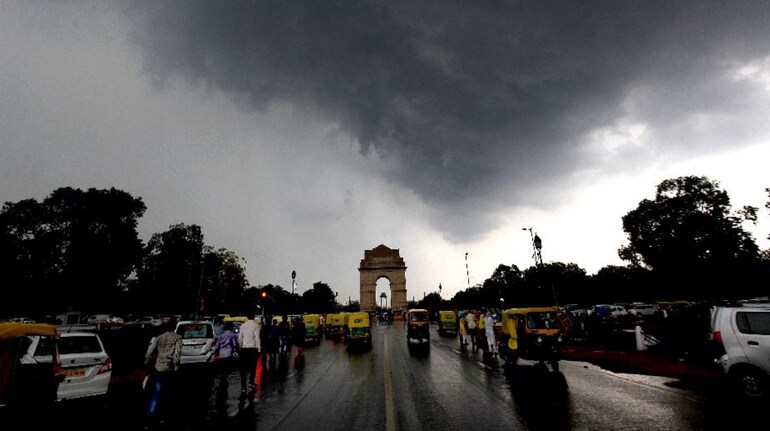
A fierce and unanticipated storm swept through Delhi-NCR in the early hours of Friday, unleashing powerful winds of up to 80 kmph and drenching the city with 77 mm of rain.
The downpour, occurring within a few hours, marked Delhi’s second-wettest day in May in more than 120 years. The scale and timing of the weather event caught residents - and even the Indian Meteorological Department (IMD) - by surprise.
Notably, the storm's intensity was the result of an unusual alignment of meteorological forces rarely seen together over the region.
IMD Director General Mrutyunjay Mohapatra acknowledged that while rainfall for the region had been forecast in advance, the ferocity of the storm that hit Delhi-NCR early Friday morning had not been predicted. “We had expected rainfall, but not this level of intensity. Thunderstorms, by nature, are highly unpredictable, especially in medium- and long-range forecasts,” he said, as cited in a report by The Print.
According to the IMD, the disturbance was driven by a rare dual inflow of moisture from both the Arabian Sea and the Bay of Bengal — an uncommon occurrence. This was made possible by two cyclonic circulations located over Rajasthan, which acted like twin engines pulling moisture from both sides of the subcontinent.
Detailing the meteorological conditions behind the storm, Mohapatra said the region saw a rare influx of moisture from both the Arabian Sea and the Bay of Bengal — a result of twin cyclonic circulations over Rajasthan. “It’s unusual for northwest India to receive simultaneous moisture from both seas,” he says.
He added that the extreme heat in western Rajasthan further destabilised the atmosphere, while powerful upper-level westerly winds — blowing at over 120 kmph at altitudes of 6 to 12 kilometers — added fuel to the storm. “A passing western disturbance acted like a spark, and all these elements coming together created the perfect conditions for an exceptionally strong storm,” Mohapatra explained.
Adding to this already volatile mix was a western disturbance — a large-scale weather system that typically brings rain and storms to northern India. Its arrival acted as a trigger that helped ignite the atmospheric conditions into a full-blown thunderstorm.
Explaining the forecasting challenge, Mohapatra pointed out that such severe weather events typically only show up in short-term nowcasts, which are issued just a few hours before impact. “These systems evolve rapidly, making it difficult to predict their strength well in advance,” he noted.
At higher altitudes, westerly winds roaring at speeds over 120 kmph added to the storm’s force, while heat over western Rajasthan added further instability to the air mass.
While the IMD had issued general forecasts for rain in the days leading up to the storm, its true intensity wasn’t captured until much later.
Even at 2:30 am on Friday, just hours before the storm hit, the weather agency had only predicted light rain and thunderstorms.
In reality, however, between 2:30 am and 5:30 am — the most severe period — Delhi’s Safdarjung weather station logged 60 mm of rain. An additional 17 mm followed in the next three hours, pushing the day’s total to 77 mm.
This 24-hour rainfall was not only the second-highest for May since records began in 1901, but also the most rain Delhi has received in a single day since August 29, 2024, when 77.1 mm was recorded during the monsoon.
Going ahead, the IMD expects the wet spell to continue into the weekend.
While wind speeds are unlikely to reach Friday’s levels, light to moderate showers, along with thunderstorms, have been forecast for the region.
The storm has also brought a remarkable drop in temperatures. In some areas, minimum temperatures have fallen by 5 to 6 degrees Celsius, and a similar cooling effect is expected in daytime highs over the next few days.
Mohapatra has also urged the public to treat IMD warnings with seriousness, particularly when an orange alert is issued. “An orange alert means there is a real possibility of intense weather. It’s a signal to stay vigilant,” he noted.
Discover the latest Business News, Sensex, and Nifty updates. Obtain Personal Finance insights, tax queries, and expert opinions on Moneycontrol or download the Moneycontrol App to stay updated!
Find the best of Al News in one place, specially curated for you every weekend.
Stay on top of the latest tech trends and biggest startup news.