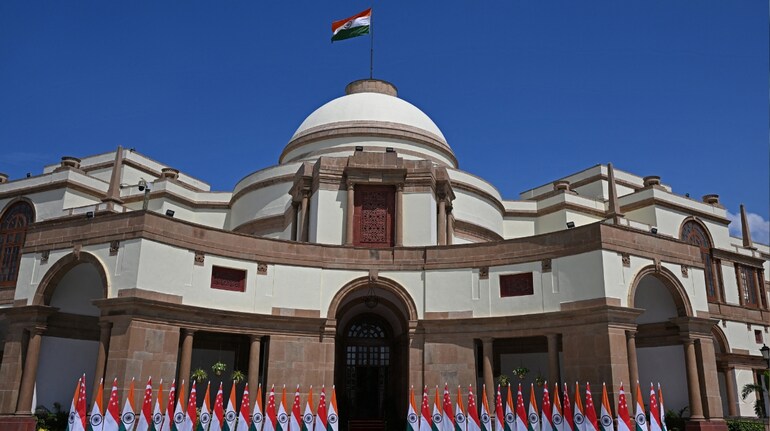
The sprawling Hyderabad House in Lutyens Delhi will be the venue for high-level talks between Prime Minister Narendra Modi and Russian President Vladimir Putin on Friday.
The nearly 100-year-old architectural landmark, spread across 8.2 acres, is thrust into the spotlight every time global leaders arrive in India on a state visit. Once the Delhi residence of the Nizam of Hyderabad, it is now synonymous with the country’s most important bilateral engagements.
However, not many know that long before Hyderabad House became the backdrop for India’s most high-stakes diplomatic engagements — from state banquets for presidents to closed-door conversations between world leaders — it was simply a princely mansion built for a young royal who was never meant to rule.
In 1928, British architect Sir Edwin Lutyens was redesigning New Delhi for the Empire. Among the grand bungalows rising in the capital’s new “Imperial City” was a magnificent residence commissioned by Mir Osman Ali Khan, the last Nizam of Hyderabad.
According to historical accounts, the Nizam of Hyderabad had grown tired of the makeshift tent cities that were erected whenever he would visit Delhi. He sought land near the Viceroy's House (now Rashtrapati Bhavan), purchasing 8.2 acres and later adding a neighbouring 3.73-acre plot.
While the land was acquired due to the Nizam’s own discomfort and prestige concerns,
the mansion itself was commissioned specifically as a Delhi residence for his heir, Azam Jah, a quiet, reluctant noble who preferred a low-profile life.
The Nizam wanted his heir to have a presence in the national capital — a statement of princely stature amid Delhi’s new power corridors.
Lutyens built a structure combining Indo-Saracenic arches with classical symmetry.
The Hyderabad House — shaped like two interlocking octagons — stood out not just for its scale but for the Nizam’s trademark opulence. It boats of teak-panelled halls, sprawling courtyards, marble floors and cavernous dining rooms designed for royal entertaining.
At a time when Hyderabad was among the richest regions in the world, the house symbolised the Nizam’s wealth and political importance.
How independence changed everything
After 1947, when princely privileges were being renegotiated, the Government of India took over several properties from erstwhile royals in Delhi, including Hyderabad House.
The Nizam, grappling with both political pressure and the complexities of Hyderabad’s accession, had bigger priorities to deal with. His Delhi mansion eventually became part of government holdings.
By the 1950s, Hyderabad House had been repurposed for state use. Its grand ballroom turned into a summit hall.
The dining rooms became venues for banquets hosting heads of state.
Over the decades, deals worth billions and decisions shaping India’s global partnerships have been negotiated within its sandstone walls.
Today, when a world leader visits New Delhi, the motorcade often halts at Hyderabad House — now the ceremonial heart of Indian diplomacy.
Discover the latest Business News, Sensex, and Nifty updates. Obtain Personal Finance insights, tax queries, and expert opinions on Moneycontrol or download the Moneycontrol App to stay updated!
Find the best of Al News in one place, specially curated for you every weekend.
Stay on top of the latest tech trends and biggest startup news.