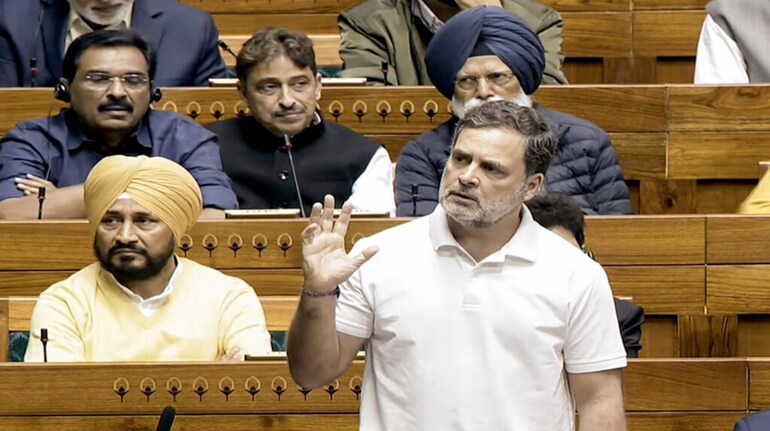

The political tension in Parliament reached its peak on February 12. BJP MP Nishikant Dubey introduced a motion calling for the immediate expulsion of the Leader of the Opposition, Rahul Gandhi, from the Lok Sabha.
Dubey has demanded the cancellation of Gandhi's Lok Sabha membership and a lifetime ban from contesting elections. But the big question is: "Can a sitting member actually be removed from the Lok Sabha?"
How Can an MP Lose Membership of Parliament?
An MP can lose membership under several constitutional and legal provisions.
Disqualification Under the Constitution (Article 102) A Member can be disqualified for holding an office of profit, being of unsound mind, being an undischarged insolvent, or not being a citizen of India.
Disqualification Under the Anti-Defection Law (Tenth Schedule) A Member can be disqualified if they voluntarily give up membership of their political party, vote or abstain against the party whip without permission, an independent Member joins a political party after election, or a nominated Member joins a party after six months.
Disqualification After Criminal Conviction (RPA, 1951)
If an MP is convicted by a court and sentenced to two years or more, they are immediately disqualified from the date of conviction and cannot contest elections for six years after release.
Expulsion By The House
The Lok Sabha has the power to expel its members for serious misconduct or actions that damage the dignity of Parliament. This authority flows from Article 105 of the Constitution and parliamentary rules, even though expulsion is not explicitly mentioned in the Constitution.
A Member may be expelled for corruption, bribery, misuse of position, contempt of the House, serious unethical conduct, or misconduct proven through inquiry. Expulsion is a rare and extreme step, but an expelled Member may contest elections again unless separately disqualified under law, such as in the case of criminal conviction.
Election Declared Void by Court
An MP can also lose membership if a High Court sets aside their election due to malpractice, fraud, or violation of election laws.
How The Expulsion Process Works
The process usually begins when a complaint is made against a sitting Member. The Ethics Committee or Privileges Committee conducts a detailed probe, examines evidence, and gives the Member an opportunity to defend themselves. If the committee finds the Member guilty and recommends expulsion, a motion is moved in the Lok Sabha to accept the recommendation. If a majority of Members support the motion, the Member is expelled.
In 2005, eleven MPs were expelled in the cash-for-query scandal, marking one of the largest mass expulsions in Indian parliamentary history. More recently, TMC MP Mahua Moitra was expelled following an Ethics Committee inquiry in connection with the cash-for-query case.
Discover the latest Business News, Sensex, and Nifty updates. Obtain Personal Finance insights, tax queries, and expert opinions on Moneycontrol or download the Moneycontrol App to stay updated!
Find the best of Al News in one place, specially curated for you every weekend.
Stay on top of the latest tech trends and biggest startup news.