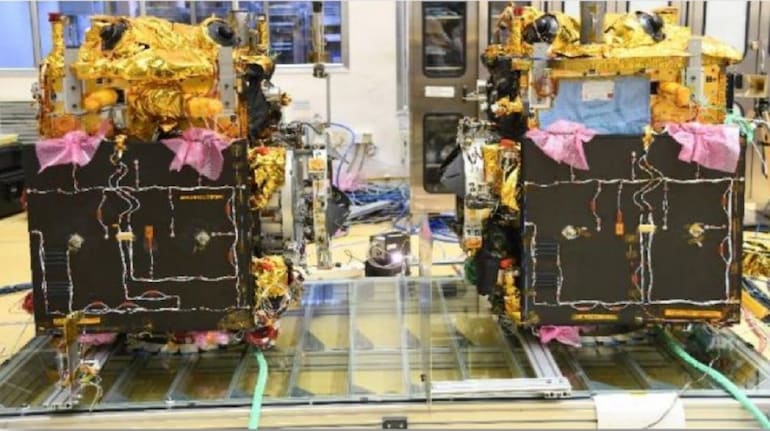
The Indian Space Research Organisation (ISRO) is set to conduct a docking experiment in space for the first time. The space agency’s two satellites, the Chaser and Target, prepare to dock in orbit on January 9.
Launched on December 30, 2024, the project is aimed at mating these two homegrown satellites together in space to make one spacecraft. This venture can also be referred to as "ISRO's Ballet in Space", or an "antariksha jugalbandi".
What is space docking?
It is a process in which two fast-moving spacecraft are manoeuvred into the same orbit. They are then brought closer together, and finally joined with each other. Docking is needed for missions that require heavy spacecraft and equipment that cannot be launched in one go.
The Indian Space Research Organisation (ISRO) will bring 2024 to a close with a mission that is a critical step towards achieving several future goals — bringing back a lunar sample, setting up a space station, and sending a human to the Moon.
On December 30, ISRO demonstrated for the first time its ability to bring together and join two satellites in space.
The SpaDeX (Space Docking Experiment) mission was launched with ISRO’s workhorse PSLV rocket lifts off from the first launch pad of the Sriharikota spaceport. The mechanism is designed to execute a "hugging" action, ensuring a secure connection between the two spacecraft.
How will the experiment be conducted?
Two small, identical satellites, each weighing around 220 kg, will be launched in a 470-km circular orbit. Once the satellites have been injected, the launch vehicle will provide a small relative velocity between them, allowing the satellites to drift away from each other. Both satellites are equipped with a suite of special homegrown ranging and tracking sensors.
The satellites will be flying at 28,800 kmph. But since both travel together, they will appear stationary to each other as the relative velocity is what matters. Once the docking process begins, the satellites will be progressively brought closer.
The Chaser will approach the Target with progressively reduced inter-satellite distances of 5 km, 1.5 km, 500 m, 225 m, 15 m, and 3 m, ultimately leading to the precise docking of the two spacecraft, according to NDTV.
When the docking happens, the Chaser will inch closer to the Target. Then the special clasps will hold the satellites together in a tight embrace.
What does it mean for India?
Successful completion of the SpaDeX mission would not only demonstrate India's growing prowess in space technology but also lay the groundwork for future endeavors such as satellite servicing and the establishment of India's Bharatiya Antariksha Station. Till now, only Russia, the US, and China have perfected the process.
Discover the latest Business News, Sensex, and Nifty updates. Obtain Personal Finance insights, tax queries, and expert opinions on Moneycontrol or download the Moneycontrol App to stay updated!
Find the best of Al News in one place, specially curated for you every weekend.
Stay on top of the latest tech trends and biggest startup news.