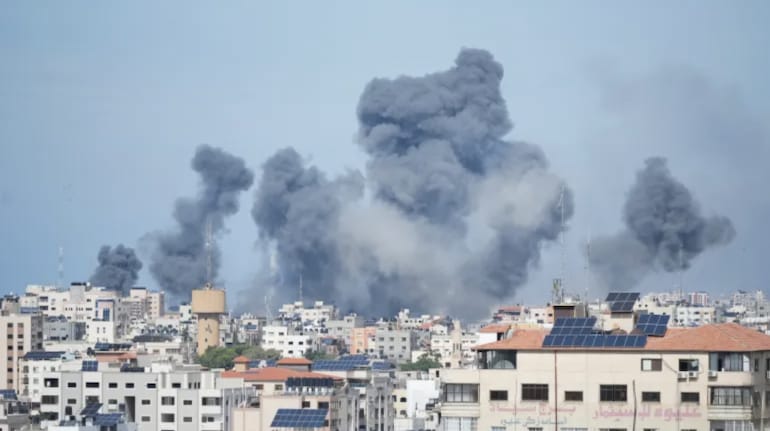
The war in West Asia has sharply divided opinion between India’s main political parties, rupturing an otherwise united front on foreign policy issues regardless of their differences over domestic affairs.
The October 7 attack that sparked the war between the Israelis and Hamas fighters led the ruling Bharatiya Janata Party to quickly back Israel, while the main opposition Congress party stressed support for the Palestinian people.
Prime Minister Narendra Modi was among the first leaders in the world to criticise the Hamas attack on Israel, calling it a terrorist act. He made it clear that India stood firmly beside Israel and was willing to extend it all help.
There was no mention of the Palestinian cause or the need for peace in his remarks. Modi expressed the same sentiment on October 9, when Israeli Prime Minister Benyamin Netanyahu telephoned to apprise him of the situation.
The only addition was Modi’s concern for the safety and security of 18,000 Indians who worked and lived in Israel. India has now launched Operation Ajay to evacuate Indians stranded in Israel.
The Congress Working Committee subsequently expressed “dismay and anguish” over the war and underlined its support for the Palestinian people’s right to land and self-government and to live with “dignity and respect.”
Criticism of Congress
Though it condemned the attack on Israel, it did not mention Hamas or hold it responsible for the assault and slaughter of innocent people in Israel. The BJP said the Congress’s decision not to mention Hamas was another instance of the party’s Muslim appeasement policy.
Congress general secretary Jairam Ramesh said his party believed the legitimate aspirations of the people of Palestine must be fulfilled through dialogue while ensuring the national security concerns of Israelis. However, the BJP claimed the Congress supported Hamas.
“Congress CWC resolution on the Israel war is a classic example of how Indian foreign policy was hostage to Congress’s minority vote bank politics,” BJP MP Tejasvi Surya said. He said the change started only after Modi came in 2014 and warned that things could go back to where they were if “we aren’t vigilant in 2024.”
The division between the two main political rivals comes as five states – Chhattisgarh, Madhya Pradesh, Mizoram, Rajasthan and Telangana – prepare for assembly elections in November. The BJP’s strong stand on terrorist acts as against the Congress’s attempt to stress on the legitimate Palestinian demand for a homeland could become part of the election campaign.
According to people aware of the matter, the Israel-Hamas conflict was the focus of a debate at the Congress Working Committee meeting. Party leaders were sharply divided over whether to mention Hamas in the statement. Ultimately, it was kept out, a decision that led to criticism by BJP leaders.
India established full diplomatic relations with Israel in 1992. In the following years, New Delhi’s statements on the West Asia crisis found more balance and were not tilted towards the Palestinians, as in the past.
Israel is now considered a reliable strategic partner of India by all political parties. Bilateral relations with Israel have been highlighted more frequently since 2014, while support for the Palestine issue was diluted.
In recent years, Modi and Netanyahu have formed a personal chemistry and special bond. Modi became the first Indian Prime Minister to visit Israel. Before that, he visited Arab countries.
Many Indian commentators argue that while Israel has stood by India whenever it faced challenges from external adversaries, the Palestinians rarely offered support at international or regional meetings when the country was criticised on the Kashmir issue. Not surprisingly, India hasn’t hesitated to offer unqualified support to Israel during this time of crisis, they said.
However, many diplomats contend that India should adopt a balanced approach as it has many friends and well-wishers in the Arab and Muslim world.
On Thursday, the Indian foreign ministry appeared to go back to a more balanced approach to the conflict. The Ministry of External Affairs spokesman Arindam Bagchi said, “Our policy has been longstanding and consistent.”
He added that India always advocated resumption of direct negotiations towards establishing a sovereign, independent and viable state of Palestine, living within secure and recognised borders, side by side at peace with Israel.”
Bagchi pointed out, “I think that position remains the same.”
In recent years, many Arab countries have also normalised relations with Israel.
More countries could have normalised ties with Israel, such as Saudi Arabia, which is the leader of the Sunni Muslim world and custodian of the two holy mosques in Mecca and Medina. But after the war broke out, they have been forced to pull back and reiterate their support for the Palestinian cause.
Experts said this support could get stronger if the war intensifies. Moreover, large-scale deaths of innocent civilians and destruction of property in Gaza could turn the sympathy of the Arab countries and other nations away from Israel and steadily towards Palestine. Much will depend on how and when the conflict ends and peace talks start.

Discover the latest Business News, Sensex, and Nifty updates. Obtain Personal Finance insights, tax queries, and expert opinions on Moneycontrol or download the Moneycontrol App to stay updated!
Find the best of Al News in one place, specially curated for you every weekend.
Stay on top of the latest tech trends and biggest startup news.