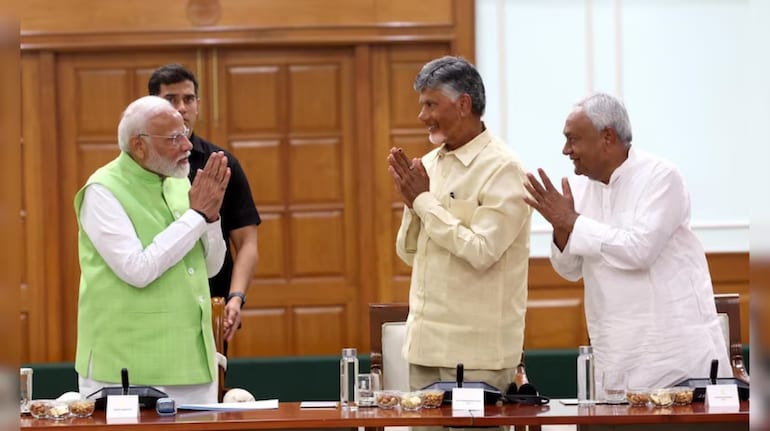
The passage of the Waqf Amendment Bill in both houses of Parliament has allowed the Bharatiya Janata Party led by Prime Minister Narendra Modi to not only further its ideological agenda but also shun the myth that the NDA's third consecutive term in power would go slow on the reforms agenda.
When the Lok Sabha election results were announced less than a year ago on June 4, many saw the BJP's dependence on allies like Nitish Kumar's JD(U) and Chandrababu Naidu's TDP as a sign of PM Modi going slow on his reforms agenda.
The JD(U) and TDP, parties which collectively command 28 MPs in the Lok Sabha, haven't seen eye to eye with the BJP on issues close to the saffron party's core agenda. With both parties having openly aired their differences over the Uniform Civil Code, there was an assumption (even within the JDU) that the BJP would be unable to get the Waqf Bill passed in Parliament.
However, back-room meetings and a constructive outreach well before time is what it took the BJP to get its allies to back the Waqf Amendment Bill in Parliament, despite both TDP and JD(U) being heavily dependent on Muslim votes.
A report in the NDTV said that prior to introducing the bill in August last year, senior ministers had informed the TDP and JD(U) leadership about its importance. They also consulted leaders from allies Chirag Paswan's Lok Janshakti and Jayant Chaudhary's Rashtriya Lok Dal, explaining its necessity and emphasizing that it was aimed at protecting Muslim interests and ensuring women's rights, rather than effecting a polarisation among communities as the Opposition has alleged.
Although the allies were broadly on board on the larger contours of the Bill, they pointed out certain concern areas that the Bill eventually addressed. The BJP's readiness to send the Bill to the Joint Parliamentary Committee also appeared to be part of the party's intent to convince allies that it was ready to incorporate some crucial suggestions that they had made.
The concerns aired by the JD(U) and the TDP primarily centred around the impact on existing Waqf properties and encroachment on state governments' rights. Of the 14 amendments that the JPC finally incorporated in the revised Bill, a significant number was of those suggested by the TDP and JD(U).
These included doing away with the retrospective application of the Bill in order to avoid interference with existing mosques, shrines, or other Muslim religious sites besides giving states the freedom in terms of dispute resolution and extending the timeline or uploading Waqf-related documents on the portal. The changes were incorporated in the Bill, eventually leading to the Cabinet's approval to the Bill and its passage in Parliament.
During the debate on the Bill, senior JD(U) leader Lallan Singh strongly backed the Bill and dismissed concerns that it was against any community. the TDP also supported the bill, stating that it was in the interests of Muslim women, youth, and marginalised communities. Other BJP allies, including LJP, Hindustan Awam Morcha, and the RLD, also aligned with this stance.
The support from TDP and JD(U), allowing the passage of a Bill that the Opposition has tried tooth and nail to paint as "anti-Muslim" and "anti-Constitution", has come as a huge victory for the BJP and another boost for brand Modi.
The passage of the Waqf Bill, with all BJP allies on board, signals continuity in PM Modi's leadership, establishes that the BJP under Modi is firmly in the saddle while getting the message across that the government has the intent and the capability to take allies along and not allow the reforms process to be derailed.
Discover the latest Business News, Sensex, and Nifty updates. Obtain Personal Finance insights, tax queries, and expert opinions on Moneycontrol or download the Moneycontrol App to stay updated!
Find the best of Al News in one place, specially curated for you every weekend.
Stay on top of the latest tech trends and biggest startup news.