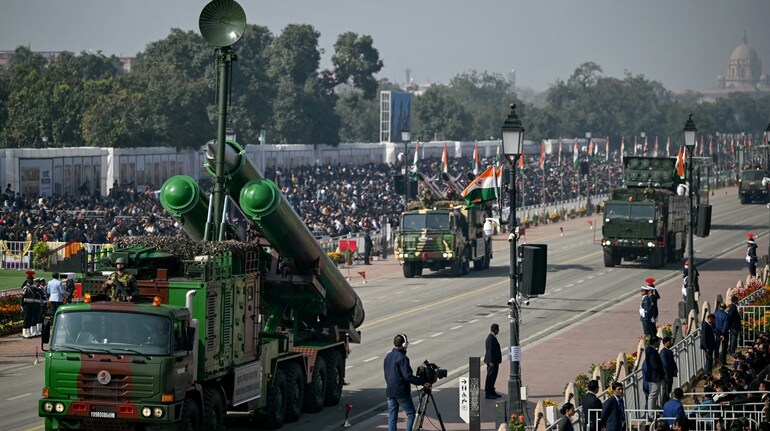

India’s armed forces are working on a long-term transformation plan under Defence Forces Vision 2047, a framework aimed at modernising the military and preparing it for future warfare, released by Defence Minister Rajnath Singh on March 10. The roadmap outlines how the Indian defence establishment intends to evolve its capabilities over the next two decades through structural reforms, technological upgrades and integrated operations.
The document is separate from a National Security Strategy and focuses specifically on building military capacity and operational effectiveness by 2047.
The roadmap titled ‘Defence Forces Vision 2047’, uploaded on the Headquarters Integrated Defence Staff (HQ IDS) website, outlines how India’s military plans to evolve in terms of organisation and technology over the next two decades.
The document proposes creating four new tri-service bodies: a Defence Geo-Spatial Agency, a Data Force, a Drone Force, and a Cognitive Warfare Action Force. These plans highlight the increasing importance of data, unmanned systems and information or perception warfare in modern conflicts.
The vision divides the transformation into three phases while laying out several priority areas including technology development, joint military structures, cyber and space warfare capabilities and modern battlefield preparedness.
Three phases of military transformation
The plan breaks the transformation into three stages.
The first phase, running until 2030, is described as the Era of Transition. During this period, the focus will be on initiating reforms and laying the foundation for structural and technological upgrades.
The second phase, from 2030 to 2040, is referred to as the Era of Consolidation, where the armed forces aim to strengthen and integrate the capabilities developed in the first stage.
The final phase, from 2040 to 2047, is described as the Era of Excellence, where the objective is to achieve a highly capable and technologically advanced military force.
Focus on technology and indigenous development
One major component of the vision involves expanding India’s technological capabilities in defence.
The armed forces aim to formalise the Integrated Capability Development Plan (ICDP) and establish a Technology Perspective and Capability Roadmap (TPCR) to guide long-term development.
The roadmap emphasises indigenous research and development, particularly in niche and complex technologies.
There is also a strong focus on incorporating emerging and disruptive technologies, including drones, counter-drone systems and autonomous intelligent platforms.
The armed forces also plan to invest heavily in intelligent systems and advanced combat assets that can act as force multipliers.
Preparing for future battlefields
The strategy also focuses on preparing the military for high-intensity conflicts and modern warfare environments.
The armed forces aim to create surge capacities that would allow them to sustain prolonged and high-intensity operations.
Another concept highlighted in the roadmap is “tactics-led modernisation,” which suggests that modernisation efforts will be guided by operational needs and battlefield experience.
The military also plans to strengthen its capabilities in the electromagnetic spectrum and enhance preparedness for chemical, biological, radiological and nuclear threats.
There are also plans to develop a tri-service strategy for war wastage reserves, including decisions on storage locations and stock levels.
Expanding air and missile defence
Air defence and missile defence systems are also expected to play a key role in the long-term strategy.
The armed forces aim to expand ballistic missile defence and air defence systems as part of Mission Sudarshan Chakra.
These systems are intended to strengthen deterrence and protect critical infrastructure and military assets from aerial and missile threats.
Strengthening deterrence and border infrastructure
The roadmap also outlines plans to strengthen deterrence capabilities through the acquisition of advanced combat assets and intelligent platforms.
The armed forces plan to develop national and theatre level strategies for potential threats.
Infrastructure development is also a key priority. The vision includes plans to build resilient border infrastructure and strengthen coastal surveillance systems.
The roadmap also mentions introducing Air Defence Areas over maritime zones to improve security in coastal and ocean regions.
Expanding space, cyber and data warfare capabilities
A major shift in the vision is the growing emphasis on new domains of warfare.
The armed forces plan to create several specialised institutions including a Defense Geo-Spatial Agency, a Data Force, a Drone Force and a Cognitive Warfare Action Force.
There are also plans to establish a Space Command and a Cyber Command, reflecting the increasing importance of these domains in modern military operations.
In addition, the armed forces aim to develop resilient cyber defence networks capable of self healing during attacks.
Strengthening maritime and space surveillance
The plan also includes expanding India’s Underwater Domain Awareness, including Seabed Domain Awareness, from territorial waters to the Exclusive Economic Zone and beyond.
At the same time, terrestrial warfare capabilities will be augmented with space-based systems that support intelligence, surveillance and reconnaissance, as well as positioning, navigation, timing and communication.
The armed forces also aim to expand the operational envelope of airspace to include near space.
Joint structures and integrated command
Another important aspect of the vision involves organisational reforms within the military.
The roadmap calls for raising a Joint Headquarters and operationalising a Joint Operations Coordination Centre.
It also proposes separating force generation from force application by creating integrated structures responsible for operational command and control.
This shift is aimed at improving coordination between the Army, Navy and Air Force and enabling more effective joint operations.
A roadmap for the future
Overall, Defence Forces Vision 2047 outlines a broad roadmap for transforming India’s military into a more integrated, technologically advanced, and future-ready force.
The plan highlights the growing importance of emerging technologies, multi-domain warfare, and joint military structures in shaping the country’s defence strategy over the coming decades.
Discover the latest Business News, Sensex, and Nifty updates. Obtain Personal Finance insights, tax queries, and expert opinions on Moneycontrol or download the Moneycontrol App to stay updated!
Find the best of Al News in one place, specially curated for you every weekend.
Stay on top of the latest tech trends and biggest startup news.