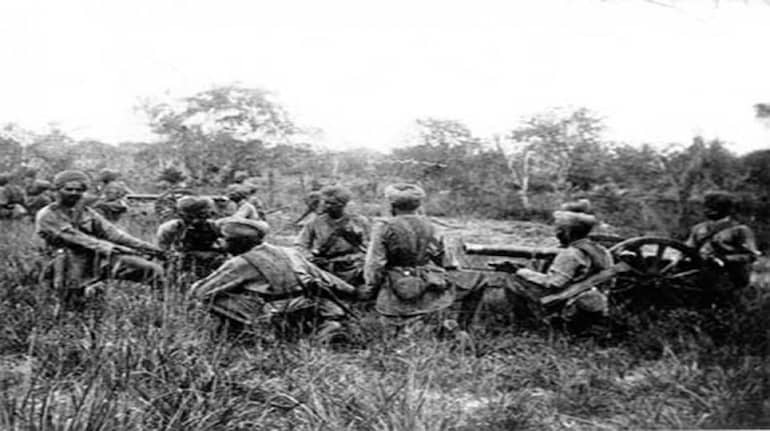
The defence of Baramulla delayed the tribal lashkar long enough for India to airlift troops into Srinagar and prevent the Valley’s collapse. Those crucial hours reshaped the opening phase of the 1947-48 war and ensured India could secure Kashmir.
Why Baramulla mattered in the opening days of the Kashmir war
In late October 1947, the future of Kashmir balanced on a knife’s edge. The tribal lashkar, backed by Pakistani elements, had swept through Muzaffarabad and Domel with alarming speed. Their objective was clear: capture Srinagar, seize its airfield and ensure that no Indian troops could ever be flown into the Valley. Baramulla, the last major town on the road before Srinagar, suddenly became the critical bottleneck. Its defence — disorganised, improvised and outnumbered — would become one of the most consequential delaying actions in modern Indian military history.
The sudden collapse of the frontier and the advance toward Baramulla
The crisis began on October 22, when thousands of tribal fighters stormed across the frontier into Kashmir. The small State Forces units posted at Muzaffarabad were overwhelmed within hours. Communications collapsed, officers were killed or ambushed and defensive lines evaporated. The tribesmen advanced along the Jhelum Valley Road, their path pointing directly toward Baramulla and from there to Srinagar. Kashmir’s Maharaja, stunned by the scale of the assault, had few troops left and almost no reserves to plug the breaches.
By October 25, panic had swept through the Valley. Refugees poured into Srinagar bringing stories of looting, massacres and villages burnt to the ground. With each passing hour, the lashkar drew closer to Baramulla, and beyond that lay only a narrow road, light defences and the vulnerable heart of Kashmir. If Srinagar fell, the Valley — and the political question of its accession — might be irreversibly altered. At this moment, the defence of Baramulla became the only barrier between order and collapse.
Baramulla before the storm: a town bracing for the worst
Baramulla was neither fortified nor prepared for a major battle. The Dogra State Forces had suffered heavy losses in earlier engagements, leaving only scattered detachments to defend the town. Townspeople could hear distant gunfire as the lashkar approached; rumours of atrocities elsewhere caused many residents to flee. Those who stayed waited for reinforcements that never came. Ammunition was limited, communications fragile, and morale strained. Still, the Dogra units, joined by police and local volunteers, formed hasty positions across key entry points into the town.
The commanders on the ground knew exactly what was at stake. If they could not slow the advancing lashkar, Srinagar would be exposed the very next day. The airfield — the only viable entry point for Indian forces — would be lost before New Delhi could react. The defence of Baramulla was not about victory; it was about time.
The tribal lashkar strikes Baramulla
On October 26, the tribal fighters launched their assault. The initial clash was fierce, particularly near the outskirts of the town, where Dogra detachments attempted to block the road with small-arms fire. The defenders fought from narrow streets, stone houses and improvised barricades, forcing the attackers to dismount and clear the town block by block.
What should have been a swift advance turned into a chaotic, drawn-out struggle. The defenders’ resistance — though limited — forced the lashkar to commit time and manpower to securing the town instead of bypassing it. The fighting broke the rhythm of the tribal advance, giving the first crucial delays that would later prove decisive.
Looting and indiscipline halt the lashkar’s momentum
But an even bigger delay came from within the enemy columns themselves. Once inside Baramulla, large sections of the lashkar broke formation and began widespread looting. Homes were ransacked, markets stripped, and civilians attacked. Hospitals, convents and mission stations were plundered. Indiscipline among the attackers, which Indian planners could not have foreseen, halted their advance more effectively than any defence could have. Instead of pushing through toward Srinagar, the lashkar spent almost two full days in Baramulla.
This pause changed the course of the war. The tribal leadership lost control, cohesion deteriorated and their momentum — the strongest asset of a raiding force — dissolved in the anarchy that followed. Those two days became the difference between Srinagar falling and Srinagar being saved.
How Baramulla bought India time to airlift troops
Back in Delhi, Kashmir’s Maharaja finally signed the Instrument of Accession. But signing the document was not enough; troops had to reach Kashmir before the lashkar did. India had only a narrow window to mount an airlift — an operation that required the Srinagar airfield to remain secure at all costs.
Every hour counted.
Because the lashkar stalled in Baramulla, Indian planners were able to assemble transport aircraft, load the first Sikh battalion and fly them into Srinagar at dawn on 27 October. If Baramulla had fallen quickly and the lashkar had continued its advance, the airfield would have been overrun before the first Dakota ever reached the Valley.
Instead, when the first Indian planes circled the airstrip, they landed safely. Soldiers deployed straight from the runway, fanning out toward vital choke points and locking down Srinagar’s perimeter. Throughout the day, more Dakotas arrived, each unloading fresh troops and supplies. By evening, Indian forces had stabilised the situation around the airfield and begun preparing for counterattacks.
None of this would have been possible if Baramulla had not slowed the tribal advance.
The defenders who held a collapsing line
The defence of Baramulla rested on the courage of battered Dogra units, policemen, and ordinary civilians who resisted until they could no longer hold. Their positions were eventually overrun, but they inflicted casualties, disrupted the tribal formations and prevented a rapid push to Srinagar. Their stand was not a victory in the traditional sense, but it achieved its purpose: it denied time to the attackers and gifted it to the defenders.
This sacrifice is often overshadowed by later battles — such as Badgam and Shalateng — but without Baramulla, those battles would never have taken place. The town’s defenders fought in isolation, without reinforcements, knowing that their resistance would almost certainly be fatal. They fought to buy hours, and those hours reshaped the entire campaign.
The turning of the tide after Baramulla
Once Indian troops secured the airfield, they began pushing outward. Reinforcements arrived steadily, armour was brought in and defensive positions strengthened. When Indian forces met the lashkar later at Shalateng, the attackers were exhausted, scattered and no longer the cohesive force that had stormed into Kashmir a week earlier. Their delay at Baramulla had cost them the chance to capture Srinagar before India’s military build-up.
From this point onward, the momentum shifted. India now held the Valley’s centre and its only air link. The tribal columns lost the initiative, and from early November onwards, Indian forces were able to push them back along key routes, eventually retaking Baramulla and stabilising the front.
The legacy of the defence of Baramulla
The events in Baramulla illustrate a powerful truth of warfare: battles are sometimes decided not by decisive victories but by the ability to hold long enough for help to arrive. Baramulla was never a conventional defensive triumph. It was a desperate action that succeeded in the one measure that mattered — time.
For India, those hours changed everything. They allowed the airlift, enabled the defence of Srinagar, and shaped the course of the conflict that followed. The defenders of Baramulla — soldiers and civilians alike — played a role far greater than the size of their force or the duration of the battle might suggest.
Their actions turned Baramulla from a tragedy into a strategic turning point, one that ensured India could secure its presence in the Valley and prevent a swift, irreversible takeover by the tribal lashkar. In the long narrative of the 1947–48 war, Baramulla stands as the battle that delayed the enemy just long enough for India to arrive — and stay.
Discover the latest Business News, Sensex, and Nifty updates. Obtain Personal Finance insights, tax queries, and expert opinions on Moneycontrol or download the Moneycontrol App to stay updated!
Find the best of Al News in one place, specially curated for you every weekend.
Stay on top of the latest tech trends and biggest startup news.