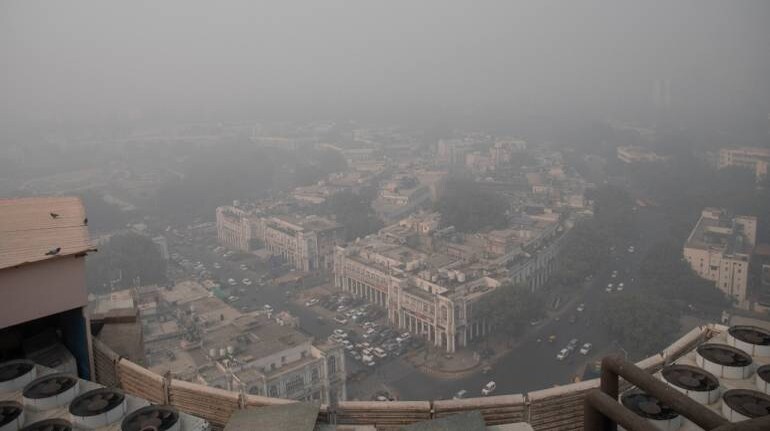
Delhi recorded the worst air quality in four years on the day after Diwali as pollution levels in the city and its suburbs crossed the "emergency" threshold on November 15 due to the combined effect of stubble burning and firecrackers.
However, higher wind speed -- up to 25 kilometers per hour -- and light rainfall under the influence of a fresh Western Disturbance brought some relief.
The air quality had turned "severe" on Diwali evening with stubble burning accounting for 32 per cent of Delhi's PM2.5 pollution, but firecrackers emissions and calm winds made the situation even worse.
Read: Rains bring much-needed relief to air pollution situation in New Delhi
The levels of PM2.5, which is about 3 percent the diameter of a human hair and can lead to premature deaths from heart and lung diseases, were 396 microgram per cubic meter (g/m3) in Delhi-NCR at 6 am, above the emergency threshold of 300 g/m3.
PM2.5 levels stood at 329 g/m3 at 7 pm. The safe limit is 60 g/m3.
PM 10 level stood at 543 g/m3 at 6 am, above the emergency threshold of 500 g/m3, before it started decreasing. It was 441 g/m3 at 7 pm, according to Central Pollution Control Board (CPCB) data. PM10 levels below 100 g/m3 are considered safe in India.
According to the Graded Response Action Plan (GRAP), the air quality is considered in the "severe plus" or "emergency" category if PM2.5 and PM10 levels persist above 300 g/m3 and 500 g/m3 for more than 48 hours.
As per Delhi Pollution Control Committee data, hourly PM10 concentrations soared to 1,636 g/m3 by 1 am at Punjabi Bagh and 1,937 g/m3 by midnight at Jahangirpuri.
A large number of people burst crackers across the national capital and its suburbs on Diwali night, flouting the ban imposed by the National Green Tribunal.
The tribunal had on November 9 imposed a total ban on sale or use of all kinds of firecrackers in the National Capital Region (NCR) from that midnight to November 30 midnight, saying "celebration by crackers is for happiness and not to celebrate deaths and diseases".
The city recorded an overall AQI of 414 on November 14. It had soared to 454 by 10 pm. On Sunday, the 24-hour average AQI stood at 435 at 4 pm, which was the worst on the day after Diwali in the last four years.
Delhi recorded a 24-hour average AQI of 337 on Diwali 2019 (October 27), and 368 and 400 on the next two days. Thereafter, pollution levels remained in the "severe" category for three days on the trot.
In 2018, the 24-hour average AQI (281) on Diwali was recorded in the "poor" category. It deteriorated to 390 the next day and remained in the "severe" category on three consecutive days thereafter.
In 2017, Delhi's 24-hour average AQI on Diwali (October 19) stood at 319. It, however, slipped into the severe zone the next day and stood at 403.
According to India Meteorological Department, Delhi-NCR witnessed light rain on Sunday and higher wind speed under the influence of a fresh Western Disturbance which aided in dispersion of pollutants.
The maximum wind speed was around 25 kilometers per hour on Sunday. It will be around 12 to 15 kmph on November 16 -- which will be favorable for dispersion of pollutants, Kuldeep Srivastava, the head of the IMD's regional forecasting centre, said.
The Ministry of Earth Sciences' air quality monitor, SAFAR, said the magnitude of PM2.5 suggests significant local additional emissions (probably firecracker related) on Saturday night combined with farm fire-related pollutant concentrations led to "such a scenario where hourly average concentrations touched more than 1000ug/m3 at midnight yesterday".
However, the boundary layer wind direction has changed to easterly which is not favourable for stubble fire-related intrusion.
Stubble fires have reduced to around 350 on Sunday compared to around 2,586 a day before. The share of farm fires in Delhi's PM2.5 was around 4 per cent on Sunday.
The Air Quality Early Warning System for Delhi also said the situation is likely to improve significantly on Monday.
Discover the latest Business News, Sensex, and Nifty updates. Obtain Personal Finance insights, tax queries, and expert opinions on Moneycontrol or download the Moneycontrol App to stay updated!

Find the best of Al News in one place, specially curated for you every weekend.
Stay on top of the latest tech trends and biggest startup news.