2024 could be a year to remember, for all the wrong reasons. Next year, global warming could exceed 1.5°C (over pre-industrialization levels) for the first time. This is a critical threshold, and scientists warn that it could have devastating consequences for the planet. We could see more extreme weather events, such as floods, droughts, and heat waves. Sea levels could rise, displacing millions of people. And the world's food supply could be threatened.
In 2015, almost every nation agreed to a binding treaty, the Paris Agreement, to limit global warming to 1.5°C. Failure to meet this goal will be a major setback for the climate movement.
It’s why all eyes are on this year’s Bonn Climate Change Conference (SB58) in Germany, where many hope discussions will be initiated to correct the course we are on. But what all is being discussed at SB58 and what’s India’s position at these talks? Let’s find out.
Key issuesEvery year, climate negotiators meet in Bonn, Germany, for two weeks. This session serves as an important marker on the road to the annual COP climate talks. The outcomes of SB58, which began on June 5 and will conclude on June 15, will give us an indication of what needs to happen in the coming months leading up to COP28 in Dubai.
Some key issues being discussed at SB58 are:
NDCs: Nationally determined contributions or NDCs are the individual plans that countries have submitted outlining their efforts to reduce greenhouse gas emissions and adapt to the impacts of climate change. The Paris Agreement requires countries to strengthen their NDCs every five years.
Climate finance: It is money that is used to help developing countries adapt to the impacts of climate change and to transition to a low-carbon economy. The Paris Agreement requires developed countries to provide climate finance to developing countries.
Loss and damage: The term describes the impacts of climate change that cannot be avoided or adapted to. This can include the loss of life and property due to extreme weather events, the loss of livelihoods, and the loss of ecosystems.
Gender: Women and girls are disproportionately impacted by climate change, and they are often excluded from decision-making processes on climate change. By addressing the gender dimensions of climate change, countries can ensure that everyone benefits from climate action.
There are also discussions happening on capacity-building, climate technology, and land and ocean use, among others. But the buzzword remains the Global Stocktake (GST).
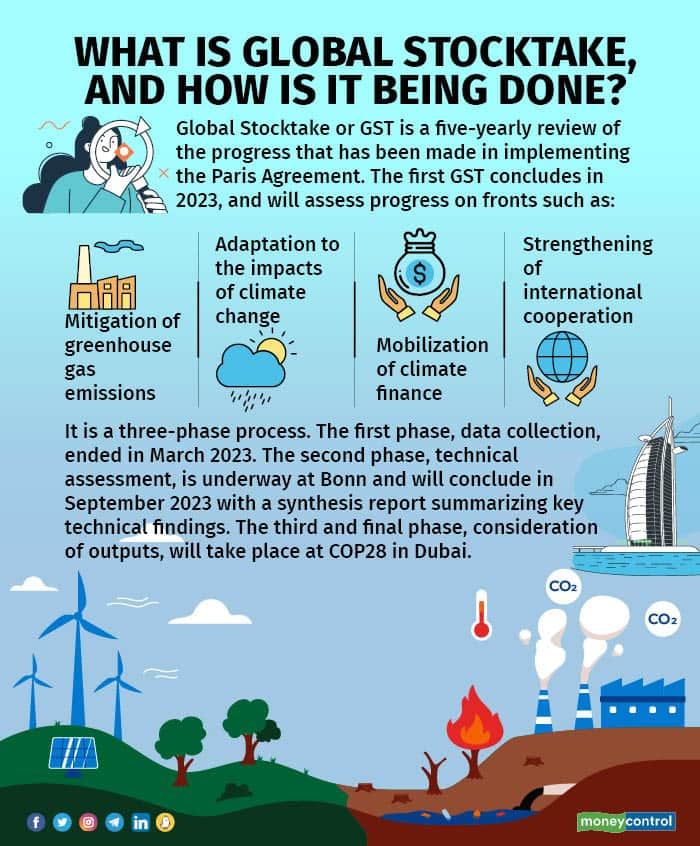
What is the Global Stocktake?The Global Stocktake or GST is a five-yearly review of the progress that has been made in implementing the Paris Agreement. It is a critical part of the Agreement, as it helps countries to assess their progress and identify areas where they need to do more. A well-implemented stocktake can lead to more ambitious NDCs and accelerate climate action.
The first GST concludes in 2023, and the next one is scheduled for 2028. The stocktake will assess progress on a number of fronts, including:
● Mitigation of greenhouse gas emissions.
● Adaptation to the impacts of climate change.
● Mobilization of climate finance.
● Strengthening of international cooperation.
It is a three-phase process. The first phase, data collection, ended in March 2023. The second phase, technical assessment, is underway at Bonn and will conclude in September 2023 with an overarching synthesis report that will summarize key technical findings. The third and final phase, consideration of outputs, is critical, and will take place at COP28 in Dubai.
The technical assessment phase will identify gaps and opportunities in climate action. It can tell how far off the world is from achieving the goals of the Paris Agreement and provide concrete guidance on actions needed to close these gaps. Countries will then have the opportunity to discuss these findings at COP28 and respond to it by adapting their future climate actions.
India’s stand at BonnThere are challenges, though. India, for instance, has said that it does not support any prescriptive messages from the GST on its NDCs. It believes that developing countries have the right to determine their own climate targets.
It has also flagged off concerns related to historical emissions, and raised concerns regarding lack of operationalizing equity in dialogue so far, pre-2020 gaps, and the depletion of the global carbon budget due to disproportionate use and the severe constraints it imposes on low-carbon development in developing countries. Further, it says the Intergovernmental Panel on Climate Change scenarios on global mitigation pathways do not adequately take into account the needs and aspirations of developing countries.
Negotiations are still on. Much work needs to be done. The outcomes at SB58 will set the stage for action in the coming months. Which makes it critical for the climate movement and our planet.
Discover the latest Business News, Sensex, and Nifty updates. Obtain Personal Finance insights, tax queries, and expert opinions on Moneycontrol or download the Moneycontrol App to stay updated!
Find the best of Al News in one place, specially curated for you every weekend.
Stay on top of the latest tech trends and biggest startup news.