The live blog session has concluded. For more news, views and updates, stay tuned withMoneycontrol.com.


MSME Policy Next Highlights: To elaborate, Meesho CFO Dhiresh Bansal explained how in e-commerce, we see that whenever there is a new trend that is catching on, typically, the fashion MSMEs are the first ones to get on that trend quickly and produce relevant items, even if not in large quantities.
The live blog session has concluded. For more news, views and updates, stay tuned withMoneycontrol.com.
Nupur Goenka, Executive Director of Tally Solutions, says: “When it comes to broad spectrum of MSMEs, technologies should not change the way the MSMEs work… The technology should not just be demo-able but also applicable.”
“When MSME owner starts using the tech and there is lack of customer support and friction, he will reject it. If we can solve connectivity for business data, how businesses transact will change.”
Let MSMEs come and make our industries their laboratories. The compliances and laws need to be rewritten for the growth of MSMEs, says Ravi Sood, president of Badli Indl Estate Association
Dhiresh Bansal, CFO of Meesho, said that MSMEs have an appetite to bring in new products or technologies and to make that happen, they have the advantage of speed. Their ability to work with lesser overheads help them in this regard, he added.
For example, he explained, in e-commerce, we see that whenever there is a new trend that is catching on, typically, the fashion MSMEs are the first ones to get on that trend quickly and produce relevant items, even if not in large quantities
Meesho CFO Dhiresh Bansal says MSMEs have the advantage of speed in terms of following changing trends. The next challenge will be to build on these strengths to compete with larger brands.
-- Two kinds of people – those who like their family business and those who don’t
-- Brick-and-mortar format MSMEs are important; Handholding is important.
-- In terms of trust building, various mechanisms like OTP verification, ratings and reviews, PAN-based authentication can help bridge the impersonation gap
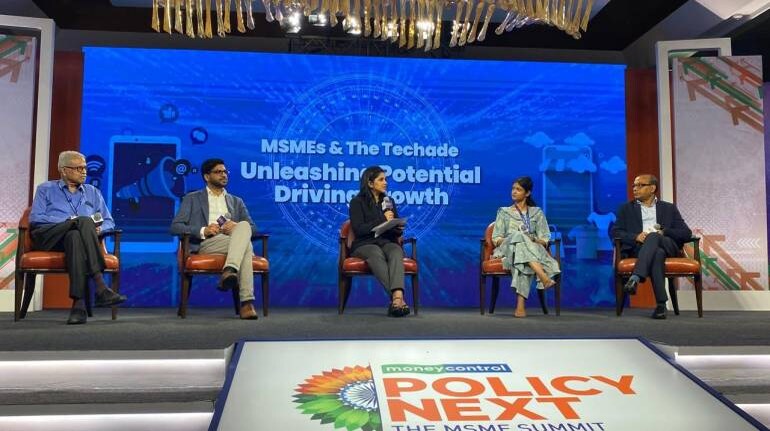
Panelists Dhiresh Bansal, CFO of Meesho, Dinesh Agarwal, CEO of IndiaMART, Nupur Goenka, Executive Director of Tally Solutions, and Ravi Sood, president of Badli Indl Estate Association are discussing the dual challenges of digital marketing and e-commerce in MSMEs
Jyoti Prakash Gadia, Managing Director, Resurgent India, says: “There are two types of customers -- one that can get software-generated loans, another that cannot get software-generated loans. The issue is whether MSMEs that cannot pass through the screens will be met with the manpowerneeded to screen them manually.”
“The quantum in rupees locked there (scheme) is only a fraction of the total number. The time it takes to resolve the issue is a problem. The amount of documentation needed is an issue. There need to be more digital and AI tools that can lead to faster resolution of MSME issues leaving only a few for manual intervention. Some contracts MSMEs have are only verbal, it is a challenge to solve these.”
“Banks do not have sub-sector level strategy for MSMEs which needs to evolve. Banks are overpricing good risk and underpricing bad risks.”
“The cost related to compliance remains very high and is not decreasing despite various measures. It has come down in certain sectors such as income tax but has increased in GST,” says Anil Bhardwaj, Secretary General, FISME.
Pushan Sharma, Director, CRISIL, said: “Unlike large organisations, MSMEs do not have compliance teams. They do not have funds for it. A direct compliance cost and opportunity cost is a double whammy for them. If India has to capitalise on this demographic dividend, we need to reduce compliance burden.”
“Much more needs to be done to increase the ease of doing business in India. China has 33 percent lesser MSMEs but its MSMEs contribute 50 percent of its GDP. If we need to scale, we need to work on it.”
Jyoti Prakash Gadia, MD, Resurgent India, said: “Understanding and documentation gap between MSMEs and banks needs to be addressed.”
He explained: “It is impossible in India for people to get their names, addresses same in all documentations for KYC process. Thus, 22 percent loan applications by MSMEs get rejected at KYC level itself. It is improper documentation or improper filing that rejects applications.”
Gadia further said that MSMEs catering to the B2C segment with no GST refund have no incentive to get regulated or join the GST mechanism. This explains why only one crore out of a total of six crore MSMEs are registered in India.
Amit Kumar, Founder and CEO, MSMEx, said: “There is a clear gap between eligibility and capability…. Asking for loans is not a right. The applicants need to find out the right way to go about it. Financial literacy is important.”