




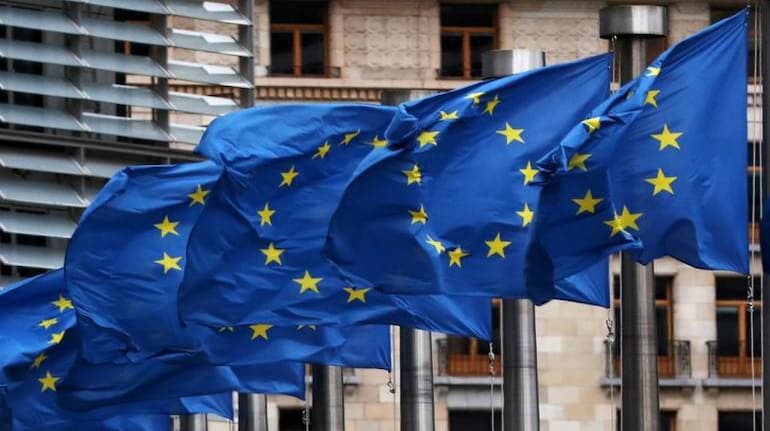
India is not expected to challenge the European Union (EU) for cutting out Indian exports from trade benefits under its Generalised System of Preferences (GSP) scheme, senior officials in the know have told Moneycontrol.
The EU has announced that exports from India will become ineligible for benefits under the GSP scheme from 1 Jan 2023.
The GSP is one of the EU’s largest preferential trade schemes, which removes import duties from products coming into the EU market from vulnerable developing nations. This would translate into $7.8 billion worth of Indian exports losing the cover of zero import duties, according to estimates by the Federation of Indian Export Organisations (FIEO).
Both raw materials and finished goods exports from India, totalling around 1,800 products such as stone, plastics, machinery, and engineering goods, currently take advantage of the GSP norms, the FIEO has said.
Difficult to counter
But while trade talks are set to be held later this month, officials said that countering the move may be tricky.
"The EU's GSP mechanism is three-tiered. India enjoys benefits under Standard GSP, the top category currently mandated for low- and lower-middle-income countries. It ensures partial or full removal of customs duties on two-thirds of tariff lines,’’ an official said. Countries such as Indonesia, Vietnam, Nigeria, and Kenya are in the category.
The other two categories are for nations that are economically weaker, politically unstable, or at the bottom rung of human development, he added. "It would be impossible to ask for benefits under these categories with a straight face,’’ he said.
Case in point, the GSP+ tier is a special incentive arrangement for sustainable development and good governance, which slashes tariffs to zero percent for vulnerable low-and lower-middle-income countries that implement 27 international conventions related to labour and human rights, environmental and climate protection, and good governance. Pakistan, Sri Lanka, Mongolia, Uzbekistan, and Bolivia are in this category.
The final Everything But Arms (EBA) category is a special arrangement for least developed countries (LDCs), providing them with duty-free, quota-free access to the EU market for all products except arms and ammunition.
Also, this isn't the first time that India has faced such a situation. Other than the EU, about a dozen countries have GSP mechanisms in place. In a similar move back in February 2020, the United States Trade Representative’s (USTR’s) office had classified India as a developed economy, ineligible for GSP benefits given by Washington to developing countries.
The USTR considers a country’s per capita gross national income (GNI) and share of world trade indicative of its level of economic development. On the criterion of a developing country having less than 0.5 percent share of global trade, India crossed the limit way back, according to the US government’s estimate.
As a result, India has subsequently stated that it does not need the US GSP benefits. ``It would be difficult to contradict our past position this time for the EU,’’ another official said.
Talks on top gear
During union commerce and industry minister Piyush Goyal’s visit to Brussels, the two sides revived Free Trade Agreement (FTA) talks on June 17 after a gap of more than eight years.
``Immediately afterwards, the second round of talks in late June set the ground. More negotiation on key issues and fine-tuning of positions is expected in the coming rounds,” a senior official said.
Since 2007, when it was proposed, there have been 16 rounds of trade negotiations till 2013. But the talks hit a wall after India decided to terminate bilateral investment treaties with 23 European countries in 2016.
Ever since, the EU has insisted that a bilateral investment pact with India would only be discussed in tandem with a proposed FTA, a rider that had complicated the negotiations process for both treaties.
The thaw in positions came last year when the EU decided to decouple the talks, which had been a key ask from New Delhi. In early 2020, before the global Covid pandemic overturned priorities, India had reached out to the EU to restart the stalled talks, signalling its willingness to slash tariffs on wines and automobiles.
Now, both sides are eyeing three separate agreements on trade, investment, and geographical indicators (GI). GI is a sign used for products that have a specific geographical origin and possess qualities or a reputation that are due to that origin.
The investment deal is expected to open India up to more foreign direct investment (FDI) from the EU. Even after UK’s exit, EU members like the Netherlands and Germany are the fourth- and seventh-largest foreign investors in India, respectively.

Discover the latest Business News, Sensex, and Nifty updates. Obtain Personal Finance insights, tax queries, and expert opinions on Moneycontrol or download the Moneycontrol App to stay updated!
Find the best of Al News in one place, specially curated for you every weekend.
Stay on top of the latest tech trends and biggest startup news.