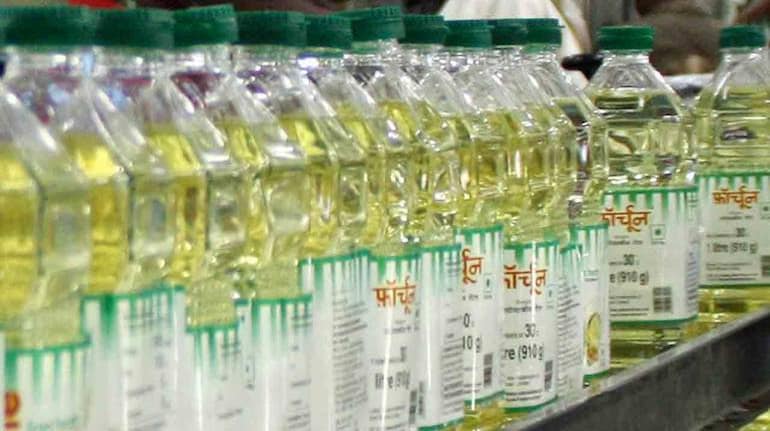
Edible oil prices in India are likely to spurt by the middle of the year as a global supply shortfall and higher freight rates due to the Red Sea crisis may impact imports to the country.
Edible oil prices are currently ruling lower than last year, with increased availability from good carryover stock. But industry experts reckon that the situation could change in a few months. Around 60 percent of the country’s edible oil requirement is met through imports.
Where do prices stand now?
Currently, in the domestic market, groundnut oil prices are almost at the same level as last year, while mustard oil, soybean oil and sunflower oil are lower by 15-20 percent from a year ago. The decline in palm oil is 12 percent, compared from a year before.
According to the Ministry of Consumer Affairs, Food and Public Distribution, retail prices per kg of major edible oils in the country on February 28 was groundnut oil (Rs 190.04), mustard oil (Rs 135.27), soya oil (Rs 122.51), sunflower oil (Rs 123.22) and palm oil (Rs 98.65).
Also read: Making India aatmanirbhar in oilseeds will not be an easy task
The Indonesia, Malaysia factors
According to B V Mehta, executive director of The Solvent Extractors’ Association of India (SEA), increased diversion of palm oil for the production of biodiesel in Indonesia and Malaysia, two of the biggest producers of the oil, has reduced its availability in the global market. This may push up the prices of palm oil and affect its imports to India.
Palm oil accounts for the largest share of edible oil consumed in the country at 38 percent, followed by soybean oil at 21 percent, mustard oil at 14 percent and sunflower oil at 12 percent. Except for mustard oil, the other three depend largely on imports. More than half of the import comprises palm oil.
Lower prices now due to excess quantity
``The excess quantity of edible oil has led to lower prices at present. Better domestic availability of edible oil may lead to lower import in the current oil year of 2023-24 (November to October) in the range of 15.5 to 16 million tonnes (MT),’’ Mehta said.
Edible oil imports to India peaked at 16.5 MT in 2022-23 oil year, up by about 16 percent from the previous year. The growth in domestic production of edible was lower by around 6 percent, at 11.35 MT.
The first quarter of oil year 2023-24 has witnessed lower import. The total import of edible oil for three months to January 2024, at 3,647,699 tonnes, is lower by 23 percent from the same period a year ago.
Global production of palm oil to be seasonally low
SEA said the global production of palm oil will be seasonally low in January to March, enforcing a reduction of stocks – both in production and imports. In India, sunflower oil import is diminishing this season, owing to shrinking total import requirement and soybean oil regaining market share.
``India may have to import higher quantities of palm oil after May when its availability will decline and prices increase. This will affect edible oil prices in India and it could go up by around 20 percent,’’ said K K Devraj, edible oil industry consultant.
At present, the import of soybean oil from South American countries has not been affected but the Red Sea crisis and higher freight rates could affect sunflower oil imports, mostly from Ukraine and Russia.
Two years ago, restrictions on palm oil export by Indonesia had led to a surge in edible oil prices in India. The Ukraine-Russia war also contributed to the rise. But prices cooled down last year and this led to higher imports.
Indonesian palm oil exports likely to be down slightly
Indonesia is the biggest palm oil producer and as per USDA foreign agriculture service report, Indonesian palm oil exports are expected to reach 27.9 MT for 2023-24, slightly down from 2022-23 amidst lower supplies, higher domestic use, and expected reduced demand from key market destinations.
It said Indonesia’s biodiesel mandate programme continues to drive palm oil use as the government has allocated 13.4 billion litres for 2024, 2 percent higher than in 2023 and the government is expected to maintain the blending rate at 35 percent. Indonesian palm oil production is forecast at 45.8 MT in 2023-24, against 44.7 MT in the previous year.
According to SEA, current edible oil consumption in India is over 24 MT, growing at 4-5 percent per annum. By 2029-30, India may need above 30 MT while local production is expected to be 15-16 MT. The widening gap may have to be bridged by higher imports. Meanwhile, the government is focusing on increasing the production of palm oil, with an aim to produce 1 MT by 2025-26 and 2.8 MT by 2029-30.
SEA has projected the current per-capita consumption of edible oil at 17.71 kg to grow to 21.15 kg by 2029-30. The increase in frequency of eating out and online food purchases are among the chief reasons for rising per-capita consumption of edible oil, said Devraj.
`` Home cooking is finding less takers among the new generation. The hotel, restaurant and catering (Horeca) sector is gaining momentum, which has raised edible oil consumption,’’ he said.
Discover the latest Business News, Sensex, and Nifty updates. Obtain Personal Finance insights, tax queries, and expert opinions on Moneycontrol or download the Moneycontrol App to stay updated!
Find the best of Al News in one place, specially curated for you every weekend.
Stay on top of the latest tech trends and biggest startup news.