

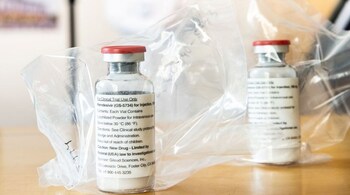
The wait for Gilead's drug Remdesivir continues even as governments and medical practitioners are scrambling for a drug to treat patients with severe novel coronavirus, or COVID-19.
The Indian drug regulator has been reviewing the marketing authorisation applications of Remdesivir of four Indian companies: Cipla, Hetero, Jubilant Life Sciences and BDR Pharmaceuticals. Except BDR, all other companies have licences from Gilead to produce and distribute the drug in 127 low and middle-income countries (LMICS). It's still not known whether Mylan has approached Drug Controller General of India (DCGI) for marketing approval or not.
Spokespersons for Cipla and Hetero declined to comment on their marketing authorisation applications.
Cautious drug regulator Sources told Moneycontrol that the drug may not be available in the market until July as DCGI has sought more data on safety and stability of the drug. The companies are responding to the requests made by the regulator.
A person with knowledge of the matter said that companies expected the approval process to be just a formality, as Gilead's Remdesivir was already approved by DCGI, and their applications were based on its data with the exception of BDR. They were stumped when the regulator started seeking more information.
"We can't find fault with regulator as they have to do their job. This is a new drug with a complicated manufacturing process. So they want to be doubly sure that the generic versions are as good as the Gilead's Remdesivir," the person above said.
Gilead the innovator of the drug, received conditional approval from DCGI on June 2 under the accelerated review process. It was granted a waiver to conduct clinical trials in India.
The company said there is limited supply of the drug at present and new supply could possibly start to become available from July.
"While there is currently limited global supply of Remdesivir, the company anticipates new supply of the drug to start to become available in July, with supply continuing to increase through the end of this year and into next year," Gilead said in a statement.
The management said it will work closely with the health authorities in India to provide guidance on anticipated drug supply, based on local incidence and severity of the disease.
As per the agreement with Gilead, Indian companies are free to price the drug. Gilead is yet to fix the price for US or any other market.
The Institute for Clinical and Economic Review (ICER), the Boston-based independent non-profit organisation, which has undertaken cost benefit modelling, has estimated the price of the drug at $4,460 (Rs 3,36,779) for a full course of treatment in the US, which is quite expensive for most Indians.
Pressure from Maharashtra Meanwhile, pressure is building up on DCGI to quickly approve the drug. Maharashtra State Housing Minister Jitendra Awhad, who had been tested positive for coronavirus and was on ventilator battling the infection before finally recovering, has sought speedy approval of the drug.
https://twitter.com/Awhadspeaks/status/1271302153550786560
Maharashtra has reported 97,648 cases and 3,590 deaths due to COVID-19, the highest in country. The state government is trying to import 10,000 doses of Remdesivir from Bangladesh companies.
Two Bangladesh drug makers, Eskayef Pharmaceuticals and Bexmico Pharma, have offered to supply Remdesivir to the Maharashtra government. But Moneycontrol wrote here that none of these companies have licence to sell Remdesivir in India and even importing limited doses of drug on compassionate basis requires DCGI approval.
Discover the latest Business News, Sensex, and Nifty updates. Obtain Personal Finance insights, tax queries, and expert opinions on Moneycontrol or download the Moneycontrol App to stay updated!





