The Uttarakhand government’s push for elevated roads over the Rispana and Bindal rivers that serve Dehradun has residents and activists up in arms.
An elevated 11 km road over the Rispana and another 15 km road over the Bindal, to be built at Rs 4,525.53 crore and 4,927.18 crore, respectively, are planned to rid the hill state’s capital of traffic congestion but locals rather have authorities rejuvenating these dying rivers that are the lifeline of the city.
Bindal is a seasonal river that flows only during the monsoon and helps prevent flooding in the city.
Rispana is a perennial river that originates from the Laal Tippa hills of Mussoorie and after flowing past the Massey Falls and Sikhar Falls enters Dehradun.
Journeying through Amwala and Tapovan, it meets the Bindal at Ajabpur. In its 27 km journey, Rispana covers a catchment area of 53.45 sq km.
The deteriorating state of Rispana
Dr Sunil Naithani from Doon University’s Environmental & Natural Resources Department said the Rispana river was vital to the city.
"Rispana flows both on the surface and underground. Hence, it plays an important role in maintaining the groundwater level in the city," he said.
Until recently, Rispana catered to the needs of the city’s population, as the Rajpur Canal built on the river brought its waters to central Dehradun, while helping irrigate farms on its banks in rural areas, said Doon Science Forum Coordinator Vijay Bhatt.
"Although there are some other rivers around Dehradun, Rispana was instrumental in recharging the city’s waters due to its proximity,” he said, adding the city's growing population took a toll on what was once a broad, clean river.
"People took to throwing household garbage directly into the river. Once Dehradun became the capital of Uttarakhand, slums housing migrant labour came up along its banks. These slums have metamorphosed into permanent colonies now.”
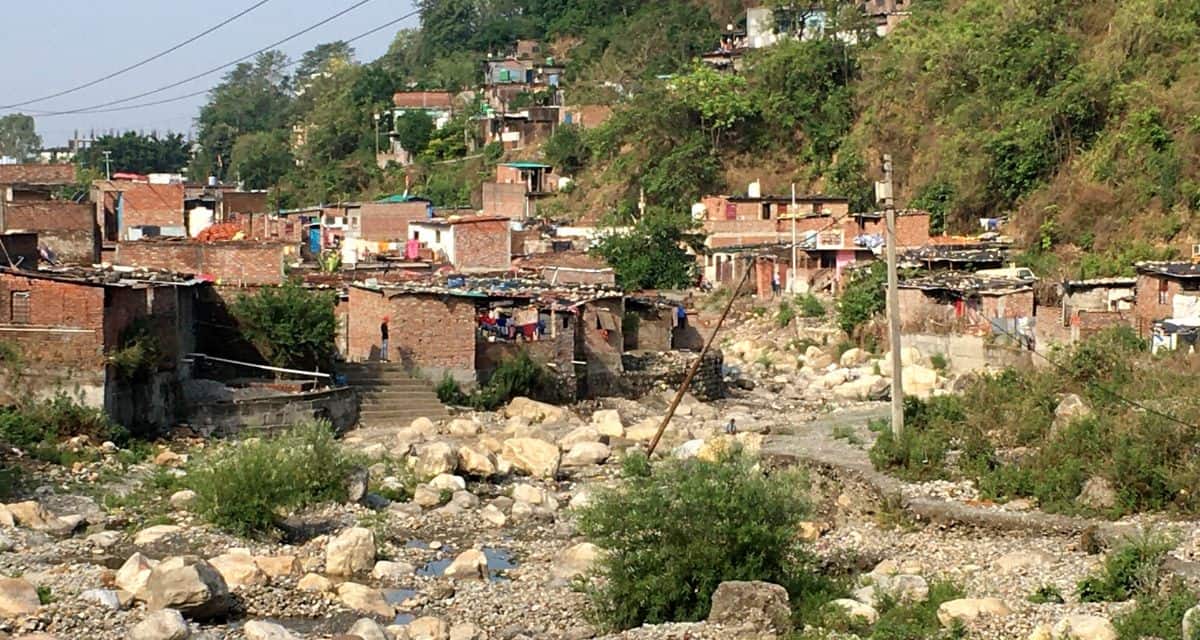 Several petitions have been filed against the mushrooming of illegal settlements along the banks of Rispana in Dehradun. (Photo: Styam Kumar).
From a breadth of 100m, the river has now narrowed to a 10-20m drain. The many tributaries that flow into it have also become victims of unplanned development.
Activists working to rejuvenate the river believe that the administration had provided water and electricity connections to the many unauthorised slums, nurturing them as a vote bank by political parties.
Several public interest litigations in the Uttarakhand High Court have flagged concerns about these slums and explanations sought from the Mussoorie-Dehradun Development Authority (MDDA) and Dehradun Municipal Corporation.
Water crisis in Dehradun
The deterioration of the Rispana has resulted in a major water crisis in Dehradun, as most households relied on groundwater.
According to a March 2022 news report, of the total demand for 324.91 million litres per day (MLD), only 275.12 MLD is being supplied.
In summer, the crisis worsens and in some parts of the city, tankers are needed to supply water.
Lekhraj, who lives on the banks of the Rispana in Karanpur, told 101Reporters that in summer, the water level drops that even after using motor pumps they can’t fill up their tanks.
The situation has worsened in the past decade, with open spaces in Dehradun, which once helped recharge groundwater, being built over by concrete structures to cater to the growing population.
According to the World and National Data, Maps and Ranking, Dehradun’s groundwater level has dropped by 12.33m from 2015 to 2019.
The Preparation of Strategic Land Report says that Rispana recharges the groundwater level in Dehradun at the rate of 23.556 million cubic metres (MCM). In the monsoons, Rispana has 120.102 MCM of water, of which 55.601 MCM flows away and 40.939 MCM gets evaporated.
A draft report from November 2019—Preparation of Strategic Land & Water Management Plan for Rejuvenation of Rispana River by the National Institute of Hydrology (NIH), Roorkee—drawn up for the Uttarakhand’s irrigation department claims that the river starts getting polluted immediately beyond the Rajpur Canal.
The level of pollution rises as it proceeds. And when it joins the Bindal near Mothrowala, the Bindal brings along the dirty waters from the city’s sewers and drains.
As per the NIH report, 9.386 MLD of dirty water from 177 drains and outlets of 2,901 homes finds its way into the Rispana. In the same manner, 18.14 MLD of dirty municipal waste finds its way into the Bindal.
When these rivers meet at Mothrowala, the pollution level of Rispana is off the charts.
Speaking to 101Reporters, human rights advocate and conservation activist Reenu Paul said, “I had filed a suit regarding the encroachment and illegal structures in the catchment areas of the Bindal and Rispana rivers in the Uttarakhand High Court in December 2021. A joint bench comprising Chief Justice RS Chauhan and Justice ND Dhanik directed the MDDA secretary and Dehradun district magistrate to file their response on the issue within four weeks. In spite of so much time having elapsed, there has been no action yet.”
In 2018, journalist Manmohan Lakhera filed a PIL in the high court regarding encroachments on the banks of the Rispana and Bindal and across Dehradun.
The court ordered all encroachments to be cleared within three months. When some residents of this settlement challenged the order in the Supreme Court, it ruled in favour of the removal of encroachments from the streets, while allowing a hearing on riverbank encroachments.
The municipal authorities then complied with the order, while the Uttarakhand government obtained a stay on the demolition of riverbank slums for three years.
 Illegal structures have come up along the banks as well as the catchment area of Rispana in Dehradun (Photo: Satyam Kumar).
Mission Rispana
Given the sorry state of the river, the then Chief Minister Trivendra Singh Rawat announced Mission Rispana in 2018, wherein the river would once again be turned into the ‘mythical Rishiparna’.
About 2.5 lakh trees were to be planted from the mouth of the Rispana to where it met the Bindal. The sewer outfalls into the river were to be shut and connected to sewage treatment plants. Around 10,000 people had contributed saplings to the project back then.
Since the Rispana and Bindal join the Ganga at Suswa, and later Raiwala, as tributaries, the project was brought under the Namami Gange Programme, the National Mission for Clean Ganga, and Rs 63.75 crore set aside for it. However, Mission Rispana was reduced to a pipe dream when neglect killed the saplings planted under the project.
Citizens' apprehensions over the elevated road project
Located between the Ganga and Yamuna, and once famed for its picturesque valleys, Dehradun has slowly been losing its identity over the years.
The logging of the Asharodi forest for the Delhi-Dehradun Highway and the construction of the elevated road over the Rispana and Bindal rivers spell a long series of assaults on Dehradun and its precincts.
“We have yet to learn of the technical features of this elevated road. But if pillars are inserted into the river to build this elevated road, it will certainly affect its ecology," warned Dr Ravi Chopra, director of the People’s Science Institute, Dehradun.
“If the water level of the river is higher than the level of the groundwater, the river recharges the groundwater. In case the groundwater level is higher than that of the river water, then the groundwater gets discharged. When pillars are dug into the river, there's a fair chance of an untoward effect.”
Advocate Reenu Paul echoed Dr Chopra's view. “Encroachments on the riverbank have narrowed down the river and blocked the flow of water. Every monsoon, water enters homes, resulting in a flood-like situation. With pillars being put up for the elevated road, the situation is bound to worsen,” she said.
A detailed project report is underway for the elevated road project, which should include an Environmental Impact Assessment.
(The author is a Uttarakhand-based freelance journalist and a member of 101Reporters, a pan-India network of grassroots reporters.)
Discover the latest Business News, Sensex, and Nifty updates. Obtain Personal Finance insights, tax queries, and expert opinions on Moneycontrol or download the Moneycontrol App to stay updated!

Find the best of Al News in one place, specially curated for you every weekend.
Stay on top of the latest tech trends and biggest startup news.