






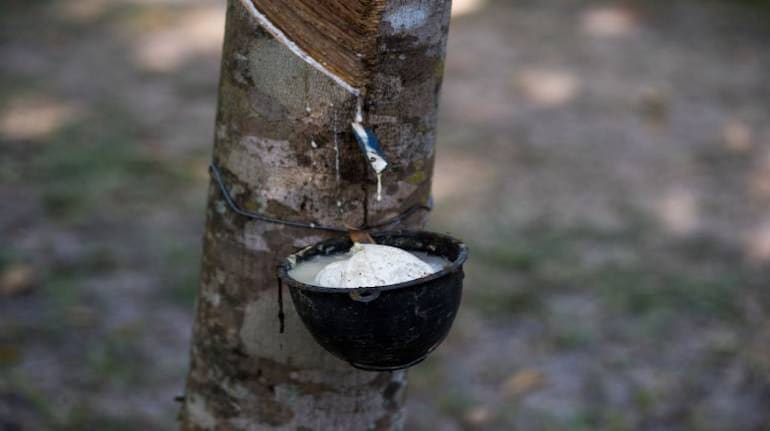
The Rubber Board is stepping up cultivation of natural rubber in North-eastern (NE) states as it looks to meet rising demand and reduce dependency on imports.
With the financial support of tyre corporates, the Rubber Board is implementing NE Mitra scheme that envisages the cultivation of rubber in two lakh hectares in the NE states in five years, at an investment of Rs 1,000 crore. The scheme commenced in June 2021 and last year 3,862 hectares were completed. The target for 2022 is 26,000 hectares.
"In 2022, we should be able to complete cultivation in 30-35,000 hectares. This includes about 25,000 hectares of new planting while the remaining will be re-planting," said Rubber Board executive director K N Raghavan.
While the new planting has been progressing steadily, the re-planting of old trees has taken a backseat due to a slump in rubber prices in the last few years. However, the prices have been rising since the end of last year and have remained at a remunerative level in 2022, giving some impetus to re-planting.
The production matrixRubber production has remained good in India in FY23 so far, slightly ahead of the level last year. As per the board’s projection, it is expected to touch 8,50,000 tonne in FY23.
"The output usually picks up in the second and third quarters, which are expected to be good as there have been good rains. Robust prices have helped bring more areas under tapping," Raghavan said.
While the natural rubber production in the country has been stagnant in the range of 7 to 8 lakh tonne annually, demand has been steadily rising above one million tonne.
In five years to FY22, the production increased 12 percent to 7,75,000 tonne while the consumption rose 18.5 percent to 12,38,000 tonne. To meet the rising demand, imports surged 28 percent to 5,46,369 tonne.
Even during the pandemic year of 2020-21, the consumption, despite showing a drop, was in double-digits at 10.96 lakh tonne.
The consumption may soar to 12,90,000 tonne and hit 15,00,000 tonne by 2025-26 if the current growth continues.
Jom Jacob, a rubber analyst, reckons the substantial production shortfall will stay for the coming few years, with the deficit falling from just under 40 percent in 2021 to 33.2 percent in another four years. By 2026, he expects, the production would touch 975,000 tonne and consumption to 14,60,000 tonne, reducing the gap to 4,85,000 tonne. While India produced 919,000 tonne of natural rubber in 2012, the output started declining from 2013 even as domestic demand kept rising.
The North-East edgeProduction in Kerala, the main traditional rubber growing region which accounts for 78 percent of the production, is saturated, leading to a shift in focus to NE states, mainly Tripura and Assam. NE states currently account for 16 percent of India's production, while the western states of Karnataka, Goa and Maharashtra have a combined share of about 6 percent.
According to Jacob, the advantages of the NE region include lower cost of production, less proneness to diseases and pests and socioeconomic contributions to less developed regions of marginalised societies. "These favourable factors enable the rubber farmers in the NE region to sell their produce at considerably lower prices than their counterparts in Kerala, which add to their cost competitiveness," he said.
Jacob said that traditional rubber growing regions are also hamstrung by adverse effects of climate change and the resultant fall in average yield per tree.
Interestingly, climate change is gradually making several non-traditional regions suitable for the economic cultivation of rubber.
The imperativeWith only around 60 per cent of India's rubber requirement met from local production and the rest from exports, there is a huge foreign exchange outgo. Considering the strategic and national importance of this critical raw material, the government came out with a National Rubber Policy in 2019 which aims at raising domestic natural rubber production to at least 75 per cent of the requirement in 2030.
The Rubber Board is also making efforts to increase the income of the growers by promoting the rubber wood industry and activities such as beekeeping and intercropping.
Kerala production may be hitThe low-cost rubber coming from the NE region may lead to a drop in rubber prices in India, making rubber cultivation unviable in Kerala and forcing many farmers in the state to give up the crop.
He warns that the large-scale expansion of rubber cultivation in low-cost regions within the country is a major risk to be factored in before investing in rubber cultivation in the traditional regions. This risk factor applies to new planting as well as the decision on replanting old trees.
Jacob said the world production in 2022 is projected to be 210,000 tonnes more than the consumption. Production picks up by July every year and remains high till the end of December. Due to the seasonal distribution of world supply, there will be excess supply for all the months from now onwards until December 2022.
Discover the latest Business News, Sensex, and Nifty updates. Obtain Personal Finance insights, tax queries, and expert opinions on Moneycontrol or download the Moneycontrol App to stay updated!

Find the best of Al News in one place, specially curated for you every weekend.
Stay on top of the latest tech trends and biggest startup news.




