




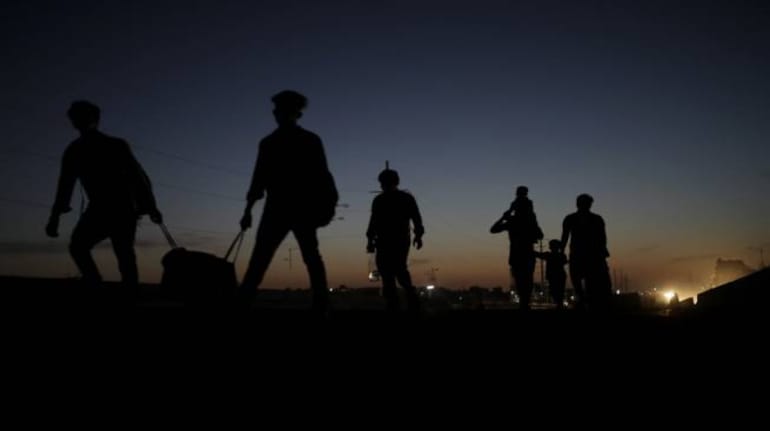
The scale of the government’s scheme to provide formal, inexpensive and well-located housing to the urban poor and migrant workers belies its stated intention both in terms of the quantity of units to be supplied when compared to demand and the attention given to governance and procedures, a study has said.
Further, the profit-oriented nature of the scheme implies that these rental projects will cater largely to salaried and formal workers, rather than those in whose name it has been formulated.
The government announced the Affordable Rental Housing Complex (ARHC) scheme in 2020, aimed at providing accommodation to the urban poor and migrant worker communities.
The Covid-19 pandemic forced migrant workers to leave cities and drew attention to the informal settlements, congestion problems and poor social amenities they faced. It also demonstrated that future health crises will affect all city dwellers, including those who live in upscale neighbourhoods.
A survey titled ‘Workers’ Housing Needs and the Affordable Rental Housing Complexes Scheme’ by the Centre for Policy Research in New Delhi pointed out that there are concerns over the substandard quality of existing vacant government housing, which will be utilised for part of the scheme.
Additionally, these housing units are located far from work locations, making them unviable options for the urban poor and migrant workers.
Also Read: Affordable rental housing complexes scheme for migrants: Here's all you need to know
The survey found that the scheme does not address the issue of migration and housing in cities, thus renewing the need to call for better land rights and basic services for urban poor and migrant workers to enable them to build, manage, and leverage housing according to their needs.
“The 1.19 lakh units promised under the ARHC scheme are a drop in the ocean as compared to the vast demand for affordable rental housing in Indian cities. Additionally, the ARHC model does not seem to accommodate the calibrated demand of informal workers and the urban poor,” the survey said.
Also Read: Affordable rental housing complexes scheme: High cost of land in urban areas remains a challenge
The survey was undertaken by the Working People’s Charter with partner organisations across India. The survey focused on Model 1 of the ARHC scheme, which aims to repurpose existing vacant government-funded housing as rental units. To understand the nature of demand, the survey also asked about the current housing conditions of the urban poor and migrant workers.
What’s the ARHC scheme about?In May 2020, the government announced the creation of the ARHC scheme as part of the Rs 20 lakh crore Aatmanirbhar Bharat relief package. The scheme envisaged the creation of a sustainable ecosystem of affordable rental housing that provides migrants and the urban poor with “dignified living with necessary civic amenities near their place of work.”
It was designated as a vertical of the Pradhan Mantri Awas Yojana - Urban (PMAY-U).
ARHC operational guidelines specify two modes of delivery. The first mode involves converting existing government-funded public housing into rental housing by public agencies or in the PPP mode.
Also Read: DDA gives final nod to development of Affordable Rental Housing Complexes (ARHCs) under MPD 2021
The ministry of housing and urban affairs, in a circular dated December 31, 2020, directed state governments to utilise vacant and under-construction houses funded by previous schemes, specifically the Basic Services for the Urban Poor and the Integrated Housing and Slum Development Programme components of the Jawaharlal Nehru National Urban Renewal Mission, as well as the Rajiv Awas Yojana, for the first model.
The second mode of delivery envisages construction of houses by private entities on their own land to be operated and maintained by them. The ministry of housing and urban affairs will oversee this scheme.
Once the states and Union Territories sign a memorandum of agreement with the ministry to implement the ARHC scheme, they and urban local bodies (ULBs) are to engage agencies, referred to in the scheme as concessionaires, to participate.
Under Model 1 of the scheme, states and ULBs will select concessionaires who will repair and retrofit vacant units, manage them for 25 years, and hand them back to the state/ULB after this time period is over. The rental amount will be set by the state/ULB. The concessionaires are also expected to develop social infrastructure such as roads, schools and health facilities as needed.
What’s lacking in the scheme?Most existing public housing projects located in peripheral locationsThe ARHC guidelines offer no convincing explanation for why public housing that is to be repurposed for rentals is vacant in the first place, the survey pointed out.
In most cities, such projects are located on the periphery of the city and are poorly connected. The outlying locations have little or no access to basic services such as water and sewerage as well as public amenities like anganwadis, government schools and health facilities, it said.
The document drew on a survey of 52 projects across 11 cities – Hyderabad, Indore, Bhopal, Mumbai, Nagpur, Nashik, Delhi, Ghaziabad, Guwahati, Mysore and Bengaluru. These projects varied in size – the smallest with 70 units and the largest with over 17,000 units. The total number of units in the surveyed projects was 93,295.
In the 52 projects surveyed, 39 percent of the units were vacant. The vacancies were the highest in Nagpur (89 percent), Mumbai (66 percent), Hyderabad (65 percent) and Ghaziabad (22 percent).
The vacancies were linked to the location of the projects – most were in the periphery of cities. In Delhi, the surveyed projects were 18-25 km away from the New Delhi railway station. In Bhopal, they were about 10 km away.
However, the Assam State Housing Board units surveyed in Guwahati built in the 1990s had very few vacancies because they were close to the city centre.
The survey found that almost 85 percent of the people commute less than 5 km and 75 percent spend less than Rs 500 a month on travel to work.
“It is apparent that households may be compromising on their housing conditions in order to be close to their work. This has clear and direct implications for the ARHC scheme as ARHC projects have to be located within close proximity to places of work and opportunity,” it said.
With the exception of one community in Mumbai, the actual rent paid ranged from Rs 1,000 to Rs 4,000 per household per month. An additional Rs 500 to Rs 1,000 is paid monthly for access to basic services such as electricity, water and toilets. This is likely to be on the higher side as the poor are known to pay more for services.
The findings imply that the rent in ARHC projects cannot be significantly higher than Rs 1,500 to Rs 4,000 per month, inclusive of all services. Since ARHC projects aim to provide houses with areas ranging from 30 square metres to 60 square metres, their rent cannot exceed the average paid for similar-sized houses in the private rental market, the survey said.
Privatised model of deliveryThere are issues regarding the privatised model of delivery of the scheme, the survey said. These concerns are exacerbated because the ARHC envisages the involvement of private concessionaires in refurbishing, allocating and maintaining the rental housing units. Incentives for concessionaire are clearly expectations of recovering investments and turning a profit in a 25-year period, the survey said.
It’s not clear how concessionaires will balance the trade-offs between vulnerability and affordability in a profit-oriented delivery model and this is unaddressed at this time, it said.
Construction quality concernThe quality of construction in public housing projects is a serious issue. About 39 percent of the units are poorly constructed and another 37 percent have problems related to breakage and seepage. Dampness and seepage were the most common visible signs of poor construction, the survey found.
In about 66 percent of the surveyed units, all rooms received adequate natural lighting. Yet, 35 percent of the units were only 10 feet away from the adjacent building.
A majority of the units, about 92 percent, had access to adequate piped supply of water. However, the situation was not so rosy with sewerage and solid waste management. While 69 percent had piped sewerage with a functional treatment plant, 22 percent had no functional sewerage at all and open dumping was reported, the survey found.
“Public housing projects face serious issues in terms of ease of living. Construction quality, sewerage and solid waste management are particular areas of concern,” the survey pointed out.
Lack of social infrastructureMany projects don’t have access to social infrastructure. Only half had access to primary and secondary schools and a third had primary healthcare facilities in the vicinity.
The survey found that about 15 percent of the units cannot be accessed by a fire trucks, either because of narrow access roads or because of obstructions and blockages on access roads.
Almost half the sample reported little or no access to parks, open playgrounds and public spaces. A majority of the households would have to depend on small shops and are impacted by the absence of markets in their vicinity.
“For the urban poor, who survive on meagre incomes and buy rations and daily necessities in small amounts, the absence of fair price shops and markets impacts household budgets substantively,” the survey said.
Projects in such poor quality neighbourhoods are unlikely to attract renters, and consequently remain unattractive to concessionaires, the survey pointed out.
Eviction histories ignoredThe scheme ignores the complex and varied histories of public housing projects, especially where they are partially occupied and there are histories of eviction and relocation. There is no guidance on how concessionaires are to deal with issues of false or contested vacancies and social conflicts that could emerge between existing allottees and new tenants, the survey said.
There is no clear mandate to provide transit housing for existing occupants while repairs are done, nor clarity on processes and on who would take on the associated costs, it said.
Broad target groupThough the ARHC guidelines signal a preference for vulnerable groups, the intended target group is very broad and includes categories like hospitality and healthcare workers, students, long-term tourists and visitors.
“Considering that this is a profit-oriented model, concessionaires will be far more likely to focus on beneficiaries with better and more regular incomes. Without clear implementable guidelines on inclusion, it is likely that vulnerable informal sector workers, especially migrants, who are most in need of secure housing, will remain excluded,” the survey added.

Discover the latest Business News, Sensex, and Nifty updates. Obtain Personal Finance insights, tax queries, and expert opinions on Moneycontrol or download the Moneycontrol App to stay updated!
Find the best of Al News in one place, specially curated for you every weekend.
Stay on top of the latest tech trends and biggest startup news.




