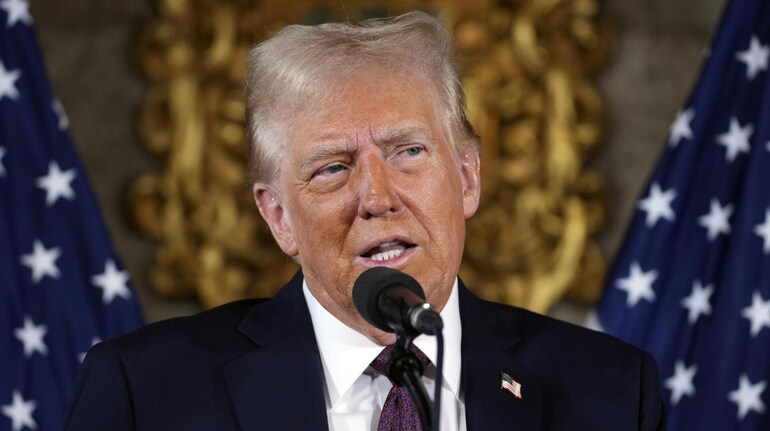
US President Donald Trump’s decision to impose reciprocal tariffs on India and other countries may trigger short-term volatility in global markets and financial experts are advising investors not to react to the news or to rumours.
Trump on April 2 unveiled global reciprocal tariffs at an event at the White House. For India, the President announced 26 percent 'kinder' reciprocal tariffs. Despite the US being India's significant trading partner, Trump has termed India a “tariff king” and “tariff abuser”, Moneycontrol reported.
Experts feel that for India, heightened trade tensions may weaken the rupee and deter foreign direct investment (FDI), though domestic stimulus could offset risks.
Also read | Follow Trump Tariff News
"Trump's 'Liberation Day' tariffs, if they're kept in place and especially if they face retaliation from targeted nations, will be a significant economic event after the 2008 financial crisis and COVID. India, with (its) domestic consumption capability will likely remain a bright spot,” said Viram Shah, Founder and CEO, Vested Finance.
“The tariff-driven volatility in the market is likely to continue for a while till the dust finally settles,” he added.
Impact on equity markets
According to experts, the reciprocal tariff may dampen India's external demand. With GDP growth already slowing, this could further strain economic performance.
Trideep Bhattacharya, Chief Investment Officer-Equities, Edelweiss MF, says, “It is relatively better for India in terms of improving relative competitive advantage versus Asian Peers, but there are increased recession-related fears in the US over time,” Bhattacharya said.
Pranay Aggarwal, Director and CEO at Stoxkart feels Indian equities could face pressure due to potential retaliatory measures, impacting export-driven sectors such as pharma and IT.
“Investors should monitor retaliatory actions and sector-specific exposures. Defensive stocks (FMCG, utilities) may outperform, while cyclical sectors (autos, metals) could underperform. Long-term implications hinge on negotiation outcomes, but near-term caution is advised,” said Aggarwal.
Impact on debt investments
With GDP growth already slowing, reciprocal tariffs could further strain economic performance.
The Reserve Bank of India (RBI) had lowered the policy repo rate to 6.25 percent in February and subsequently injected durable liquidity into the banking system to support growth.
Also read | Winner and losers of Trump's tariffs: Which countries & sectors are hit hardest and which are exempt
By maintaining surplus liquidity and ensuring robust credit flow, the RBI aims to stabilise financial markets and shield the economy from global uncertainties, such as trade tensions.
“This supportive stance promotes sustainable growth domestically while mitigating external pressures. We anticipate further rate cuts and continued positive liquidity measures, reflecting the RBI's commitment to resilience and growth,” said Abhishek Bisen, Head-Fixed Income, Kotak Mahindra AMC.
Mahendra Kumar Jajoo, CIO – Fixed Income, Mirae Asset Investment Managers (India), says US tariffs introduce uncertainty in global trade, which could lead to volatility in commodity prices and currency movements, impacting investor sentiment.
However, India’s fixed-income market remains resilient, backed by the RBI’s strong liquidity management.
"With inflation under control and a stable interest rate outlook, Indian bonds continue to offer an attractive investment opportunity. While global disruptions may create short-term noise, India’s bond market fundamentals remain strong, providing investors with stability amid external uncertainties. In this environment, a strategic focus on high-quality fixed-income assets remains key for long-term portfolio resilience," Jajoo said.
Falling interest rates generally benefit debt mutual funds because of the inverse relationship between bond prices and interest rates.
Debt mutual funds invest in bonds, and when interest rates fall, the price of existing bonds with higher coupon rates increases. This leads to capital appreciation, boosting the Net Asset Value (NAV) of debt funds.
Impact on gold and silver investments
Gold and silver showed very high volatility in the international markets after US tariff announcements, as gold hit life-time highs.
On Wednesday, gold and silver were settled on a positive note in the international markets. Gold June futures contract were settled at $3,166.20 per troy ounce up by 0.64 percent and silver May futures contracts were settled at $34.65 per troy ounce, up by 0.99 percent.
Also read | Taxpayers, CAs challenge I-T notices on rebate claims before appellate body
“After US' reciprocal tariff announcements global markets remain highly volatile as partnering countries will retaliate or go for trade deals with the United States. It’s time to be cautious on markets and trade with limited quantities. We expect gold and silver prices to remain volatile this week amid volatility in the dollar index,” said Manoj Jain, Director of Prithvi Finmart.
What should investors do?
Nitin Rao, CEO of InCred Wealth, says global markets were discounting Trump tariffs with limited gains over the past six months and booming gold prices.
“Markets will have to price this in, both in terms of sentiment and earnings. Volatility would continue, but at some point, it will result in sharp falls over a few days, which may give good buying opportunities in a new economic order for high-risk investors,” said Rao.
Vikas Gupta, CEO and Chief Investment Strategist at OmniScience Capital, feels that the precise impact cannot be exactly determined immediately since companies would choose to shift their manufacturing bases to other countries where the impact of tariffs could be lower.
“We would caution investors not to react to news or rumours. Expect the market to keep changing views on specific companies on a daily basis. We are of the view that it would be best to take the benefit of lower prices in the stock market while all this is going on. But no knee-jerk reactions. Analyse and proceed,” Gupta said.
Discover the latest Business News, Sensex, and Nifty updates. Obtain Personal Finance insights, tax queries, and expert opinions on Moneycontrol or download the Moneycontrol App to stay updated!
Find the best of Al News in one place, specially curated for you every weekend.
Stay on top of the latest tech trends and biggest startup news.