

Rajya Sabha MP Raghav Chadha has proposed an optional joint income tax return (ITR) system for married couples, stating that the existing tax structure tends to penalise households with a single earning member.
To highlight the imbalance, he pointed to two scenarios: a dual-income couple earning Rs 10 lakh each ends up paying no tax, whereas a single-earner family with a total income of Rs 20 lakh faces a tax liability of Rs 1.92 lakh, despite both households earning the same overall amount.
“One roof. One kitchen. One household budget. But when tax time comes, the family disappears. The tax system sees two individuals. A husband and wife become strangers. No clubbing of income or rebates,” Chadha wrote in a post on X.
Chadha noted that several developed countries, including France, Germany, the United States, and the United Kingdom, already follow a system of joint taxation for married couples. He said the proposal seeks to ensure greater fairness for single-income households by enabling them to access tax benefits on par with dual-income families.
“Allowing married couples to file a single return will definitely simplify compliance, considering the clubbing provisions under section 64 when the property/investment is acquired in joint name, or funding is provided by another spouse,” said Gopal Bohra, Partner -Tax, N.A.Shah Associates.
The idea of joint taxation for married couples is not new. The Institute of Chartered Accountants of India (ICAI) has consistently recommended introducing a joint filing system in its last two pre-budget memorandums, including its submission ahead of Budget 2026.
The Institute of Chartered Accountants of India (ICAI) had proposed allowing married couples, provided both spouses had valid PANs, to file a joint income tax return and opt for combined taxation. At the same time, taxpayers had retained the flexibility to continue filing individually under the existing system.
As part of the proposal, ICAI had suggested doubling the basic exemption limit for joint filers and restructuring tax slabs in line with total household income. Under the proposed framework, joint income up to Rs 8 lakh would have been tax-free, with higher income taxed progressively, and the top tax rate of 30 percent applying to income above Rs 48 lakh.
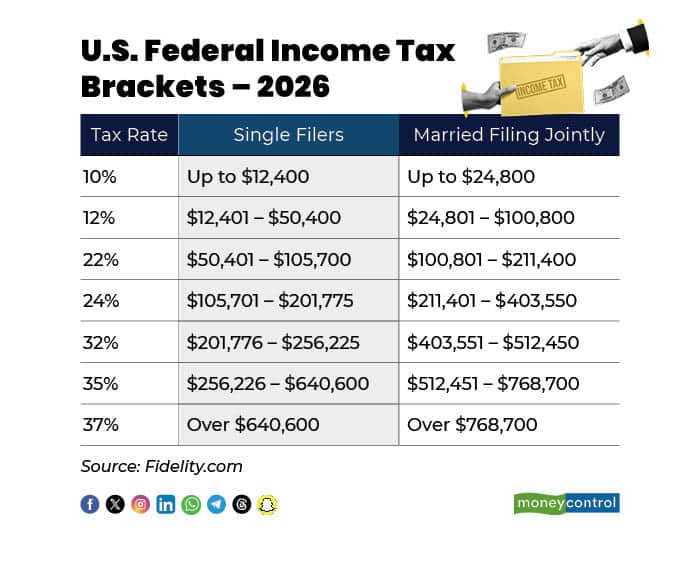
What are join filing tax bracket in United States
The United States follows a Married Filing Jointly (MFJ) system, where joint tax slabs are broadly double the single-filer thresholds, allowing equitable income averaging for married households.
Can joint taxation benefit families?
If both spouses are earning, the benefits of joint filing become beneficial, an aspect also reflected in the Institute of Chartered Accountants of India (ICAI) proposal. For instance, consider a couple where one spouse earns Rs 18 lakh and the other earns Rs 6 lakh. Under the current system, both are taxed separately; if joint taxation is introduced, tax rates may be lower for the joint income.
“Joint filing encourages cohesive household financial planning, simplifies investment structuring, and aligns neatly with the government’s vision of a new tax regime with minimal deductions and cleaner slab-based taxation,” said Priyal Goel Jain, CA, Partner NRI Tax Expert - Dinesh Aarjav & Associates, Chartered Accountants.
“Retired couples, in particular, would benefit from smoother taxation of pension and investment income, reducing the need for complex tax arbitrage. Over time, this could also lead to lower tax evasion and reduced litigation, as incentives for artificial income-splitting diminish,” Jain said.
Discover the latest Business News, Sensex, and Nifty updates. Obtain Personal Finance insights, tax queries, and expert opinions on Moneycontrol or download the Moneycontrol App to stay updated!
Find the best of Al News in one place, specially curated for you every weekend.
Stay on top of the latest tech trends and biggest startup news.