Dear Reader,
The Panorama newsletter is sent to Moneycontrol Pro subscribers on market days. It offers easy access to stories published on Moneycontrol Pro and gives a little extra by setting out a context or an event or trend that investors should keep track of.Friendships can make or break lives and, in some cases, the very economies of countries.
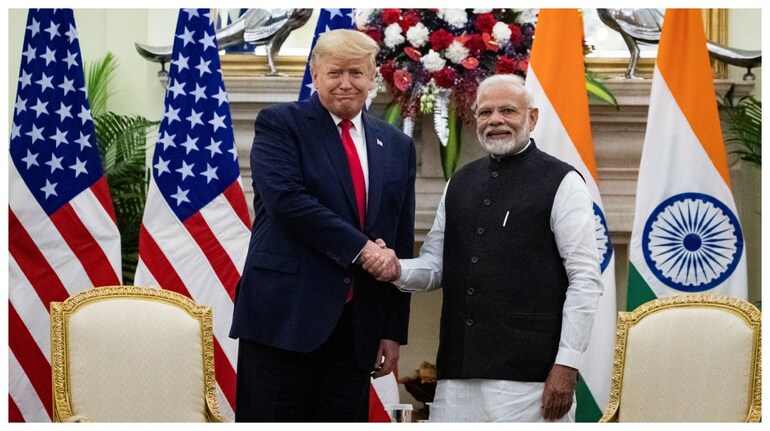
Prime Minister Narendra Modi calls US President Donald Trump “my friend” in his tweets. Trump, too, had moments of warmth with Modi during his first term and the much-hyped India visit.
Perhaps, India needs this bonhomie to work well now more than ever as Modi and Trump are set to meet on February 13 in Washington.
Reason: Tariffs.
The tariff war threatened and imposed by Trump on the rest of the world, including India, can give a jolt to India’s already faltering economy. How? Take a look at the MC Pro Chart of the Day.
According to data released by Nomura Research, if Trump intensifies the trade tariff war through reciprocal tariffs, India faces significant risks due to its relatively high tariff rates on US exports, thereby attracting high reciprocal tariffs.
With a weighted average effective tariff of 9.5 percent on US goods—compared to the 3 percent tariff imposed by the US on Indian exports—India could be hit hard by matching tariffs, particularly in key sectors like agriculture, transportation, textiles, footwear, and chemicals, according to Nomura.
Markets are already feeling the heat. The Nifty and the Sensex have faced heavy selling pressure since Trump’s victory, which analysts attribute to potential anti-India tariff plans. Trump’s now-famous motto to “Make America Great Again” shouldn’t make the rest of the world a less happy place to live.
Question is: Who will bell the cat?
It is in this backdrop, as Vivek Kelkar writes in this piece, that Modi’s US visit is key to India achieving its long-term strategic objectives. Can Modi work his magic in Washington? We won’t have to wait long to find out!
What are Modi’s options? Not many!
That said, the only option before Modi is to negotiate to lower India’s tariffs for the US. To mitigate risks, India is already considering lowering tariffs on over 30 items and increasing purchases of US defence and energy products, signalling a strategic shift to negotiate favourable terms.
But this is easier said than done, and there are consequences. Trump isn’t India’s only worry. As Kelkar writes, Trump’s threat of tariffs, China’s manufacturing might, ASEAN’s vulnerabilities, and indeed India’s own weaknesses are converging forces that only complicate India’s ability to negotiate on “fair trade” with the US.
The immediate costs of foregoing an existing relationship and developing substitutes could have a short-to-medium-term effect on India’s economy, and indeed crimp long-term plans to drive manufacturing growth and exports.
Rupee Unhappy!
Moving on, the rupee continues to throw its tantrums, and the RBI continues to pour in money to arrest the slide. On February 10, the Indian rupee touched a new record low at 87.95 against the US dollar due to the introduction of new tariff plans by US President Trump.
According to Bloomberg data, the Indian rupee depreciated 3.60 percent since September, which was lower compared to the Japanese yen (-6.49 percent), Canadian dollar (-5.71 percent), British pound (-7.58 percent), Australian dollar (-9.04 percent), and euro (-7.53 percent).
But the RBI is in stealth mode. The RBI sold between $4 billion and $7 billion on Monday as it intervened in the FX market to support the rupee. The RBI typically sells dollars in the spot market and takes positions in the forward market to arrest the currency’s fall.
My colleague Aparna Iyer writes a change of guard at the RBI may not mean a change of approach in the forex market. Take a look at the piece.
The question is how long can the central bank keep aiding a currency. Ultimately, the rupee will settle where it is supposed to.
Markets have a way to reach the equilibrium.
Investing insights from our research team Why investors should consider this stock, a proxy for health insurance growthOla Electric Q3 FY25: Still a long journey to profitabilityShould you participate in the re-listing of Hexaware Technologies?Berger Paints Q3: Soft growth amid intense market competitionEscorts Kubota Q3 stands on a shaky pitchGoldiam International: Robust Q3 FY25 results, healthy growth outlookGalaxy Surfactants: Weak show signals more pain for the FMCG sectorVa Tech Wabag: Robust order book, international expansion support growth outlook What else are we reading? Don’t panic, just SIPPersonal Finance | View the market through a long-term lensElon Musk gatecrashes OpenAI restructuring (republished from the FT) As Modi meets Trump, the premise and promise of US-India tiesIndia needs to find its Moore’s law of growth by investing in AI innovationIn the audacious Gaza proposal, different dimensions of Trump 2.0 tactics are on display Tech and Startups Govt internally tests IndiaAI datasets platform to power indigenous AI model developmentTechnical Picks: Schneider, Kaynes, Bajaj Finance, Bharat Forge.
Dinesh Unnikrishnan Moneycontrol Pro

Discover the latest Business News, Sensex, and Nifty updates. Obtain Personal Finance insights, tax queries, and expert opinions on Moneycontrol or download the Moneycontrol App to stay updated!





Find the best of Al News in one place, specially curated for you every weekend.
Stay on top of the latest tech trends and biggest startup news.