Two leading minds on financial markets hold divergent views on how the US should engage with international conflicts.
While JP Morgan Chase's Jamie Dimon believes that America needs to stay engaged with global wars, Jefferies' Christopher 'Chris' Wood has suggested that American involvement in international conflicts may prove an expensive mistake.
In his annual letter to shareholders, the Chairman and CEO of JP Morgan Chase, Dimon wrote that staying on the sidelines of the Russia-Ukraine war is not an option for America and argued stridently for American involvement. In contrast, the February issue of Greed and Fear, Jefferies' Global Head of Equity Strategy, Wood recalled a former US diplomat calling attempts at North Atlantic Treaty Organization (NATO) expansion "the most fateful error of American policy in the entire post-Cold War era".
Dimon's expressed worries that if America does not take leadership in ensuring Ukraine's victory, it could be a "disaster for the whole free world". On the other hand, Wood raised concerns about geopolitical tensions causing a rise in oil prices, which would then weigh on Biden administration's and Federal Reserve's attempts to bring inflation under control.
Dimon wrote, "Global wars come to our shores whether we like it or not — we need to stay engaged."
He recalled how American leaders have inspired citizens to defend the country's allies and democracies. He wrote that it was never an option for the country to stand on the sidelines when battles were being faught between "autocracy and democracy" or between "dictatorship and freedom".
He wrote, "Ukraine is the front line of democracy. If the war goes badly for Ukraine, you may see the splintering of Pax Americana, which would be a disaster for the whole free world. Ukraine’s struggle is our struggle, and ensuring their victory is ensuring America first. It is imperative that our national leaders explain to the American people what is at stake and make a powerful case – with energy, consistency and clarity – for our strong enduring commitment to Ukraine’s survival for as long as it takes (and it could take years)."
He also pointed out that America is supplying Ukraine with weapons and equipment to fight its war, and therefore America's aid is not just helping Ukraine but also American manufacturers. He added that this is also helping American rebuild its military industrial capacity for the next generation.
Fighting inflation
Wood's worries centered around rising oil prices and he pointed out the longstanding correlation between the Brent crude oil and the US five-year forward inflation expectations.
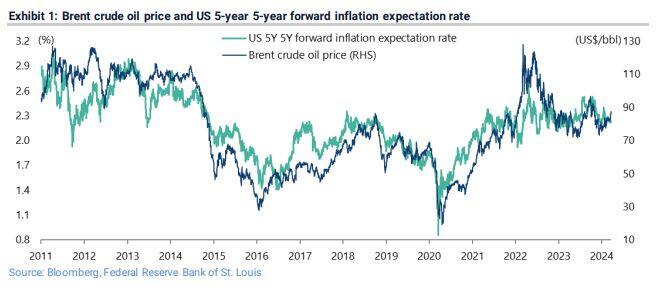
Wood said that oil prices have been appreciating since the International Energy Agency (IEA) on March 14 increased its demand forecast and reduced its supply forecast. Meanwhile, China has been building its reserves and US has been depleting its reserves.
He also pointed out that shale production in most of the major regions in the US seem to have peaked out, except the Permian region, where too there were signs of stress.
In this context, he considered the rising geopolitical tensions and their effect on US' oil-bill.
He referenced a memoir he was reading, which was written by US career diplomat William Burns, who is now heading the country's Central Intelligence Agency (CIA).
Burns narrated an incident when a US Secretary of State James Baker in 1989 said that "now is the time to lay aside, once and for all, the unrealistic vision of a greater Israel". The current Israeli Prime Minister Benjamin Netanyahu, then a foreign minister, accused the US administration of "lies and distortions" and found himself banned from the State Department for 18 months.
Wood also cited another "episode of relevance", when Baker in 1990 reassured the then Soviet lead Mikhail Gorbachev that NATO would not be extended "one inch to the east" of the borders of a reunified Germany. The book's author had concerns about Clinton's efforts to promote US expansion and the author quotes US diplomat George Keenan who called the expansion "the most fateful error of American policy in the entire post-Cold War era".
Also read: Equity values are at the high end of the valuation range: JP Morgan Chase's Jamie Dimon
In Greed and Fear, Wood wrote that he hopes that that statement (of Keenan) "does not turn out to be prophetic as it currently sounds".
In a stark contrast to this, Dimon wrote that what hopes to see is a book about How The West Was Won. Dimon wrote, imagining the trajectory of the book, "As the wars in Ukraine and the Middle East dragged on and as the fears of the Western world mounted, America rose to the challenge as it had in other turbulent times in history. America coalesced with its allies to form the alliances necessary to keep the world safe for freedom and democracy."
Discover the latest Business News, Sensex, and Nifty updates. Obtain Personal Finance insights, tax queries, and expert opinions on Moneycontrol or download the Moneycontrol App to stay updated!
Find the best of Al News in one place, specially curated for you every weekend.
Stay on top of the latest tech trends and biggest startup news.