




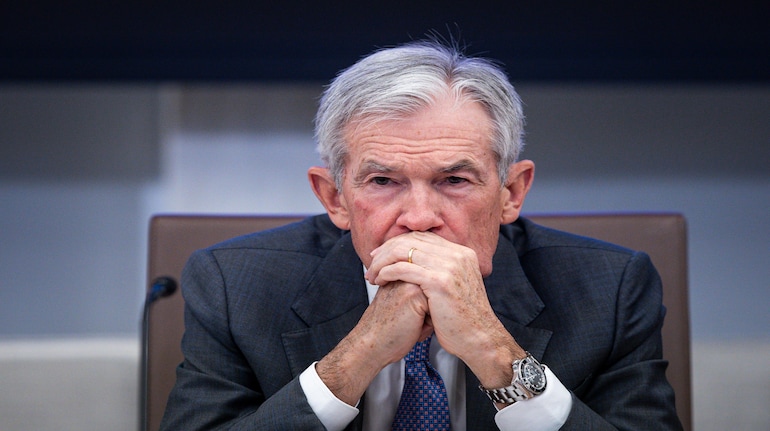
The Federal Reserve is expected to deliver a third consecutive interest-rate cut this week, but Chair Jerome Powell’s challenge in getting his colleagues to support that move portends the difficult tests that lay ahead for his successor.
This year’s rate cuts have each come with dissenting votes. Three policymakers are expected to do so again at the central bank’s last gathering of the year.
With just one tool to address two goals that are in conflict — inflation that’s too high even as the job market weakens — the Fed leader famous for mustering consensus even at difficult times is now finding that task nearly impossible.
“I would be more concerned if there weren’t disagreements,” said Loretta Mester, who was president of the Cleveland Fed from 2014 to 2024. “The dissents that we’re seeing really are illustrative of the fact that the economy could evolve in different ways.”
Given that Powell, whose term as chair expires in May, enjoys deep respect across the rate-setting committee, this bodes poorly for the next chair’s ability to corral their 18 colleagues.
Neutral Debate
Fed officials are broadly in agreement about their desire to lower rates to a level that’s not putting significant pressure on the economy nor actively stimulating it. But they can’t agree on where, exactly, that level lies, and that’s driving the increase in dissents.
“That’s the nature of the beast,” said Marc Giannoni, chief US economist at Barclays Capital and former research director at the Dallas Fed. “It’s much harder to argue whether policy is really neutral, expansionary or restrictive at this point.”
The six weeks since the last Fed meeting laid bare the differing opinions over how many more rate cuts are needed. As officials volleyed preferences back and forth — some urging more to support a flagging labor market and others arguing for a pause as they eyed persistent inflation — market odds of a December rate reduction swung in tandem.
The closing salvo went to the doves when two officials seen as Powell’s closest lieutenants revealed their readiness to cut, and thereby signaled the chair’s intention to move more of the committee in that direction.
That’s a role Powell, who has seen few dissenting votes during his time as chair, has played many times. The Fed, unlike some other central banks, typically operates by consensus, with potential dissenters trading their support for tweaks to the post-meeting statement or the chair’s guidance to markets on the likely future path of rates. Fans of the approach believe it signals more confidence in policy, thereby limiting uncertainty and volatility in markets.
But that era of collegiality seems to be coming to an end. This month’s meeting will be the fourth straight featuring at least one vote against the majority decision — bringing the total number of dissents over that span to eight, if there are three in December. That’s the same number cast over the preceding 47 meetings.
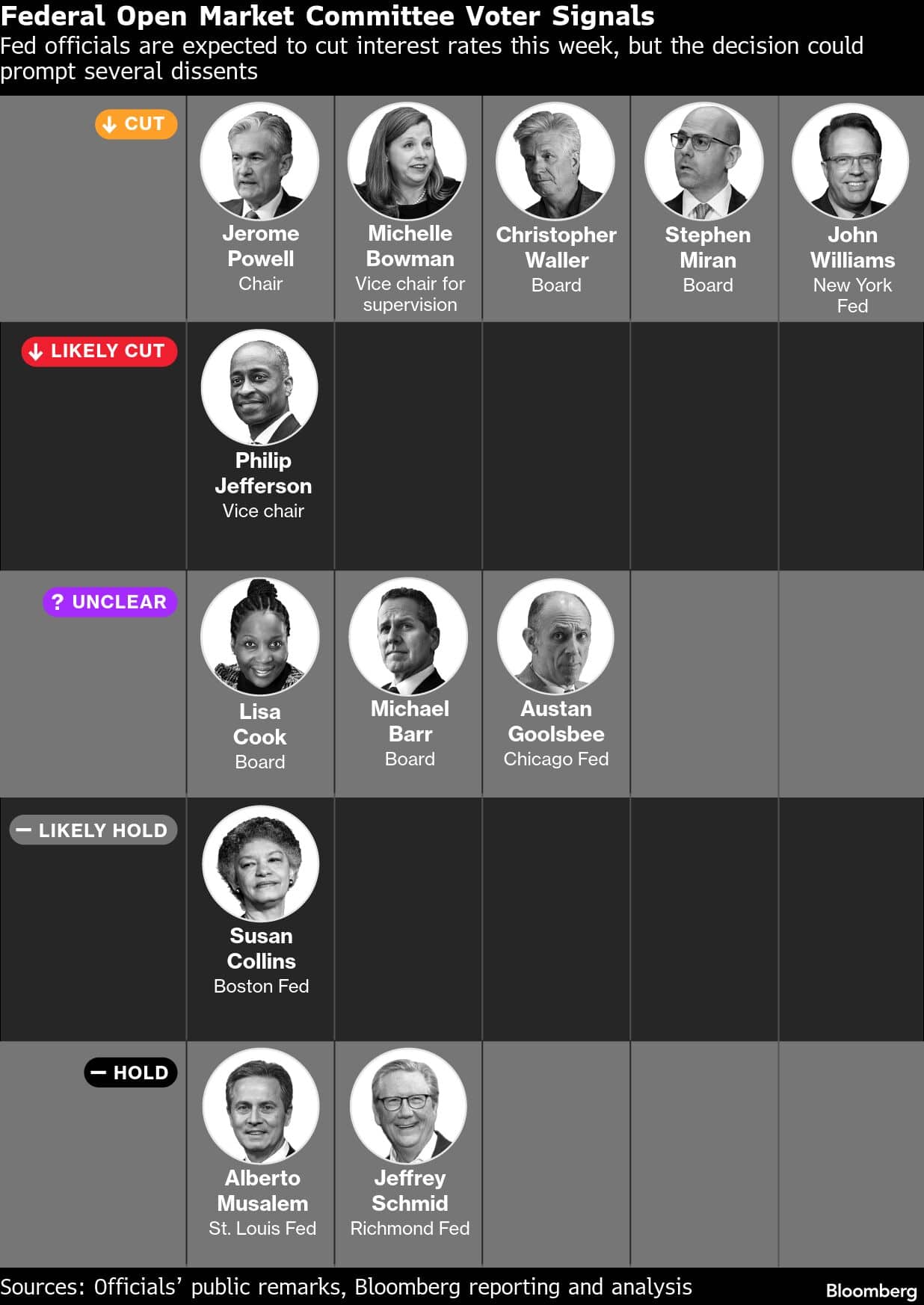
With President Donald Trump on the cusp of naming a new chair, frequent and numerous dissents may become routine. The president has made no secret of his desire for much lower rates. That will make many Fed officials, especially those worried about inflation, significantly more skeptical if Trump’s appointee argues for more cuts.
Kevin Hassett, the frontrunner in the race to replace Powell, has said the Fed can lower rates materially because the artificial intelligence boom is increasing productivity in the US economy. Producing more with less can mellow the effects of growth on inflation, as the introduction of the Internet did in the 1990s.
But most of Hassett’s potential future colleagues aren’t fully convinced this is what’s happening right now. In projections released in September — which will be updated next week — officials said they expected, on average, only one additional rate cut in 2026 and one in 2027.
Regardless, they’re more concerned about getting policy right in the near term.
Those who vote in favor of cutting rates again this month will likely point to recently released data that showed further weakening in the labor market, including an uptick in the unemployment rate to 4.4% in September. Data from ADP Research released last week signaled things got worse in November, with companies cutting 32,000 workers in the biggest payrolls decline in nearly three years.
What Economics Says...
“A 25-basis-point rate cut is all but priced in for the Dec. 9-10 FOMC meeting, but the messaging around it is up in the air. ... If Fed Chair Jerome Powell leans hawkish at the news conference to appease hawkish regional Fed presidents, will it even matter anymore? After all, the next Fed chair — National Economic Council Director Kevin Hassett is the frontrunner — could join the board as soon as February.”
— Anna Wong and Stuart Paul
But those who’ve expressed a reticence to cut further have said policy should still be working to tamp down inflation. New price data — delayed by the shutdown — showed the Fed’s preferred inflation gauge rose by 2.8% in the 12 months through September, still well above the 2% target.
Some also worry a tailwind from the administration’s new tax policy and deregulatory efforts could boost economic activity in the new year, further pressuring prices.
Official November data for the labor market won’t be released until after the Fed meeting, on Dec. 16, followed by inflation data two days later, adding anxiety for those closely watching the economy.
A cut next week will likely be framed in a hawkish way, both to appease officials who would rather hold steady and to reflect most policymakers’ expectations that few additional reductions are needed.
“The internal politics are difficult, but if anyone can hold it together, it’s Powell,” said Derek Tang, an economist at LH/Meyer Monetary Policy Analytics. “Powell has earned so much respect from his colleagues. He has a lot of internal political capital.”
Discover the latest Business News, Sensex, and Nifty updates. Obtain Personal Finance insights, tax queries, and expert opinions on Moneycontrol or download the Moneycontrol App to stay updated!
Find the best of Al News in one place, specially curated for you every weekend.
Stay on top of the latest tech trends and biggest startup news.