






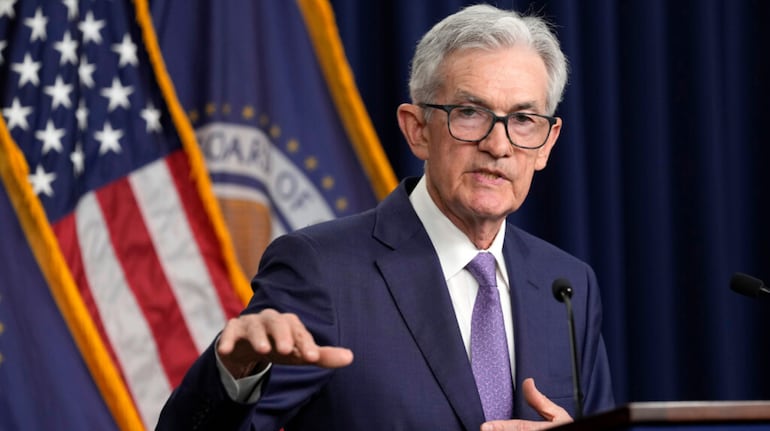
Traders are harking back on 1995, when Alan Greenspan led the Federal Reserve in pulling off a rare soft landing, for a playbook on trading the first interest-rate cut in four years.
Like nearly three decades ago, bonds and stocks are rallying ahead of a critical Fed meeting. But this time, the central question for Chair Jerome Powell is which approach — reducing rates by 25 basis points or 50 basis points — is most beneficial for the US economy.
To Kristina Hooper, chief global market strategist at Invesco, the US economy looks set to avert a recession as the Fed starts easing policy just ahead of the US election.
“Once the Fed starts to cut, there’ll be a psychological reaction to that,” she said. “That will be supportive.”
The S&P 500 Index and Treasuries, and gold have typically risen as the Fed starts lowering rates, according to Bloomberg News analysis of markets during the past six Fed easing cycles going back to 1989.

In the equity market, the S&P has rallied by an average 13% in the six months after the central bank started cutting — except for during the recessionary years of 2001 and 2007, the data show.
Short-term Treasuries, meantime, have usually outperformed their longer-term notes — a phenomenon known as yield curve steepening — during Fed easing cycles. Six months after the first cut, the 10-year and two-year yield gap often widened by an average of 44 basis points.
Gold delivered returns to investors during four of the past six Fed easing cycles. The dollar and oil were mixed.
Of course, traders are far from certain going into the months ahead. The Fed will be embarking on a rate-cutting path just before former President Donald Trump and Vice President Kamala Harris face off in the November election.
The candidates are pitching starkly different economic agendas, though both have the potential to roil global markets depending on the outcome of congressional votes.
“The soft landing is the most likely scenario,” said Salman Ahmed, Fidelity International’s global head of macro and strategic asset allocation, who has downgraded his rating of US equities to neutral from overweight partially because of election risks. “But elections are going to matter. It’s probably a unique cycle.”

Republican nominee Trump has pledged to impose steep tariffs and extend tax cuts — a policy mix seen as bullish for the dollar and bearish for bonds. Goldman Sachs Group Inc. economists said that Trump’s tariffs, if implemented, will likely fuel inflation.
The former president’s promise to cut the federal corporate tax rate to 15% from 21% would provide a tailwind for earnings. In contrast, his Democratic opponent Harris proposed lifting the tax rate to 28%, which would reduce corporate earnings by about 5%, according to the Goldman economists.
Back to 1995Over the past six easing cycles since 1989, there were only two episodes – in 1995 and 1998 — where the Fed managed to avoid an immediate economic downturn. This time, US equity and bond markets are anticipating that the Fed will get a 1995-style soft landing.
Back then, Greenspan and his colleagues at the Fed cut rates to 5.25% from 6% in just six months, cooling the economy without plunging it into a downturn. US Treasury yields ended higher in the 12-month period following the first rate cut, while bonds’ total returns trailed cash.
This time around, Fed officials have been holding the target range for their benchmark at 5.25% to 5.5% for 14 months, though policymakers have held off from guaranteeing aggressive action.
Bond traders are pricing in more than 2 percentage points worth of easing over the next 12 months, the S&P 500 is a fraction away from an all-time high and the credit spreads are near historical lows.
What makes investors hopeful for a soft landing is that households and companies’ balance sheets are strong. Corporate profit and household wealth are at record highs, leaving them less vulnerable to economic shocks.
“Inflation is no longer the big problem the economy and the stock market face — it’s high interest rates,” said Yung-Yu Ma, chief investment officer at BMO Wealth Management. “By cutting rates now, the Fed may solve that issue and prevent a downturn.”
What Bloomberg strategists say...“Treasury bonds traditionally rally at the onset of a Fed easing cycle — when it coincides with a weakening economy. In the event of a soft landing, though, bond performance tends to lag stocks.”
That leaves traders to position for lower borrowing costs and a relatively resilient economy.
The latest equity flows data from Bank of America Corp. and EPFR Global show a rotation into utilities and real estate — two crucial groups closely tied to the economy that historically benefit from rate cuts as long as there’s robust economic growth.
Discover the latest Business News, Sensex, and Nifty updates. Obtain Personal Finance insights, tax queries, and expert opinions on Moneycontrol or download the Moneycontrol App to stay updated!

Find the best of Al News in one place, specially curated for you every weekend.
Stay on top of the latest tech trends and biggest startup news.




