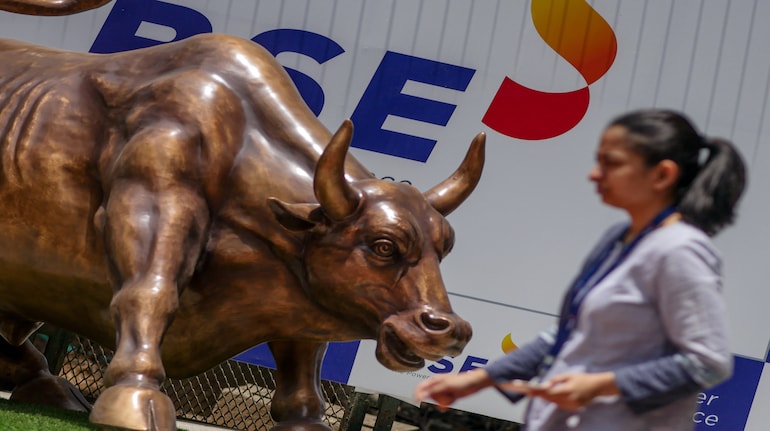
Shares of BSE, Angel One, other capital market stocks rose up to 2% on September 15 after there was no decision taken regarding ending the weekly F&O expiry at the SEBI board meet.
On September 12, SEBI chairman Tuhin Kanta Pandey said "will get consultation paper (on ending weekly F&O expiry as and when ready": CNBC-TV18 reported last week that SEBI is exploring a proposal to end weekly expiry contracts in equity derivatives trading.
"We will inform all participants transparently on weekly option decision. We will decide on any rules post floating consultation paper and following due process," Pandey added.
At 12:15 pm on September 15, BSE shares were trading 1.8% higher at Rs 2,240 apiece while those of Angel One were trading 0.8% higher at Rs 2,241 apiece.
Other capital market stocks were also in green with Motilal Oswal Financial Services stock increasing 1.3% while Anand Rathi and CDSL rose 0.84% and 0.53%, respectively.
Meanwhile, Nuvama Institutional Equities projected that if SEBI permits fortnightly expiries on different days, BSE’s average daily premium turnover could drop by 55.8% to Rs 6,600 crore by FY27, potentially cutting its earnings per share (EPS) by 26.8% to Rs 39.9, according to ET NOW on X (formerly Twitter).
Nuvama believes the most likely outcome is SEBI allowing only fortnightly expiries.
Four scenarios for BSE
In a scenario where monthly expiries occur on different days (e.g., Tuesday and Thursday), Nuvama expects the overall daily premium turnover to fall 66.8% to Rs 21,000 crore in FY27, with BSE’s share shrinking to 15.9%. Under this model, BSE’s turnover could plunge 77.5% to Rs 3,300 crore, with EPS falling 36.7% to Rs 34.5.
If monthly expiries are split between exchanges (BSE in mid-month and NSE at month-end), the total market could shrink by 54% to Rs 29,100 crore, but BSE’s market share might rise to 27.5%.
In a scenario where both exchanges adopt the same day for fortnightly expiries, the total market could contract by 47.6%, with BSE holding a 15.2% share. BSE’s daily premium turnover could drop 66.3% to Rs 5,000 crore, and EPS fall by 32% to Rs 37. NSE’s turnover could decrease 41.9% to Rs 28,100 crore, cutting its EPS by 22.4% to Rs 33.4, reported Informist.
Similarly, under a monthly expiry on the same day for both exchanges, Nuvama projects the market to decline by 54.1% to Rs 29,100 crore, with BSE’s share dropping to 9.8%. In this case, BSE’s turnover may fall 80.8% to Rs 2,900 crore, and EPS could be reduced by 38.5% to Rs 33.5.
Impact on BSE
Nuvama warned that any move toward longer-duration equity derivative contracts would likely reduce total market size and impact exchange earnings, potentially prompting a re-evaluation of stock valuations.
Thus, Nuvama expects BSE’s FY27 earnings to drop between 19.8% and 38.5%, depending on how SEBI reforms the expiry structure. Despite the risks, it maintained a 'buy' rating on BSE with a target price of Rs 2,820.
Discover the latest Business News, Sensex, and Nifty updates. Obtain Personal Finance insights, tax queries, and expert opinions on Moneycontrol or download the Moneycontrol App to stay updated!
Find the best of Al News in one place, specially curated for you every weekend.
Stay on top of the latest tech trends and biggest startup news.