






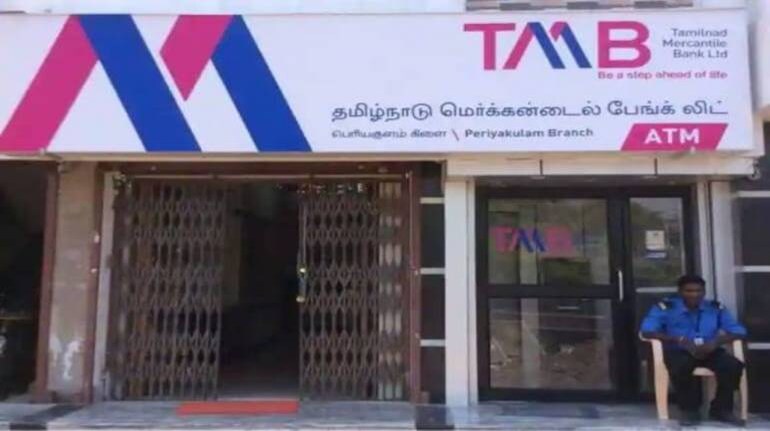
Tamilnad Mercantile Bank’s (TMB) shares do not seem attractive to market participants as their grey market premium has been falling consistently since the issue opened.
Experts cited regulatory hearings, low IPO subscription, rich valuation and uncertainty over the management's long-term performance for the poor show.
TMB shares were trading with just a 1-2 percent premium over the final issue price of Rs 525 in the grey market, analysts said. When the issue opened, the premium was 6-7 percent over the upper end of the price band.
The grey market is an unofficial platform for trading in IPO shares. Investors get some sense about the listing price by looking at the grey market premium.
Trading in IPO shares in the grey market starts when the price band is announced and continues till the listing of the shares on the bourses.
Tamilnad Mercantile Bank raised Rs 831.60 crore through its public issue, which was subscribed 2.86 times on September 5-7. As it is a fresh issue, the entire money will be utilised by the company to augment its tier-I capital base to meet future capital requirements.
The IPO was launched with a price band of Rs 500-525 a share.
"At the current valuation, TMB is seen demanding a richer valuation compared to its peers given that TMB is outperforming its peers on the majority of financial parameters," Narendra Solanki, Head–Equity Research, Anand Rathi Shares & Stock Brokers, said. Considering its consistency in performance and the healthy return ratio, the brokerage had recommended a “subscribe- long term” rating to the IPO.
Overall market sentiments also affected the premium to some extent, the experts feel.
CSB Bank, DCB Bank, Karur Vysya Bank, and Karnataka Bank were available at P/E of 3.4-8.0 their FY22 earnings.
In the last couple of weeks, the equity market has corrected and remained range-bound after hitting psychological levels — 60,000 on the BSE Sensex and near 18,000 on the Nifty50 amid nervousness among global peers.
Legal proceedings and management qualityAbhishek Jain, Head of Research at Arihant Capital Markets, thinks the muted response in the grey market to the IPO can be attributed to the bank’s non-aggressive management and an impending regulatory hearing.
Tamilnad Mercantile Bank's 37.73 percent paid-up equity share capital or 53.76 million equity shares is subject to outstanding legal proceedings at various forums, in connection with which proceedings against the bank have been initiated by various regulatory authorities.
They include the RBI and the Directorate of Enforcement; some of the regulators have imposed or sought to impose penalties on the bank in the past.
The bank cannot assure investors that these matters will be resolved in a timely manner or at all. And any adverse developments in such proceedings could result in the imposition of injunctions or penalties and require it to incur significant costs to contest them, which could have a material impact on its reputation, business, financial condition and operations, said Arihant Capital Markets.
Santosh Meena, Head of Research at Swastika Investmart, agreed with Jain, saying the various legal challenges, and a lack of clarity on the management's likely long-term performance, had made investors averse to the IPO.
It is important to note that management quality is paramount for any banking or finance company as it is synonymous with betting on the jockey, not the horse, indicated Santosh. Thus, he added, investors have better options in existing listed banks, where the management's track record and performance during multiple credit cycles are visible.
In short, large-sized banks and a few mid-sized banks are the best choices to ride the upcoming credit and economic growth cycle, he added.
New MD & CEOA day before the issue opening, the Board of Directors appointed Krishnan Sankarasubramaniam as Managing Director & CEO of the bank, after the term of MD & CEO KV Rama Moorthy ended on September 3.
Krishnan will be the Managing Director & CEO of Tamilnad Mercantile Bank for the next three years. Earlier he was the MD & CEO of Punjab and Sind Bank.
Tamilnad Mercantile Bank recorded 18 percent year-on-year growth in net interest income at Rs 1,815 crore in FY22, driven by 8 percent growth in net advances and a 33 bps expansion in NIM at 4.1 percent. NIM expansion was largely due to a 59 bps decline in cost of deposits, at 4.9 percent. The yield on advances declined by 20 bps YoY to 9.5 percent in FY22.
The cost-to-income ratio of the bank reduced from 46.1 percent in FY20 to 42.1 percent in FY22.
Profit increased by 42 percent CAGR in the FY20-FY22 period to Rs 822 crore. The bank has also reported a consistent improvement in its return ratio with the return on assets increasing from 1 percent in FY20 to 1.7 percent in FY22 and return on equity increasing from 10.7 percent in FY20 to 16.6 percent in FY22. TMB has a high capital adequacy ratio of 22.1 percent, which will improve further post IPO, said Jain.
Disclaimer: The views and investment tips expressed by investment experts on Moneycontrol.com are their own and not those of the website or its management. Moneycontrol.com advises users to check with certified experts before taking any investment decisions.Discover the latest Business News, Sensex, and Nifty updates. Obtain Personal Finance insights, tax queries, and expert opinions on Moneycontrol or download the Moneycontrol App to stay updated!
Find the best of Al News in one place, specially curated for you every weekend.
Stay on top of the latest tech trends and biggest startup news.




