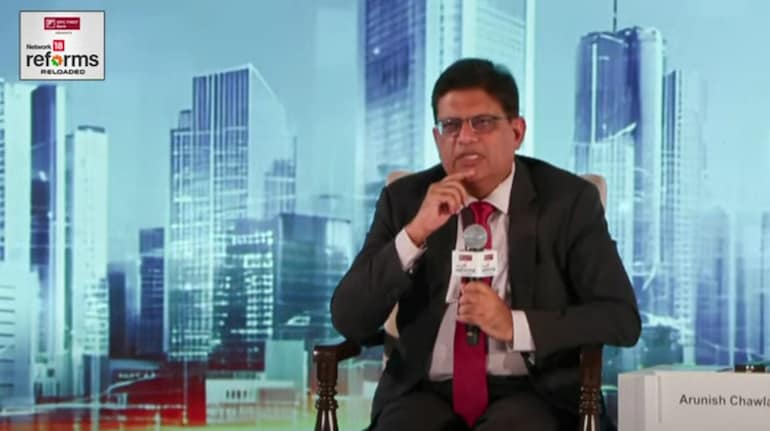
Speaking at the Network18 Reforms Reloaded 2025 summit in Delhi, Arunish Chawla, Secretary of the Department of Investment and Public Asset Management (DIPAM), said the government is confident of surpassing its Rs 47,000 crore disinvestment target this year. He underlined the growing role of domestic investors in stabilising Indian markets, promised more IPOs, OFSs and minority stake sales in the coming months, and called the rise of small investors a “fresh breeze” powering India’s capital markets.
Here is the full transcript: Shereen Bhan:
What better way to kick off Reforms Reloaded with the market-facing department of the Government of India, the Secretary of DIPAM right here with us, Mr. Chawla. What a pleasure. Thank you so much for joining us here. Before I talk to you about disinvestment and the disinvestment roadmap, I want to understand from you the broad picture within North Block at this point in time with the rollout of the GST, with the income tax cuts that were given by the government, the clear effort and message seems to be, as we heard from the Prime Minister yesterday in his address to the nation, boost consumption, drive consumption. The budget-making exercise is going to start shortly, Mr. Chawla. How does all of this stack up on balance as you get into the budget-making process?
Arunish Chawla:
Thank you. Honourable Finance Minister will speak about it in more detail in the evening. I'll just make two supporting comments. One, our government is providing a balanced support to the economy. And balanced support includes support to private consumption and which, as you very rightly said, includes both the income tax relief that was given in the budget and this great GST 2.0 reform which is being rolled out and which was announced by the Honourable Prime Minister, both from the Red Fort and yesterday.
Secondly, we have not forgotten investment, we have not forgotten about productive investment and the need to increase the productive capacity of the economy. As you know, the budget this year provided for more than double-digit growth in capex, which includes both budgetary and extra-budgetary resources. And as you know, if you can see the CGA data which came out the first quarter, that investment, public investment through the budgetary sources was on target. Equally important, what is called the extra-budgetary resources where we directly come in and where the public enterprises play a role, the data we have as of end of July, we achieved almost one third, about 30% to 33% of the yearly target by July itself, which tells you that we have front-loaded reforms, we have kept them on track and the industry and the commercial side of the government is working on the global value chains, how to revisit them, how to reorient them so that we can insulate our economy from the global headwinds. I also have one suggestion. We should not get obsessed with individual numbers. India is a growing economy, we are in a phase of growth convergence and it is how we perform relative to the rest of the world that is what matters.
Shereen Bhan:
So which number should we not get obsessed with, sir?
Arunish Chawla:
It's the headline number which we all tend to get obsessed about and the right way of looking at it is, say, in spite of global headwinds, the world is going to grow say at 3% or even lower. If we can grow double that in real terms and maybe exceed that, and that is what the early data shows, we should be thrilled. That is my suggestion.
Shereen Bhan:
Well, your suggestion and point taken, sir, let me now address the issue of disinvestment and what the government is likely to do as far as the disinvestment roadmap is concerned. I talked about the markets and the Indian markets have of course faced their own degree of volatility on account of the fluctuation of FII inflows, but that's been offset by very strong domestic institutional interest and domestic institutional investment into the stock markets.
There really has been in a way a democratization of the Indian capital markets that we've seen. How does your department, how does the government intend to leverage what we see happening in the market? What can we expect? More public sector companies doing OFSs, are we likely to see more IPOs? What can we now realistically expect?
Arunish Chawla:
Good question and I entirely agree with you on the observation. The first dose or the first dose of financial inclusion was Jan Dhan, was Aadhaar, was UPI, what is globally called the India stack. The second big structural change that has come about in our economy is this great democratizing of our capital markets. And as you know, the foreign institutional investors keep moving in and out, they have their own sentiments.
Last year they gave us a tough time and this year as well in the last few months there has been great nervousness because of the reasons that you well know. To great comfort and great relief, be slightly negative in the net sense, the domestic institutional investors poured in six lakh crores of savings into the capital markets. So we have moved away from that era where everyone just kept money in fixed deposits and provident funds.
And mind you, almost two-third of our domestic institutional investments, the mutual funds and the more high net worth individuals, almost two-third of it is just individual investors. And what they poured in as six lakh crores is almost twice as the three-year moving average, which is again twice of the previous three-year moving average. And this year, say from January to August, again as the FIIs in a net withdrew one lakh crores, the domestic institutional investors poured in five lakh crores. And that is why our capital markets are the best performing world over. We have overcome the headwinds and you can see they're now stable and looking forward to what today you call reforms reloaded.
Shereen Bhan:
So what can we expect as far as your pipeline is concerned, sir, both in terms of IPOs, in terms of public sector enterprises, public sector banks needing to meet the minimum float norms that the regulator has in place? Give us a timeline of what is on the anvil.
Arunish Chawla:
You can expect from us honest gratitude to the small investor.
Shereen Bhan:
Can you put a number to that, sir? What does that mean exactly?
Arunish Chawla:
So essentially what that means is that we started with a few market stake sales at the beginning of the year. We held up a bit in the days of nervousness, but as markets have stabilized, we will bring in value creation opportunities for small investors. We will bring in more OFS, we'll bring in minority stake sales, we'll bring in maybe a few IPOs and we will speed up this journey. And I will also congratulate and thank CNBC TV 18 because you have helped us connect the policy space, the market space, the investors together in such a beautiful manner.
Shereen Bhan:
Well, thank you very much for that and we look forward to being able to continue to do that, sir. But the second half of the year, IPOs, minority stake sales and OFS, do you intend to make that disinvestment target of 47,000 crore rupees or perhaps this time for a change, beat the disinvestment target as well?
Arunish Chawla:
Fingers crossed. Beat it this year.
Shereen Bhan:
Beat it this year. You're feeling confident about that?
Arunish Chawla:
Absolutely.
Shereen Bhan:
IPOs, sir, you know, on the insurance side, are we likely to see IPOs from the insurance companies? Are we likely to see IPOs from the defense space? Because that's a space that the markets are at this point in time fairly excited about. Where could we see the next set of IPOs coming in from, from the public sector?
Arunish Chawla:
It would not be fair for me to name individual companies.
Shereen Bhan:
You can give us a sector.
Arunish Chawla:
Yes. But broadly speaking, what you said are the right sectors. And in these sectors, you will see various forms of minority stake sales through various methods, the SEBI approved methods. And we, as you said, have a good target in mind and maybe exceed it so that all these small investors who have reposed their faith in us, we repay it, repay the gratitude back to them.
Shereen Bhan:
So how do you then respond, sir, to the comments that have come in from many market observers and market watchers who say that, look, the disinvestment story in India is dead?
Arunish Chawla:
I would refute that very strongly. We tend to pick up stereotypes very quickly. What is disinvestment needs to be understood very carefully. And if you see the evolution of this policy, 25 years ago, when this Department of the Government was founded, it has been through four phases. The first phase was 99-2004, which was a learning phase, or you can say an experimental phase. The second phase, that is 4-14, was a phase of political constraints or coalition constraints. That is a better word. And of course, the strategic disinvestment took a backseat. But the department continued with minority stake sales. The department continued to engage with the capital markets.
The third phase, which is 16-21, we would say was the revival phase, when strategic disinvestment was revived, and revived in the right earnest, because you see, and the fourth phase, which is 21 onwards, which is called the Atmanirbhar Bharat PSE policy, is a phase of integrated disinvestment policy. And what that means is that disinvestment and closure are two sides of the same coin.
At a micro level, they may look very different. But at a macro level, or in a general equilibrium framework, they both create greater space for the private sector. And if you see as many as 50 public enterprises have been taken up either for disinvestment or closure in the last 50 years, and that has yielded dividends, you see such an exciting private sector manufacturing growth. But we must not forget that public sector also has a fair, bona fide role to play in our economy.
There are certain strategic sectors, there are certain public goods, there are certain public services, there are issues of inclusion, which are not for profit in nature. That is where and of course, now in the present global framework, maintaining the security of our global supply chains of our raw materials of our minerals is equally important. And therefore, when we talk about the disinvestment policy today, it means public sector does its job that is due to it, the private sector does what is due to it, and we share wealth and value that public assets create with the people of India, with the citizens of India, and with our small investors.
Shereen Bhan:
So let me just push back a little bit on that. Because the banking sector, for instance, the expectation was that we would see privatisation. That is not the case. In fact, we have the DFS Secretary telling us that the government has no intention of bringing down holdings under 51% at this point in time. Telecom, another sector where the government has decided that from a strategic point of view, it does not intend to disinvest. So which are the sectors where strategic disinvestment is likely, where there is still an intent and an appetite to go forward with strategic disinvestment?
Arunish Chawla:
I would not like to comment beyond my pay grade.
Shereen Bhan:
Sir, this is very much your pay grade. You're going to have to do this.
Arunish Chawla:
Okay, let me say, put it this way. I would not like to say things which are beyond my immediate domain. But all I can assure you is that all major public sectors, including the financial sector, which is the banks and the financial institutions, are part of our disinvestment framework. You may see one or two big strategic disinvestments, but you may see many more, maybe half a dozen OFS or follow-on offers or different forms of minority stake sales.
Shereen Bhan:
So half a dozen minority stake sales by way of OFSs, etc., but one or two strategic disinvestments. Let me guess which one or two of those strategic disinvestments it could possibly be. IDBI Bank, sir, we're talking about reforms, reloaded and accelerating reforms. It's been a disinvestment in the making for over a decade now. Are we going to close it this financial year?
Arunish Chawla:
Hopefully, yes. Honourable Finance Minister said it in an interview recently. And we are working hard day and night to make it happen.
Shereen Bhan:
By when will you invite the bids for IDBI Bank?
Arunish Chawla:
The only number, timeline given out in the media is end of the financial year. A lot of things happen and are done outside the media glaze. So let the interested parties wrestle it out.
Shereen Bhan:
Speaking of interested parties wrestling it out, sir, would it be fair to assume that the foreign interest is higher than the domestic interest, specifically as far as IDBI Bank is concerned?
Arunish Chawla:
No comments.
Shereen Bhan:
I'm trying my luck to extract as much as possible from you. So IDBI Bank, of course, as you stated, is being targeted for this financial year. What could the second candidate be, sir, from a strategic disinvestment point of view?
Arunish Chawla:
Wait and watch. You will hear the announcement at the right time. And we'll make the announcement through you.
Shereen Bhan:
You'll make the announcement to us, so we will hold you to that, sir. But the other important aspect that you spoke of, and I think that's something that the market is also watching very closely, is the government's dividend policy. And perhaps you could shed some light on how you're looking at the dividend policy going forward as well.
Arunish Chawla:
Very good question. A fair dividend policy is part of our integrated disinvestment framework. And the reason is almost the same reason as the monetary policy. Essentially, it is the discretion versus rule, which is also called time consistency. And it's a very careful optimization between the investors and the traders. We don't give any targets to the private sector. We allow them to freely operate in the capital markets. For the public sector, we want them to be benchmarks. So we create that nudge. And over the last 10 years, we have debated this internally. The policy framework has evolved and matured.
And we now ensure that public enterprises who have moved bravely onto the capital markets and have won the trust of investors should pay 30% of their profit after tax or 4% of their net worth, whichever is higher, as fair dividends to small investors. And this has picked up, if you see in the last five years, the dividends payout by the public sector enterprises has doubled. And even though they have occupied only 14% of the market cap in our capital markets, they pay 25% of dividends to the small investors.
Shereen Bhan:
So that will continue?
Arunish Chawla:
That will continue. And they achieved a record landmark last year, almost 1,20,000 crores was distributed as total dividends. And we hope to exceed it this year.
Shereen Bhan:
You hope to exceed that number this year, 1,20,000 crores? You know, IPOs, and I want to go back to that, because the last big blockbuster from the government, of course, was the LIC IPO. What's the thinking? What would you like to prioritize in terms of the IPO pipeline? We talked about how strong the appetite has been as far as the primary markets are concerned. What would the government like to prioritize, given the global challenges, as well as the appetite in the market, from an IPO perspective?
Arunish Chawla:
Good. We are doing investor meetings and market research. You should expect that at least some public enterprises in the strategic sector or natural resources space, or maybe their subsidiaries, will be brought out and placed suitably.
Shereen Bhan:
So natural resources space. So you've given us a clear heads up there in terms of what the priority is likely to be, sectorally at least at this point in time. Okay. And how soon can we expect you to look at hitting the markets?
Arunish Chawla:
End of financial year.
Shereen Bhan:
Anything before that.
Arunish Chawla:
This financial year.
Shereen Bhan:
So that's the target. And how many are you working towards, sir?
Arunish Chawla:
No comment.
Shereen Bhan:
Okay. Fair enough. You know, Mr. Chawla, I want to take a little segue away from disinvestment to talk about something that I know you've very closely been involved with. I don't know how many people in this room know, but he's of course had stints at the IMF and he's been very closely involved with economic diplomacy as well. As you look at what's playing out at this point in time, with tariffs, especially with the ongoing negotiations between India and the US, what do you believe are likely to be the outcomes of these negotiations? How confident do you feel that we will in fact be closer to getting some sort of an agreement in the next few weeks?
Arunish Chawla:
Those who are not part of negotiations do not comment on it when particularly they leave those negotiations.
Shereen Bhan:
As an observer.
Arunish Chawla:
As an observer, this engagement will continue. It's very difficult for anyone to predict which way it will go. But my own view is that we should not respond in a knee-jerk fashion, which is what we are doing. We should continue to work on our fundamentals, strengthen our economy, provide balanced support to growth, reorient our value chains, and at the end of it, it will pay us good dividends.
Shereen Bhan:
So, a calibrated approach is what you are essentially suggesting. But on the macros, as you look at what's happening, especially as far as the currency markets are concerned, and we've seen a fair degree of volatility there, how do you see the rupee and the move in the rupee also offsetting some of the impact as far as exporters are concerned? But what do you believe the strategy should be there?
Arunish Chawla:
It's the domain of the central bank. So, I would not give any comment on it. But being the market-facing department, whatever we see and whatever we research, broadly the rupee is aligned with the fundamentals, which is called the real effective.
Shereen Bhan:
Coming back to asset monetization, and we had that big plan as far as asset monetization was concerned, what can we expect now realistically as far as this financial year is concerned and on that front specifically, sir?
Arunish Chawla:
As I said, I would reiterate that we are on course to meet our target. We've been planning it since the beginning of the year. We did a few things at the beginning. When the headwinds come, we lie down, but we keep ourselves ready. And the moment the fresh breeze comes, we come out and, I would say, give fair returns, and if I may use my language, fair dividends to the investors.
Shereen Bhan:
Fair returns and fair dividends. Do you feel a fresh breeze, sir? Is it picking up momentum? Is it getting stronger at this point in time?
Arunish Chawla:
Very much. And I'm very happy to say that the fresh breeze is now coming from the domestic investors. And they have saved our capital markets. They have saved our economy. And I use this opportunity through you to acknowledge their contribution and also assure and promise them that we will come back with a bouquet of gratitude and give them, share more assets and more valuable assets with them as part of their portfolio.
Shereen Bhan:
That's a great message from the Reforms Reloaded platform from you, Mr. Chawla. But what's next is the question that we're asking here. The government has undertaken several steps, several measures. We saw in the budget the income tax cuts. We've now seen the GST cuts. There's been many moves as far as the ease of doing business is concerned, both at the level of the centre as well as the level of the state. If investors are trying to understand how much appetite the government has for future reforms, what could we realistically expect in terms of next steps? What do you believe the order of priority should be?
Arunish Chawla:
I would leave that for the Honourable Finance Minister to answer and address in the evening when she speaks to you. But, as far as capital markets are concerned, we are seeing a structural change that is coming about. We are seeing greater democratisation and, as we see through economic media, the small investors are responding, are becoming part of this combined market framework. And, we will continue to support them. And, as the first half of this year, in spite of global headwinds, you saw 50,000 crores worth of IPO in our country. Risk capital is scarce. Risk capital is what drives the economy. Our capital markets are now fourth largest. Very soon, they will be third largest. I think this is a great opportunity. I would urge all Indians, entrepreneurs, start-ups, investors, CEOs, and fund managers to not miss this opportunity. This is an opportunity which will be there, say, for two, three decades before the growth convergence moderates. We should all celebrate the success of India, the success of Bharat, and make it part of everyone's dream.
Shereen Bhan:
Well, the Indian stock markets today continue to be fairly resilient. Despite all of the headwinds that came in over the weekend, the markets have been holding and holding quite bravely through the storms. But they say reform is the art of the possible, Mr. Chawla. Especially from your vantage point as the Secretary of the Department of Public Asset Management, we know the political constraints. What would be some of the other constraints, what are some of the other challenges that your department has to contend with to get things done, and especially to pick up the pace on where you find yourself today?
Arunish Chawla:
A good question. It is essentially the market movements that we care about. Of course, the timing of what we announce and what we do is determined by that. And that is what will drive us going forward. We do our homework well. We are a well-researched department. We hope to put smiles on everyone's face.
Shereen Bhan:
Well, certainly. Smiles on everyone's face. I'm going to throw this open to the audience. If there's a question that anybody here has for the Disinvestment Secretary, we will get a microphone across to you. Sir, if you can just stand up so that it will be easier for us to get a microphone across to you. And then, we can have your question coming in. If you don't have a microphone, I'll come. The mic is coming. Okay, perfect. The mic is coming. Just one second, sir. The microphone is getting to you in 10 seconds.
Audience (Anil Verma):
I'm Anil Verma, Chairman, Anand Group of Enterprises. Sir, I'm ex-banker also. I've retired from State Bank as an AGM. As far as investment is concerned, sir, it is a basic concern of the investor only two factors. Security, number one. Return, second. Do you have any investment scheme in your mind which ensures these two things? Because banks are failing. Financial institutions are failing. Even stock market is also dodging. That is why people are investing in gold. And gold is soaring. Which ensures security as also return. Do you have an investment scheme in your mind, sir?
Shereen Bhan:
Do you have a gold-beating investment scheme up your sleeves, Mr. Chawla?
Arunish Chawla:
I would partly agree with you and also partly disagree. It is true that traditional modes of investment excite households even today. Part of it because of sentimental reasons. Habits take time to change. But as far as the other side is concerned, the reason why we have adopted an integrated value creation strategy is precisely what you said. The strategy nowadays has four pillars.
One is corporate performance. We guide, we monitor and we nudge the corporate performance through a very strict evaluation framework. And most public sector managers, their pay, their perks and their future depends on it. Secondly, sustained capital investment. They all have, in line with their business needs, they all have individual investment targets, which are monitored on a monthly basis. The third is fair dividends, which is to ensure returns to small investors in a consistent, sustained manner. And fourth, of course, is calibrated disinvestment or asset monetization, as you said. The purpose behind this integrated policy is precisely what you said. Habits are changing. They take time to change. They are changing, and we see evidence of that change. And we hope the future will be better.
Shereen Bhan:
Well, we certainly hope the future will be better. Let me end by asking you, sir, you promised to put smiles on the faces of investors. How quickly should we be prepared for that?
Arunish Chawla:
As I said, this financial year itself.
Shereen Bhan:
This financial year itself. Arunish Chawla, many, many thanks for joining us and kicking off the Reforms Reloaded event with a very clear roadmap on what the government intends to prioritize as far as its disinvestment plan is concerned. You believe and you feel confident that you're going to be able to beat your target this time around, and we look forward to hearing more from you as and when you do deliver that number. Ladies and gentlemen, a big round of applause for the DIPAM Secretary Arunish Chawla. Thank you very much for your time, sir.
Arunish Chawla:
Thank you very much.
Discover the latest Business News, Sensex, and Nifty updates. Obtain Personal Finance insights, tax queries, and expert opinions on Moneycontrol or download the Moneycontrol App to stay updated!
Find the best of Al News in one place, specially curated for you every weekend.
Stay on top of the latest tech trends and biggest startup news.