




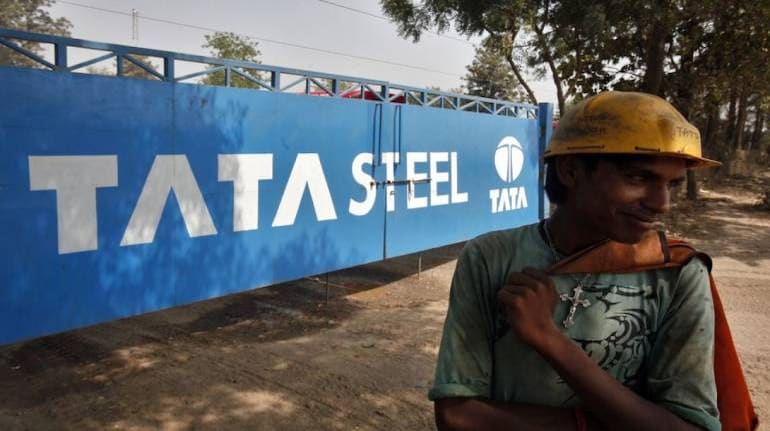
TV Narendran, CEO and managing director, Tata Steel, said following a tough second quarter, the company’s India business has seen a margin improvement. The top official also indicated that the third quarter was toughest for the European steel market, but is now witnessing signs of improvement. Narendran spoke to Moneycontrol’s Chandra Srikanth at Davos, discussing global supply shortages, steel demand, acquisitions and deleveraging plans.
Give us a sense of the mood at Davos this time around—is it very pessimistic or are people hopeful of a pickup and uptake in China since they've opened up the economy now. What trends are you picking up?It's been a bit of a mixed bag. If you talk to all the Indian delegates who are here, everyone's optimistic and rightly so. If you talk to the Europeans, they are quite pessimistic. The Americans are also waiting to see how long inflation will stay, but I think America has always displayed tremendous resilience and I expect it to bounce back. To me, the positives have been China. I've been hearing a lot of good stuff coming out of China. You know, over the last two, three years, I understand the savings rate in China was about 35 percent, compared to the 25 percent which is normal for them. And there's an expectation that all that will come into the consumption economy as well as into the travel economy. I'm told the requests to travel out of China on travel platforms are growing at three-digit rates, which is like more than 100 percent growth. So there's an enormous amount of pent-up demand, which is probably going to come out of China despite all the challenges they're facing. And that gives me a little bit more optimism than when I came to Davos. Japan has also been a fairly good story. So I think you're seeing many major economies also looking optimistic.
There are concerns that India's economic growth may slow down, hit by global supply shortages as well as high input costs. The Reserve Bank of India (RBI) is also expected to stay hawkish given the elevated inflation. So given the confluence of these factors, what's your view on how this can impact the steel industry?You know, even if you look at inflation in India, I think the worst is behind us. I think the last couple of months things have started dipping. Also, the inflation that we've seen is not something you've not seen in the past. I think if you look at the developed world, they have not seen this kind of inflation for a long time. So I think in India, things are a bit more under control than we've seen in the past and I think things will get better. As far as the steel industry is concerned, there are two factors. One is the demand side. And I think the demand side is strong because of the government's continued focus on infrastructure. I think that will continue because you have the elections next year as well. So the government will be keen to complete a lot of the projects that they've started. On the supply side, the cost pressures are there, because coking coal costs have been trending up. Iron ore prices have been going up, again reflecting what's happening in China. So there will be cost pressures on the steel industry, because as you saw from the numbers, most steel companies are not making money. And, hence, there's not much room to go down further. And even if you see in China, in the last four weeks, steel prices have gone up by almost $100. So I'm quite positive over the prospects of the industry over the next few quarters.
And what is the global steel outlook?We certainly are seeing steel prices go up in Southeast Asia, it's up at least $70 to $80. Domestic prices in China are up $100. In Europe, price increases have been sought. But in Europe, the fundamentals are still a bit weak. But good news is gas prices have been dropping. While it doesn't seem so, this is seen as a warmer winter than normal. But I think that's positive…
So gas prices are settling in Europe. And I think the worst of the crisis, as far as Europe is concerned on gas, is behind them.
While we've seen a demand uptick, prices have still remain muted. Do you expect that to change? What's your outlook as far as prices are concerned?As you may have seen, steel prices have been going up in India for the last couple of weeks, partly driven by demand, because January to June is typically the peak season for steel consumption. So we're seeing that kicking in. And secondly, steel companies, like I said, have pretty much reached the bottom as far as prices are concerned. So over the last month, I think steel prices both in flat and long products have gone up around Rs 3,000-5,000, but it's still at levels which are much lower than what we saw one year back.
The bet profit for the first six months of FY23 was significantly lower than a year ago. How is the year panned out so far for you? And how do you expect to close the current fiscal?I think what we have guided in the past was that Q2 in some sense for India was the toughest quarter because you have the confluence of high coking coal prices and low steel prices. Things started improving, margin expansion started happening in Q3, not as much as we expected, but it will continue. So I see the India side continuing to do better quarter on quarter. Europe probably will have its toughest quarter in Q3 because that's when the demand was most fragile and the costs were not any lower. But I'm seeing things starting to improve in Europe as well.
I think you mentioned that de-leveraging your balance sheet is one of your priorities. How do you see that panning out? Again, how will the debt figures look by the end of FY23?I wouldn't give a guidance on the specific debt figures for the end of the year yet. But I think what we were committed to about three, four years back is at least $1 billion of deleveraging every year. We did more than that in the last few years. This year, of course, it's challenging because of gas prices in Europe, coal prices, working capital. In fact, working capital has taken in a lot of money. We also bought Neelachal (Ispat, the government-owned steel unit in Odisha that had been idled) for about Rs 12,000 crore. So this year, I don't know if we are going to have that deleveraging. But the commitment to deleveraging continues.
We pretty much got the operations going within three months. You know, they were closed for almost three years. So that was a great work done by the team. We didn't have to spend so much capex to get it going to this level, and we'll take it to a million tonnes (per annum output) a year without much capex, maybe Rs 200-300 crore, that's more to take care of spares and things like that. The major capex will happen after this.
Will you be open to doing more acquisitions? What kind of appetite do you have? Or from here on is it going to be more organic, sort of doubling down on the acquisitions that you've already made?You know, with the assets that we have in our portfolio today, we can realise our growth ambitions for the next 5 to 10 years because we are today producing about 20 million tonnes in India, going through with an expansion of 5 million in Kalinganagar that takes us to 25, and between Kalinganagar, Angul, the Neelachal site and Jamshedpur, we can easily go to 45 to 48 million tonnes. We have enough land in our existing sites to do that. Having said that, obviously, any opportunity will be looked at on a case-to-case basis, but we are in a stronger position because we can realise our growth ambitions even without doing any inorganic growth, but whether we will do it or not, we'll decide later.

Discover the latest Business News, Sensex, and Nifty updates. Obtain Personal Finance insights, tax queries, and expert opinions on Moneycontrol or download the Moneycontrol App to stay updated!
Find the best of Al News in one place, specially curated for you every weekend.
Stay on top of the latest tech trends and biggest startup news.




