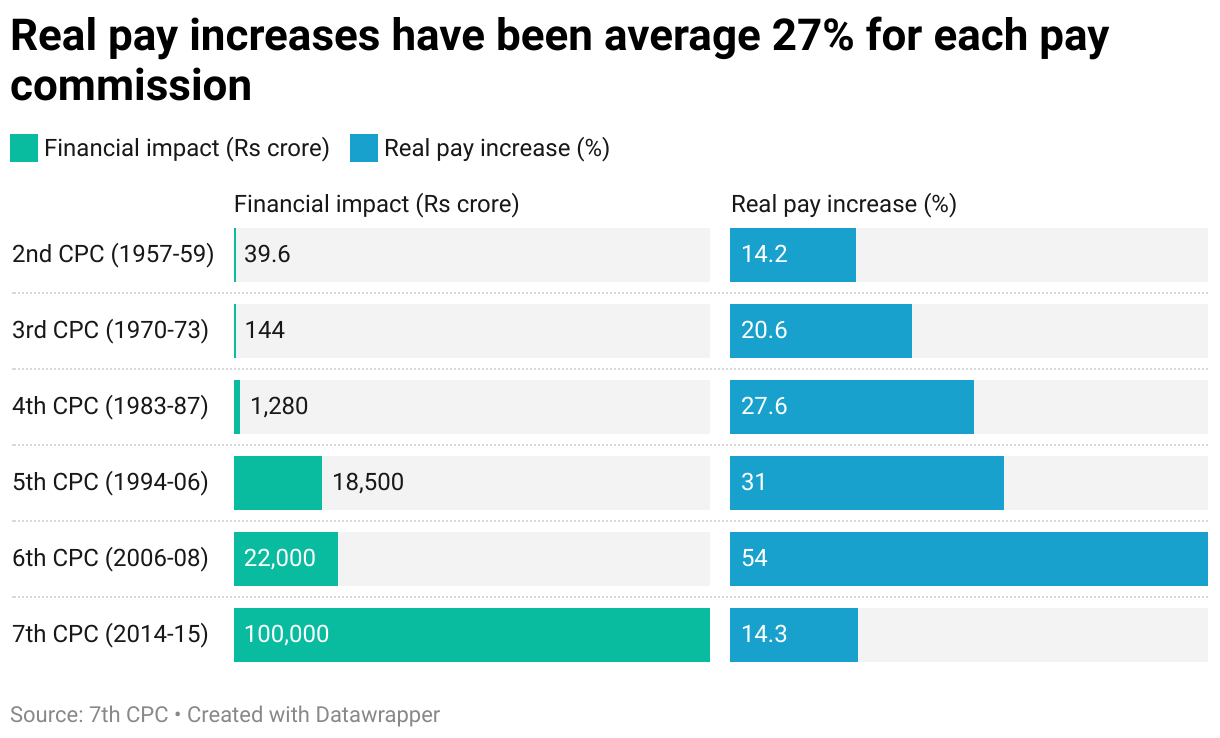
The average pay increase, after adjusting for inflation, for the six Central Pay Commissions since 1957 has been around 27 percent, with pensioners consistently gaining more than serving employees, a Moneycontrol analysis shows.
The government has announced the terms of reference for the Eighth Central Pay Commission, with an 18-month mandate. The commission’s recommendations will take effect in 2026, covering the next 10-year pay cycle for central government employees.
Fiscal cost rising exponentially
The financial cost of pay revisions has increased dramatically over time — from Rs 39.6 crore under the Second Pay Commission (1957–59) to nearly Rs 1 lakh crore under the Seventh Commission (2014–15). The expansion reflects both a larger workforce and more generous compensation formulas in later rounds.
While the inflation-adjusted average pay raise over the six commissions stands at 27 percent, the Sixth Pay Commission (2006–08) was the most generous, granting a 54 percent real hike, followed by a 31 percent rise under the Fifth Commission.
Salary surges, then stabilises
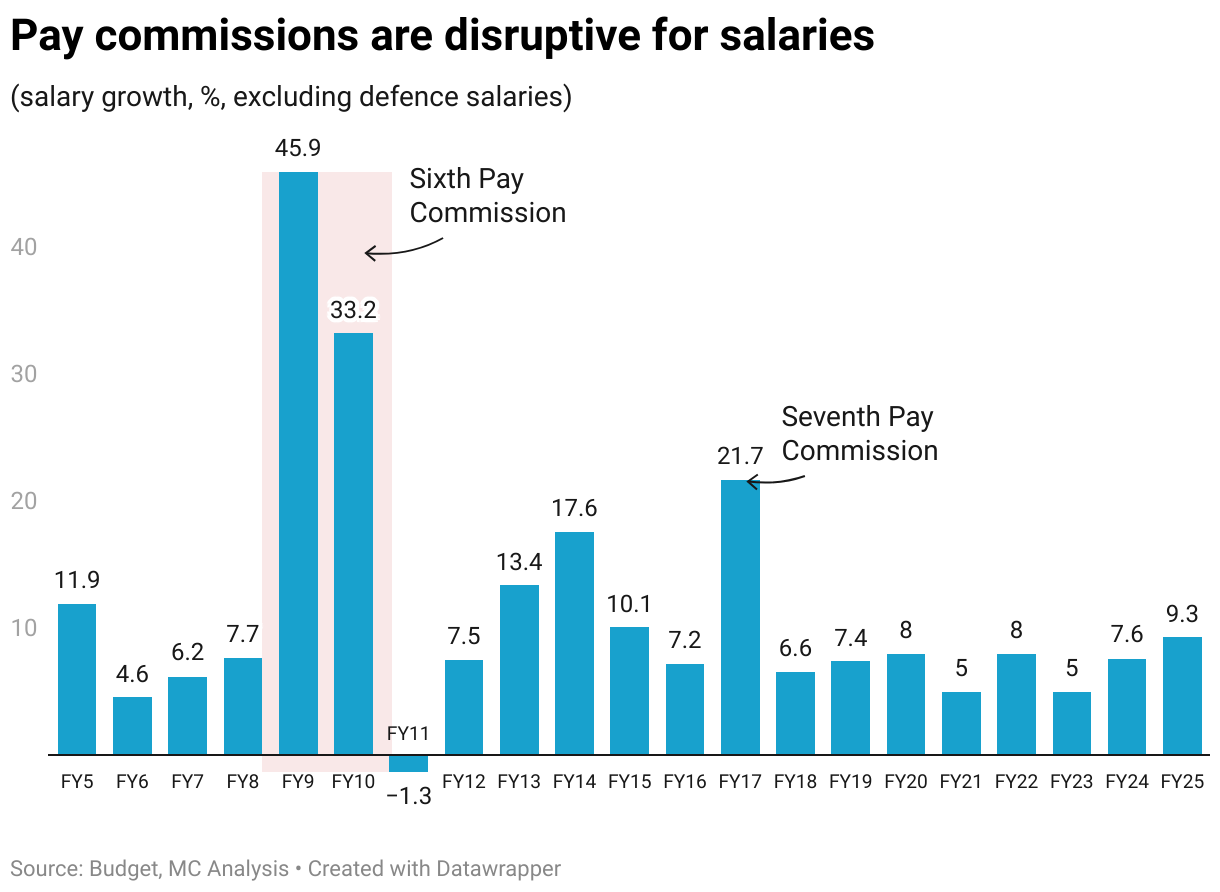
Each pay revision has historically produced a sharp, short-term jump in government salary growth, followed by a return to moderate increases. After the Sixth Pay Commission’s implementation, salaries rose 46 percent in FY09 and 33 percent in FY10, before stabilising to single-digit growth in subsequent years.
The Seventh Pay Commission (implemented in FY17) produced a similar pattern, with salary growth peaking at 21.7 percent in FY17 before easing to below 8 percent in later years.
Pension payouts show greater volatility
The swings have been even more pronounced in pensions, which have seen larger and more erratic jumps than salaries. Pension expenditure surged 46 percent in FY99 and 70 percent in FY10, corresponding to the 5th and 6th commissions, while FY17 recorded a 35.8 percent increase after the 7th CPC.
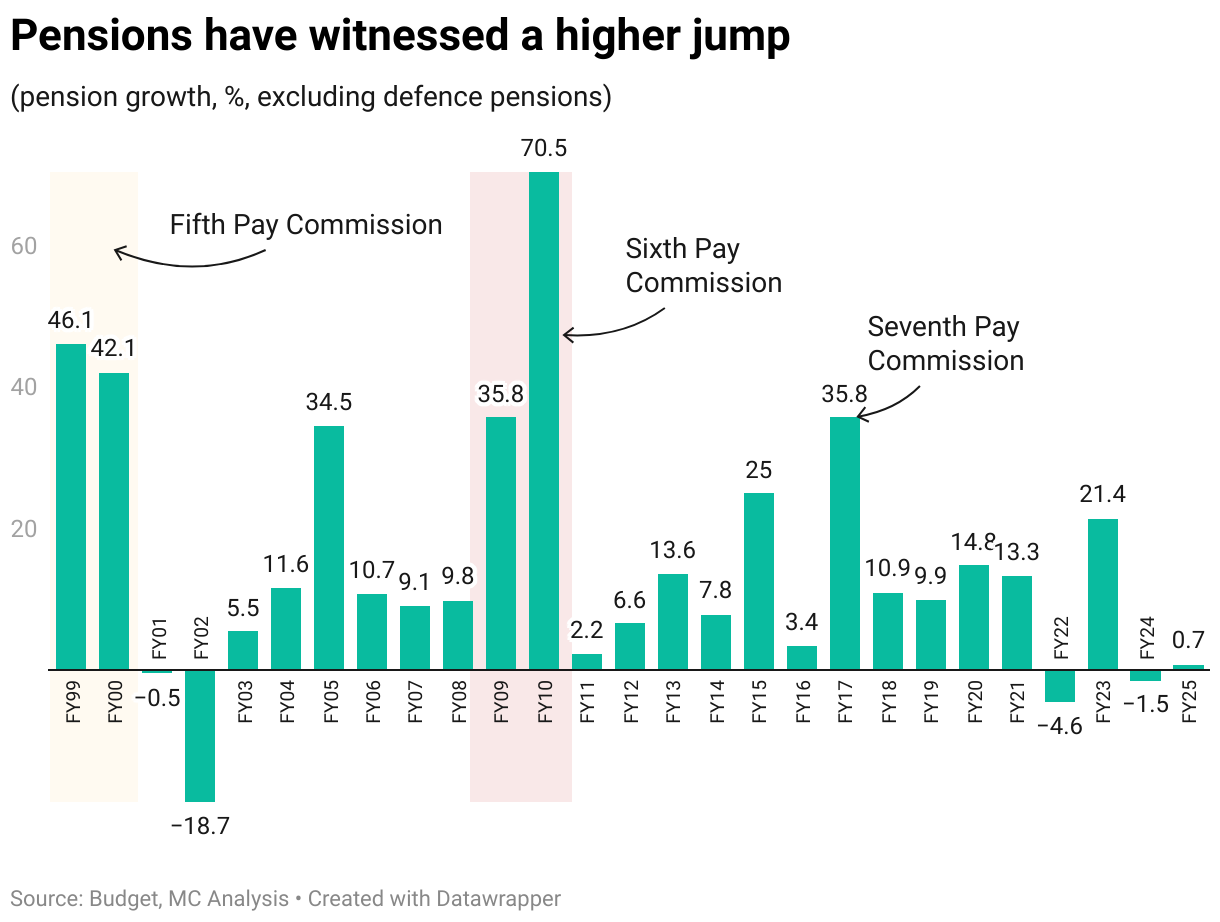
Such jumps have added fiscal pressure to government finances, particularly as pension liabilities grow alongside an ageing public workforce.
Growing workforce adds to fiscal burden
The upcoming pay revision comes at a time when the central government workforce is expanding again after years of restraint. A Moneycontrol analysis found that the Centre reversed a five-year downsizing trend in FY24, increasing its strength to 3.56 million employees, up from 3.17 million the previous year.
With salaries and pensions together accounting for a significant share of the Union Budget’s revenue expenditure, the Eighth Pay Commission is expected to be one of the most consequential in shaping fiscal policy over the next decade.
Salaries and pensions are likely to account for 8.7 percent of the Centre’s Budget.
Discover the latest Business News, Sensex, and Nifty updates. Obtain Personal Finance insights, tax queries, and expert opinions on Moneycontrol or download the Moneycontrol App to stay updated!
Find the best of Al News in one place, specially curated for you every weekend.
Stay on top of the latest tech trends and biggest startup news.