

A sharp selloff in Indian equities since late February, triggered by escalating Middle East tensions and rising crude oil prices, has split opinion on whether markets are entering bear territory.
Benchmark indices have retreated, with the Sensex and the Nifty 50 both declining 9.8 percent since February 23. The Nifty 500 index has fallen 8.6 percent, while broader markets have also weakened, with the BSE MidCap index down 7.2 percent and the BSE SmallCap index declining 7.8 percent. All returns are in dollar terms.
From the September 2024 peak, equities have seen a sharper correction, with the Sensex and Nifty declining about 19 percent each, while the Nifty 500 has fallen over 18 percent. Broader markets have underperformed, with the BSE MidCap 150 index and the BSE SmallCap 250 index declining 20 percent and 28 percent, respectively.
Despite the decline, some market participants argue the correction remains within haistorical norms. Deepak Shenoy, Chief Executive Officer of Capitalmind Mutual Fund, said the current phase appears more drawn out but lacks the intensity typically associated with bear markets. He noted that declines remain moderate relative to past cycles, which were often preceded by sharper rallies.
Historical Patterns & Perspectives
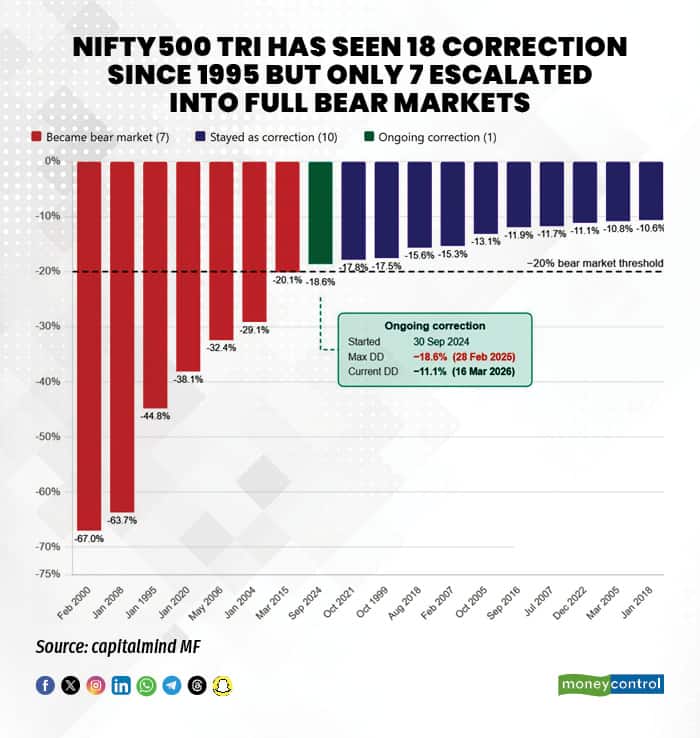
The Nifty 500 index, representing about 90 percent of India’s market capitalisation, has recorded 18 corrections of more than 10 percent since 1995. Of these, only seven evolved into full bear markets, defined as declines exceeding 20 percent.
In other words, more than half of double-digit corrections historically did not escalate into prolonged downturns.
By that definition, current levels remain short of bear market territory. Historical probabilities suggest there is a greater-than-even chance the present correction may not deepen into a full-fledged bear phase.
Crucially, deeper drawdowns have typically followed periods of excess. The 2000 decline of about 67 percent came after markets more than doubled in roughly seven months. The 2008 fall of 64 percent followed a 156 percent rally over 18 months, while the 2006 correction of 32 percent came after markets nearly doubled in the preceding year.
By contrast, corrections do not always signal trend reversals. In 2007, despite two drawdowns of over 10 percent, markets went on to rise 43 percent beyond previous peaks.
More Consolidation Than Capitulation
In the current cycle, the Nifty 500 gained roughly 70 percent between 2023 and 2024, followed by a correction of less than 20 percent so far. The preceding rally was less euphoric than earlier cycles, and the subsequent decline has been relatively contained.
That has led some strategists to view the current phase as consolidation rather than the start of a bear market.
Volatility, however, is unlikely to ease in the near term. Geopolitical tensions, concerns over a prolonged conflict, and potential disruptions to oil and gas supply continue to weigh on sentiment, alongside elevated retail participation.
Kranthi Baithani, Director – Equity Strategy at WealthMills Securities, said bear phases have become shorter but more intense, while bull markets have extended in duration. He added that markets are currently “near the edge” of a bear phase but are more likely to remain range-bound in the near term.
As long as the Nifty stays below 25,000, sentiment is likely to remain weak, he said.
Fragile Breadth Signals Caution
Other analysts point to underlying fragility, particularly in market breadth. Akshay Chinchalkar, Managing Partner and Head of Markets Strategy at Wealth Co, said the Nifty 500 is down just over 10 percent from its September 2024 peak, marking the first instance where the 100-week moving average has been breached to this extent without a swift recovery.
In previous corrections — including June 2022, April 2023 and April 2025 — similar declines were quickly bought into. The lack of a comparable rebound this time suggests a more cautious backdrop.
Breadth indicators reinforce that view. The proportion of stocks trading above their 50-, 100- and 200-day moving averages has yet to reach the 5 percent–15 percent capitulation levels typically seen at durable bottoms. While recent lows near 21,000 are holding, Chinchalkar warned that a break below these levels could trigger another leg of selling, unless geopolitical tensions ease — an outcome he sees as unlikely in the near term.
Discover the latest Business News, Sensex, and Nifty updates. Obtain Personal Finance insights, tax queries, and expert opinions on Moneycontrol or download the Moneycontrol App to stay updated!
Find the best of Al News in one place, specially curated for you every weekend.
Stay on top of the latest tech trends and biggest startup news.