






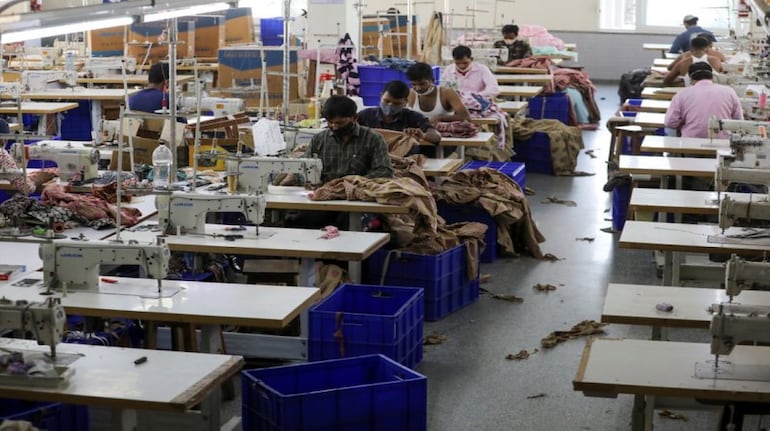
Bangladesh’s textile sector has been touted as a miracle since it has grown to support over 80 percent of the country’s total exports. What’s worked for the nation is access to cheap Chinese fabric, leaner labour laws and mammoth factories.
Now, with the crisis in Bangladesh intensifying, expectations have emerged that Indian textiles could become the next best choice for European, British, and American markets, providing a much-needed boost for a sector that has seen a slowdown in outbound shipments.
Can India benefit?According to some experts, temporary setbacks in any country may not have an immediate impact on the long-term trading relationship between a buyer and a seller.
India Ratings’ chief economist Devendra Pant said that if the unrest in Bangladesh continues, it may offer an opportunity for India’s textiles sector, but if it is resolved sooner than later, it is unlikely that buyers will shift base.
The question around the opportunity a crisis in Bangladesh offers India’s textile sector is crucial given that the former has been a mainstay for key international buyers when it comes to ready-made garments.
At nearly $47 billion, ready-made garments constituted 84.6 percent of Bangladesh’s total exports in 2022-23.
As per Rahul Mehta, chief mentor, Clothing Manufacturers Association of India (CMAI), if the country is set to face economic or political instability for a prolonged period, buyers may want another option and India could possibly be the next best choice.
However, Mehta added that given that India and Bangladesh’s fortes in this sector lie in different metrics, it may not be that India is a shoo-in as the preferred destination for buyers.
“India and Bangladesh’s strengths in the sector are very different. Bangladesh has large factories with sometimes as much as 20,000 workers capable of taking bulk production. India’s strength is more in smaller-quantity orders, in flexible and value-added requirements. It is not going to be cakewalk for Indian exporters to get into this space,” Mehta said.
Vishal S. Budhia, secretary for the South Gujarat Textile Processors Welfare Association, said the impact could be a mixed bag for the Indian textile sector. While garment-manufacturing states and districts like Coimbatore, Tirupur and Delhi may benefit, Surat would lose more than gain.
“Surat is not a garment exporter and is primarily a net exporter directly or indirectly to Bangladesh for products such as sarees as well as for fabrics used in garment manufacturing. Therefore, Surat will be more hurt than benefited,” Budhia said.
Budhia estimates a loss of around Rs 9-10 crore per day in exports to Bangladesh during the upcoming festive season that lasts around 120 days.
“Especially ahead of Durga Puja, we see good demand from eastern India and Bangladesh because new designs are sent from Surat. We had prepared for sales which may get impacted. We export around 3-5 lakh sarees per day to Bangladesh, so a fair amount of that could be impacted as many of it could get stuck at the borders,” he added.
While the ready-made garments sector is the single biggest export earner for Bangladesh, it was only 3.35 percent of India’s total outbound shipments in FY24. In fact, New Delhi is looking to extend its production-linked incentive (PLI) scheme to this category of textiles in a bid to boost trade.
The Budget allocation for the PLI scheme for textiles has also been increased to Rs 45 crore for the ongoing fiscal year from a mere Rs 5 crore in 2023–24
Indian exports of all categories of textiles dropped 3.23 percent on-year to $34.40 billion in FY24, as per commerce ministry data.
The China angleThe ongoing turmoil in Bangladesh could further strengthen the western world’s China plus one policy wherein buyers may now look to diversify supply chains beyond Bangladesh.
“In the long run, Indian exporters can have an edge. The western world was already looking at a China plus one strategy and that place was largely occupied by Bangladesh. This kind of upheaval will only strengthen the buyer's resolve to diversify supply chains and that is where India may benefit,” Mehta said.
Budhia concurred that since Bangladesh plays a pivotal role in the western world’s China plus one strategy, Indian garment makers could get an immediate benefit from the turmoil in Dhaka.
But yet another China angle could make it harder for India to take advantage of the crisis in its neighbourhood. Bangladesh’s pricing edge in textiles is a result of the nation’s cheaper Chinese fabric
“Bangladesh primarily uses Chinese fabrics via imports from China. That is not encouraged in India. The question is whether those kinds of fabrics are available in India, whether we can import them to the same extent, whether Indian fabric can compete in international markets when pricing is concerned. All these are questions that needs to be answered before we can start saying by how India will gain from the crisis,” CMAI's Mehta said.
He added that India needs to focus on increasing domestic capacity, enhance its skilled workforce and offer a greater range of products to effectively become a preferred source for the world’s textile needs.
“India is focusing on a product category that is of smaller importance in world trade. In apparels, we are focused on low- to mid-priced casual wear, which is 80 percent of our exports, whereas man-made fibre and speciality garments are products that occupy 65 percent of world trade, where we are totally absent,” Mehta pointed out.
Small wins?Given the fluidity of the situation, the impact on trade is a tough question at this point. But recent developments point to difficult times for Bangladesh’s garment factories.
A day after Sheikh Hasina stepped down as prime minister and fled Bangladesh, the country’s main garments manufacturers' body called for a total shutdown of all facilities, a BBC report said on Tuesday. This is seen as a major disruption to key industries.
The complete shutdown of all garment factories across Bangladesh will hit apparel giants such as H&M and Zara.
Mehta said, “Whether the buyers are based out of UK, France, Germany or India, they will watch the situation carefully. If a riot-like situation continues for three months or more, the well-being of factories in Bangladesh may be impacted. But if the military is able to improve the law and order situation and life returns to normalcy soon, then I don’t see an immediate shifting of orders.”
But what could be of significance, according to Mehta, is that buyers like Reliance and Arvind, stationed in India and importing from Bangladesh for duty exemptions, may reduce their share of such inbound shipments from the neighbouring nation and instead look at Vietnam, Myanmar or indeed reconsider China, or even ask some of the local manufacturers to up their capacity.
Meanwhile, Budhia expects a more immediate advantage for Indian garments manufacturers due to the tensions in Dhaka. “Key western markets such as the US and UK would start ordering materials for Christmastime around now. So I am sure buyers may have immediately shifted inquiries from last week given the situation in Bangladesh,” Budhia said.
India's exports to Bangladesh also includes textiles apart from machinery, electronics, auto parts, iron and steel, electricity and plastics.
Whether India ultimately gains from the meltdown in its neighbouring state may depend on how long the crisis lasts.
As India Ratings’ Pant said, “If the situation turns out to be more fluid than what it is right now, if it impacts the supply chain, and manufacturing and production lines in Bangladesh, we may see a shift in buyers. But, whatever its impact, it will be felt after a lag, it won’t be immediate.”
Discover the latest Business News, Sensex, and Nifty updates. Obtain Personal Finance insights, tax queries, and expert opinions on Moneycontrol or download the Moneycontrol App to stay updated!
Find the best of Al News in one place, specially curated for you every weekend.
Stay on top of the latest tech trends and biggest startup news.




